On September 13, 2026, “NUI,” an AI application that gives existing stuffed animals a voice, personality, and memory for interactive conversation, officially launched. Its debut comes amid rapid technological advancements in Anthropic’s natural language processing model “Claude” and the booming market trend of “nuikatsu” (stuffed animal lifestyle culture).
- Service Overview and Core Functionality
- Technical Background and the Rapid Expansion of the “Nuikatsu” Market
- Anthropomorphism, Intimacy, and Communication Effects
- Emotional Investment and Acceptance as Social Agents
- Safeguards for In-Home Data and External AI Training
- Industry Prospects and Societal Integration
Service Overview and Core Functionality
On September 13, 2026, “NUI” (pronounced nui), a web application designed to let users converse with their own plush toys by giving them a voice, personality, and memory, officially launched. A major feature of this service is that it requires no specialized hardware purchases, running directly in web browsers on smartphones or desktop computers. The conversation generation engine is powered by Anthropic’s large language model, Claude, integrated with speech synthesis and speech recognition technologies.
Users can choose their preferred voice from 10 sample options and freely configure first-person pronouns (such as “I,” “me,” or the toy’s name) as well as how the toy addresses its owner. Initial personality settings offer four options: “Energetic,” “Cool,” “Gentle,” and “Clingy,” which can be further customized with a custom description and an estimated age persona (around 3 years old, kindergarten age, early elementary school, or 15 years old). As conversations accumulate, the personality and tone adjust based on the owner’s responses. The app also features an automated “diary” function where the plush toy logs daily conversations, as well as a memory feature to record and share special moments, such as how the owner and toy first met.
Regarding pricing, a 7-day free trial (equivalent to the Basic tier, allowing 15 interactions per day) is provided upon registration. Paid subscription plans include Basic at ¥680/month, Premium at ¥1,980/month, and Platinum at ¥3,780/month (all tax included). As shown in the diagram below, launching the app easily via a web browser creates a seamless environment for enjoying AI communication in daily life.

Technical Background and the Rapid Expansion of the “Nuikatsu” Market
The development of the “NUI” app is backed by the rapid growth of “nuikatsu” culture—the lifestyle of carrying plush toys daily, taking photos with them, and sharing life together—and a record expansion in its associated market. Popularized primarily among younger generations, the momentum of “nuikatsu” is clearly reflected in industry statistics.
According to a survey by the Japan Toy Association, the domestic plush toy category market reached 62.398 billion yen in FY2025, recording a dramatic year-over-year increase of 38.2%. This far outpaces the overall domestic toy market growth rate of 6.3% YoY (total market size of 1.1664 trillion yen). Compared to FY2015’s market size of 19.513 billion yen, the market has expanded roughly 3.2 times in a decade. Furthermore, an enterprise database analysis by Tokyo Shoko Research (TSR) revealed that the combined revenue of 34 plush-toy-related companies reached 84.9 billion yen in 2025, growing 1.7-fold from 50.4 billion yen in 2021 over five years. During the same period, net profits nearly doubled from 2.8 billion yen to 5.4 billion yen.
On the technical front, the integration of natural dialogue generation via LLMs, high-precision speech synthesis, and practical smartphone-based speech recognition has made it possible to breathe pseudo-life into everyday plush toys without manufacturing expensive robotic hardware.
The Evolving Relationship Between Humans and Toys Through AI Dialogue
Anthropomorphism, Intimacy, and Communication Effects
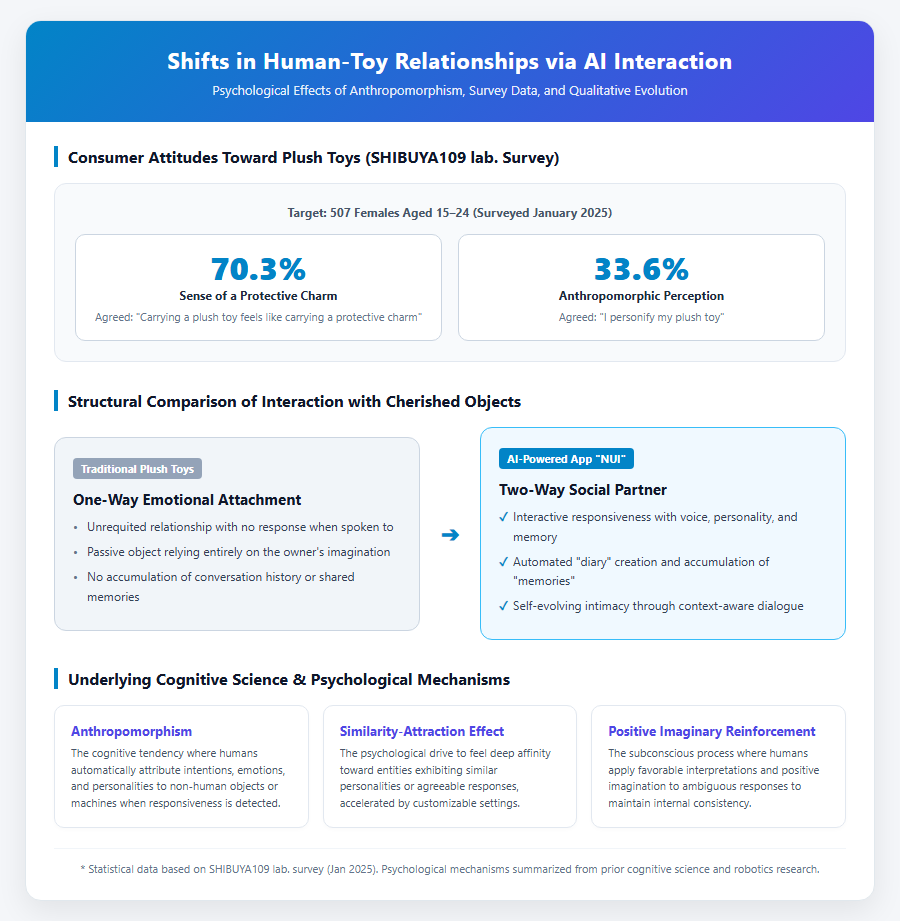
The psychological phenomenon in which humans attribute intentions, emotions, and personalities to non-human entities is known as “anthropomorphism.” Prior research in cognitive science and robotics demonstrates that when an object or machine exhibits a certain level of responsiveness or perceived intent, people automatically react as if interacting with a human being. Furthermore, under the “similarity-attraction effect”—where individuals feel affinity toward entities possessing similar personalities or favorable responses—humans experience deep psychological comfort when engaging with conversational agents.
Prof. Hiroshi Ishiguro and fellow researchers in robotics and informatics note that during interactions with humanlike forms or endearing objects, people instinctively apply positive imagination to bridge gaps. While traditional stuffed toys remained in a one-way relationship unable to respond to their owners, AI responsiveness establishes true two-way dialogue.
With the introduction of “NUI,” owners discover value in their plush toys far beyond that of mere playthings. As context—such as pronouns, nicknames, and anniversaries—accumulates, interactions adapt naturally to conversational history, raising the user’s emotional fulfillment and therapeutic comfort. The illustration below highlights this qualitative shift in the bond between humans and cherished objects.
Emotional Investment and Acceptance as Social Agents
Conversing with an object of affection triggers strong emotional investment in users. Historical precedents, such as SoftBank Robotics’ “Pepper” launched in June 2015 and Mattel’s “Hello Barbie” released in November 2015, showed that interfaces capable of verbal interaction were often embraced in households as “family members” or “siblings.”
The developer of “NUI” cited resolving the “loneliness of unrequited affection”—the childhood feeling of talking to stuffed animals without receiving a reply—as the core motivation behind the app. Rather than chatting with a newly created AI avatar, conferring a voice, personality, and memory onto “that special toy that has always been in my room” delivers a profound sense of a social agent to the user.
Mechanism features such as logging daily exchanges into a “diary” and recalling shared outings in subsequent conversations serve to deepen the human-toy bond over time. Consequently, unlike functional voice assistants, the plush toy establishes a distinct position as a companion closely attuned to the user’s living space.
Privacy Protection, Data Management, and Future Outlook
Safeguards for In-Home Data and External AI Training
When conversational AI and microphone-equipped devices enter the home environment, privacy protection and personal data security become critical considerations. As demonstrated by past incidents—such as the prohibition of the connected doll “My Friend Cayla” in Germany due to eavesdropping risks and broader concerns over transmission security—audio data collected within private residential spaces requires rigorous management.
The “NUI” app implements multiple data protection measures to ensure safe usage. First, spoken audio input from smartphones is instantly transcribed into text for processing; the raw audio files are never stored on NUI’s servers. Furthermore, user configurations, chat histories, and generated diary entries are securely stored on servers located within Japan.
In addition, agreements and technical settings with Anthropic (for Claude conversation generation) and external speech synthesis providers explicitly prohibit sending user conversation data to be used for training commercial AI models. This significantly mitigates the risk of intimate household conversations or sensitive personal information leaking or being utilized for external AI training.
Industry Prospects and Societal Integration
The market for AI-powered plush toys and smart toys is projected to experience substantial global expansion in the coming years. According to a report published by market research firm QYResearch titled “Global AI Plush Toys Market Outlook (2026–2032),” the global market size for AI plush toys is forecasted to grow from approximately \$1.1 billion in 2025 to \$1.468 billion in 2026, reaching \$3.962 billion by 2032. The compound annual growth rate (CAGR) from 2026 to 2032 is estimated at approximately 18%.
The axis of industry competition is shifting from traditional textile manufacturing and exterior design toward the quality of AI conversation, the precision of emotional interaction, privacy protection, safety assurance, and algorithm performance. Applications are expanding beyond early childhood education and youth companionship to include “oshikatsu” (fandom culture) among teens, mental health care for adults, and emotional support for the elderly.
Moving forward, alongside advancements in multimodal dialogue technology and further cost reductions, enhanced user literacy and product design grounded in “Privacy by Design” principles will become increasingly vital. As a novel form of human-AI coexistence within daily life, the development of plush-toy interfaces continues to draw significant industry attention.
Reference Pages
- [NUI Official Site] https://nuiai.app/?src=prt
- [NUI Press Release (PR TIMES)] https://prtimes.jp/main/html/rd/p/000000001.000190046.html
【#AI #PlushToys #NUI #Claude #Nuikatsu #GenerativeAI #Privacy #SpeechSynthesis】

コメント