On September 27, 2026, Chinese AI startup MiniMax newly introduced the high-speed large language model “MiniMax-M3.1-Flash-Preview.” The move achieves a dramatic improvement in inference speed and thoroughly low pricing, balancing practicality and economic efficiency amid the fiercely escalating US-China AI development race.
- Key Points of the MiniMax-M3.1-Flash-Preview Announcement
- Architecture and processing power enabling high-speed inference
- Astonishingly low pricing and the disruptive power of token unit costs
- Shift in Revenue Structure from CtoC to BtoB and ARR Expansion
- The Challenges Surrounding Hefty R&D Investment and Monetization
- All-Modal Approaches and Next-Generation Models: What to Watch Moving Forward
Key Points of the MiniMax-M3.1-Flash-Preview Announcement
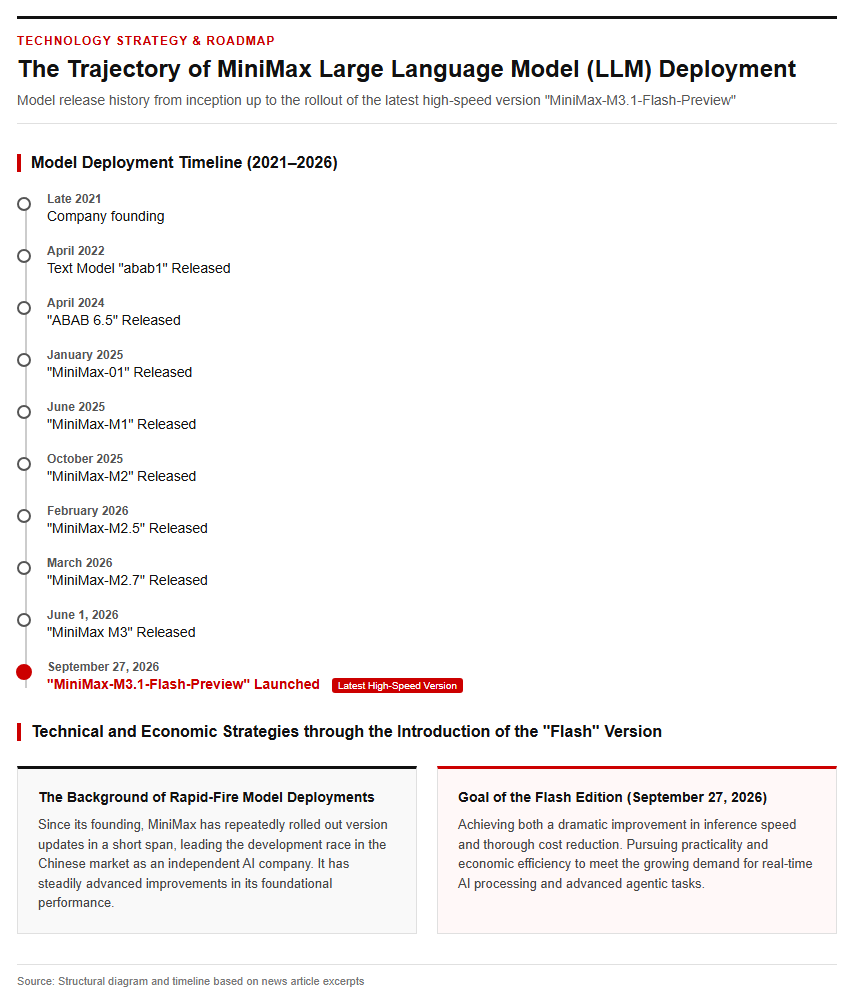
MiniMax, one of the major independent companies in China’s generative AI sector, announced its latest high-speed large language model, “MiniMax-M3.1-Flash-Preview,” on September 27, 2026. Since its founding at the end of 2021, the company has a history of rapidly releasing models in succession: the text model “abab1” in April 2022, followed by “ABAB 6.5” in April 2024, “MiniMax-01” in January 2025, “MiniMax-M1” in June of the same year, “MiniMax-M2” in October, “MiniMax-M2.5” in February 2026, “MiniMax-M2.7” in March, and “MiniMax M3” on June 1. The launch of this Flash version aims to provide high-precision intelligent processing with lower latency and lower cost, serving as a strategic development to meet the growing demand for real-time AI processing and advanced agent-based tasks. The following figure illustrates the concept of model deployment and acceleration technology at MiniMax.
For the developer community and enterprise users, while retaining the high contextual understanding of conventional flagship models, the significant improvement in response speed has brought a transformative impact, dramatically enhancing responsiveness in business settings.
Architecture and processing power enabling high-speed inference
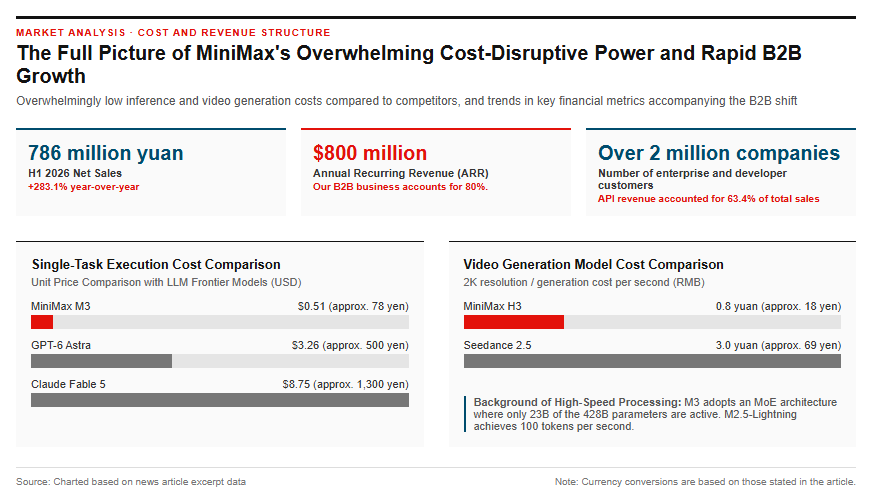
Behind the acceleration technology driven by MiniMax lie advanced architectural optimizations and energy-saving designs. Released in February 2026, “MiniMax-M2.5-Lightning” achieved a processing speed of 100 tokens per second, vastly outperforming major models from other companies. The “MiniMax M3”, introduced in June 2026, employs a Mixture of Experts (MoE) structure that selectively activates only 23 billion (23B) parameters required for each process out of a total parameter count of 428 billion (428B). The latest M3.1-Flash-Preview also incorporates this efficient pre-training framework and inference pipeline optimization, successfully minimizing the computational overhead associated with processing complex multi-tasks and long contexts. As a result, this has enabled smooth operation with significantly reduced latency in autonomous agent tasks such as large-scale data processing and programming assistance.
Cost-Performance Revolution and Rapid Growth in the B2B Market
Astonishingly low pricing and the disruptive power of token unit costs
MiniMax’s greatest strength in the market lies in its overwhelming cost-performance, which significantly outpaces overseas competing models. The execution cost of its large language model “MiniMax M3” for a single task is calculated at $0.51 (approx. 78 yen), achieving a dramatic reduction in price compared to Claude Fable 5 at $8.75 (approx. 1,300 yen) and GPT-6 Astra at $3.26 (approx. 500 yen). Furthermore, the company’s video generation model “MiniMax H3” is priced at 0.8 yuan per second (approx. 18 yen) for 2K resolution, enabling massive cost savings compared to its peer model from another company, Seedance 2.5, which costs 3 yuan per second (approx. 69 yen). By keeping the supply cost of intelligence down to 1/10th to 1/20th of frontier models and promoting “AI you can use without worrying about the meter,” the company is rapidly capturing demand from startups and small-to-medium-sized enterprises with low cost tolerance.
Shift in Revenue Structure from CtoC to BtoB and ARR Expansion
Armed with a low-price strategy, the company’s business foundation is making a major pivot from CtoC (consumer-facing) to BtoB (enterprise-facing). Revenue for the first half of 2026 reached 786 million yuan (approximately 18 billion yen), recording rapid growth of 283.1% year-on-year. In particular, revenue from open platforms and enterprise API services surged 703.1% year-on-year to 497 million yuan, growing into the largest pillar and accounting for 63.4% of total sales. As of August 2026, Annual Recurring Revenue (ARR) surpassed $800 million (approximately 120 billion yen), with the BtoB business accounting for 80% of it. The number of corporate and developer customers has exceeded 2 million, with product strength and self-service customer acquisition through word-of-mouth driving this growth. The structural diagram below illustrates the sales growth and expansion of the customer base accompanying the BtoB shift.
Breaking Away from Deficits and Wild Stock Price Fluctuations: Future Outlook
The Challenges Surrounding Hefty R&D Investment and Monetization
Meanwhile, behind its rapid scaling, heavy R&D expenses and a deficit-ridden structure loom as major challenges. R&D expenses for the first half of 2026 reached $297 million (approx. 46 billion yen), remaining at a high level with a 138.8% increase year-over-year, and continuing an R&D-heavy structure that is approximately 11 times its selling expenses. As a result, the adjusted net loss for the same period expanded to $293 million (approx. 45 billion yen). Having successfully listed on the Stock Exchange of Hong Kong (00100.HK) on January 9, 2026, the company saw its stock price surge to a peak of 1,330 Hong Kong dollars in March, recording a market capitalization of approximately 410 billion Hong Kong dollars (approx. 8 trillion yen). However, it was hit by a roughly 80% plunge in its stock price due to pricing revision issues accompanying the M3 announcement in June and the expiration of the share lock-up. The company is exposed to severe uncertainties from the capital markets, as highlighted by founder and CEO Yan Yunjie declaring zero compensation until the achievement of AGI.
All-Modal Approaches and Next-Generation Models: What to Watch Moving Forward
The future focus lies in the deployment of next-generation flagship models and the integration of all-modal technologies. MiniMax remains committed to an all-modal strategy, independently developing not only single-text models but also audio (Speech 2.6), video (H3), and music (Music 2.5). In the market, attention is focused on the performance of the upcoming full version of “M3.1” and “M3 Pro,” which is expected to scale up its parameter size to approximately 3 trillion (3T) and feature the new “MSA 2.0” architecture. The company positions visual and video multimodal generation as a major market following programming assistance, and has outlined plans to further triple computational efficiency. The biggest key to predicting future growth will be whether the company can maintain thorough cost-efficiency and inference speed while pushing the boundaries of state-of-the-art intelligence.
Reference Page
- [MiniMax Official Website] https://www.minimax.io/
【#MiniMax #LLM #GenerativeAI #ArtificialIntelligence #ChinaAI #ScienceAndTechnology】

コメント