
Independent IT consulting firm Power Solutions (4450) has announced an upward revision to its full-year earnings forecast for the fiscal year ending December 2026. Reversing the initial forecast of a profit decline to project record-high profits for the second consecutive fiscal year is driven by a shift toward high-unit-price projects and strong tailwinds in the asset management industry.
- The Impact of a 43.7% Upward Revision in Ordinary Profit and Record-High Earnings
- The Structural Reason Behind the Surge in Profits Amid Modest Sales Growth
- Recording Extraordinary Losses and Shifting the UiPath License Strategy
- A Unique Positioning Riding the Tailwinds of the “Asset Management Nation” Policy
- Stock Price Diagnosis and Investor Evaluation Indicated by Shareholder Return Policies
- Future Growth Scenarios and Risks for Investors to Watch Closely
The Impact of a 43.7% Upward Revision in Ordinary Profit and Record-High Earnings
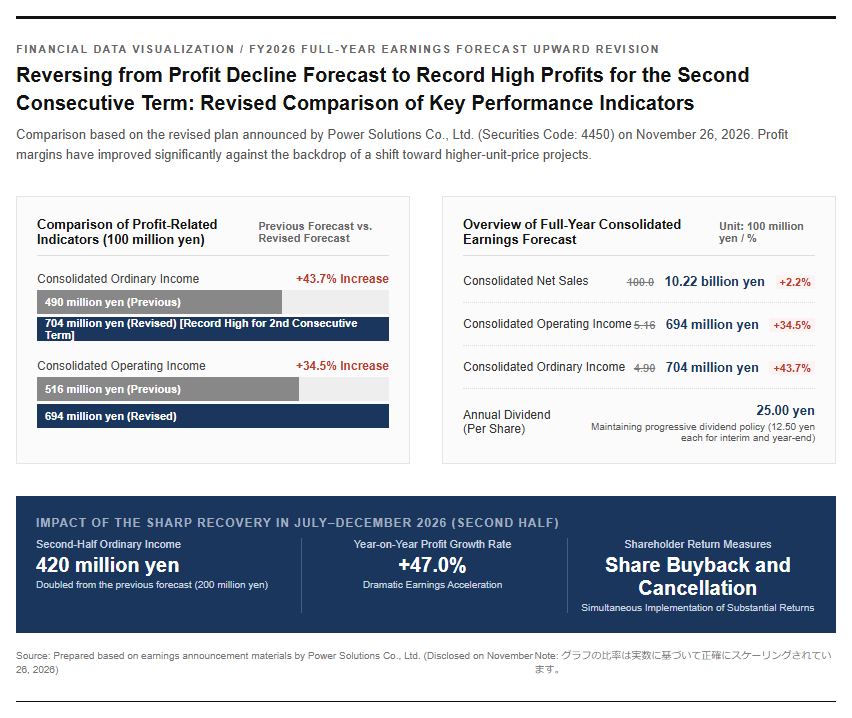
Power Solutions Co., Ltd. (Security Code: 4450), listed on the Tokyo Stock Exchange Growth Market, announced an upward revision to its full-year consolidated earnings forecast for the fiscal year ending December 2026 after the close of trading on November 26, 2026. Consolidated ordinary profit, which was previously expected to decline, has been revised upward by 43.7% from the previous estimate of 490 million yen to 704 million yen. This marks a turnaround to an expected 0.1% increase year-on-year, placing the company on track to achieve record-high profits for the second consecutive year. Based on the full-year plan announced the same day, consolidated ordinary profit for the period from July to December 2026 (the second half) is projected to double from the previous estimate of 200 million yen to 420 million yen, representing a dramatic earnings recovery of 47.0% year-on-year. Full-year consolidated net sales were also revised upward by 2.2% from the previous 10 billion yen to 10.22 billion yen, while consolidated operating profit was raised by 34.5% from 516 million yen to 694 million yen. In addition, alongside maintaining its progressive dividend policy of an annual dividend of 25.00 yen per share (interim 12.50 yen, year-end 12.50 yen) in line with favorable earnings developments, the company simultaneously rolled out substantial shareholder return measures consisting of a share buyback and the cancellation of the acquired treasury shares.
The image below provides a visual summary of the earnings trends and upward revision rates.
The Structural Reason Behind the Surge in Profits Amid Modest Sales Growth
The most notable aspect of this earnings revision is that while the upward revision for full-year net sales is limited to 2.2%, operating profit has surged significantly by 34.5% and ordinary profit by 43.7%. There are two clear structural reasons for this sharp expansion in profits without a commensurate surge in the top line. The first reason is the disappearance in the second half of non-recurring, lump-sum costs—such as office relocation expenses—that were recorded in the first half (January to June). In the first half, despite a 13.6% year-on-year increase in net sales, operating profit dipped by 36.6% due to relocation burdens, but this weight completely lifted entering the second half. The second reason is that the group as a whole selectively shifted away from low-unit-price commissioned projects toward high-value-added, high-unit-price projects, while revitalizing human resource exchanges within the group. As a result of shifting resources from a structure reliant on handling large volumes of low-cost work to projects with high profit margins, the company successfully transformed into a profit structure where gross profit increases substantially even when net sales remain flat.
Recording Extraordinary Losses and Shifting the UiPath License Strategy
While individual profits have been significantly revised upward, the full-year forecast for net income attributable to owners of the parent remains unchanged at 217 million yen. This is because the company plans to record an extraordinary loss (impairment loss) of 130 to 140 million yen in the fourth quarter, following a rigorous review of the future recoverability of sales license inventory for RPA (robotic process automation) related services held by the group. In past fiscal years, the company had bulk-purchased multi-year licenses from US-based UiPath, but the contract terms resulted in a heavy concentration of cost burdens in the final year of the contract (April 2027 to March 2028). Furthermore, the rapid rise of generative AI changed corporate business automation needs and technology selection policies, causing growth in the license resale business to fall below initial expectations. In response, the company is pivoting its strategy from simply expanding license sales to strengthening delivery services that combine the flexible reasoning power of generative AI with the reliability of RPA, while expanding cross-selling with other solutions. By processing the impairment and resolving risks early, the company aims to strengthen its medium- to long-term earnings foundation.
Business Strengths, Industry Environment, and Points to Watch
A Unique Positioning Riding the Tailwinds of the “Asset Management Nation” Policy
Power Solutions’ strength lies in its unique business domain, which specializes in the back offices and operational front lines of its primary clients: domestic financial institutions, particularly asset management companies. With the Japanese government’s “Asset Income Well-being Nation” (Asset Management Nation) policy and the rollout of the new NISA system, the inflow of individual investor funds and the number of funds are accelerating, while the administrative burden on operational front lines—such as calculations, report generation, and compliance with legal regulations—continues to grow. Financial administration handling confidential information and client asset data is extremely difficult to outsource overseas, leaving companies with no choice but to entrust it to trusted domestic specialist providers. The company exclusively captures the “gap” between unglamorous, complex on-site operations that large system integrators (SIers) prefer not to touch and security requirements that small and medium-sized operators cannot handle. It has built a sticky business model where once implemented, switching to another company is difficult, generating stable, high gross margins based on strong relationships with major clients, such as the Nomura Group, which accounts for 37.8% of sales.
Stock Price Diagnosis and Investor Evaluation Indicated by Shareholder Return Policies
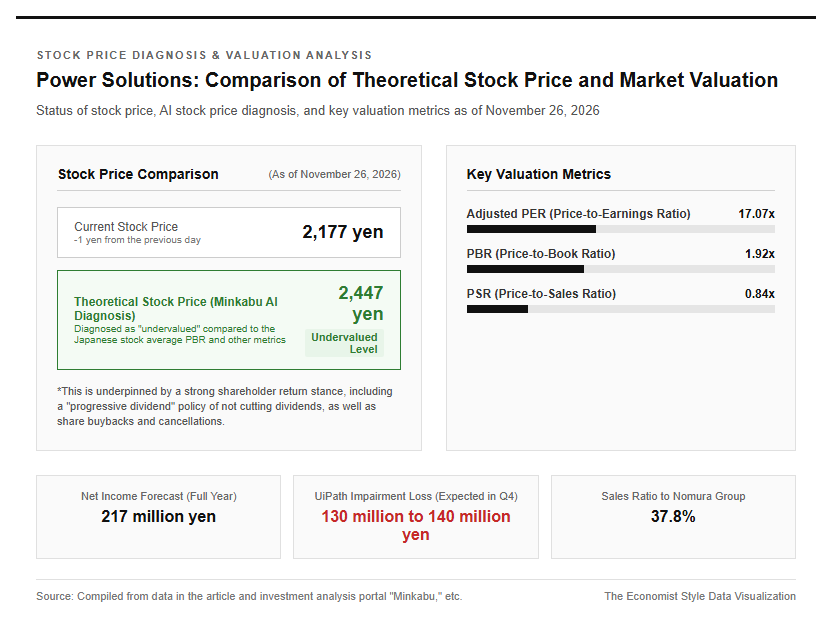
As of November 26, 2026, when the earnings revision was announced, the company’s stock price was trading at 2,177 yen (down 1 yen from the previous day). According to the AI stock price diagnosis on the investment analysis portal “Minkabu,” the company’s theoretical stock price is calculated at 2,447 yen, and its current stock price level is diagnosed as “undervalued” based on a relative comparison with the average PBR (Price-to-Book Ratio) of Japanese stocks as a whole. Looking at the company’s key metrics, the adjusted PER is 17.07x, the PBR is 1.92x, and the PSR is 0.84x. As a shareholder return policy, management advocates a “progressive dividend” that links to financial performance while avoiding dividend cuts, gaining the support of individual investors seeking stable returns. The dividend hike and the acquisition and retirement of treasury shares decided alongside this upward earnings revision are perceived as direct evidence of management’s strong confidence in the company’s future profit-generating capacity and ability to maintain a high level of cash flow.
The image below is an illustrative representation of the balance between stock price diagnosis and valuation in the market.
Future Growth Scenarios and Risks for Investors to Watch Closely
For future growth, the most important factor for investors to closely monitor—alongside margin improvements driven by a shift toward higher-unit-price projects—is whether the absolute amount of the overall top line (net sales) can be sustained and expanded. The latest record-high profits were achieved primarily through improved profit margins and cost optimization, so accelerating revenue growth is essential for medium- to long-term stock price appreciation. In addition, because the company’s sales dependency on the Nomura Group is high at approximately 38%, the progress made in expanding its client base to non-Nomura financial institutions and non-financial industries remains an ongoing challenge. Furthermore, since the company is a small-cap stock listed on the TSE Growth Market with a market capitalization of approximately 6.6 billion yen, attention must also be paid to its high stock price volatility in response to earnings news and market fluctuations. The main focus will be the full-year financial results for the fiscal year ending December 2026 and the earnings forecasts for the fiscal year ending December 2027, both scheduled to be announced in February 2027; proving that the high-profit model presented this time is a continuous capability rather than a temporary phenomenon will be the key to the stock’s re-evaluation.
Reference Pages
- [Power Solutions Inc. Official Website] https://powersolutions.co.jp/
- [IR Information: Group Business Content] https://powersolutions.co.jp/ir/groupbusiness/
[#PowerSolutions #UpwardEarningsRevision #StockInvestment #AssetManagementNation #DXConsulting #JapaneseStocks #GrowthMarket]


コメント