Major password management service 1Password experienced unauthorized access to its backend system, resulting in the leakage of management data, such as the names and email addresses of some customers, to the outside. In the background of this incident lies the risk of a supply chain attack in which an employee’s corporate GitHub account was compromised, and malicious code was injected via the CI/CD pipeline.
- Key points of the event: Customer data leak triggered by a compromised GitHub account
- The clear boundary between leaked information and safe critical assets
- Why the Vault remained safe: The mechanism of zero-knowledge encryption
- Risks of invitation and recovery tokens and technical countermeasures of making confirmation codes 10 characters long
- The Importance of CI/CD Pipeline Protection and Developer Identity Management
- Future Outlook and Key Focus: Vigilance Against Secondary Phishing Attacks and Organizational Defense Measures
Key points of the event: Customer data leak triggered by a compromised GitHub account
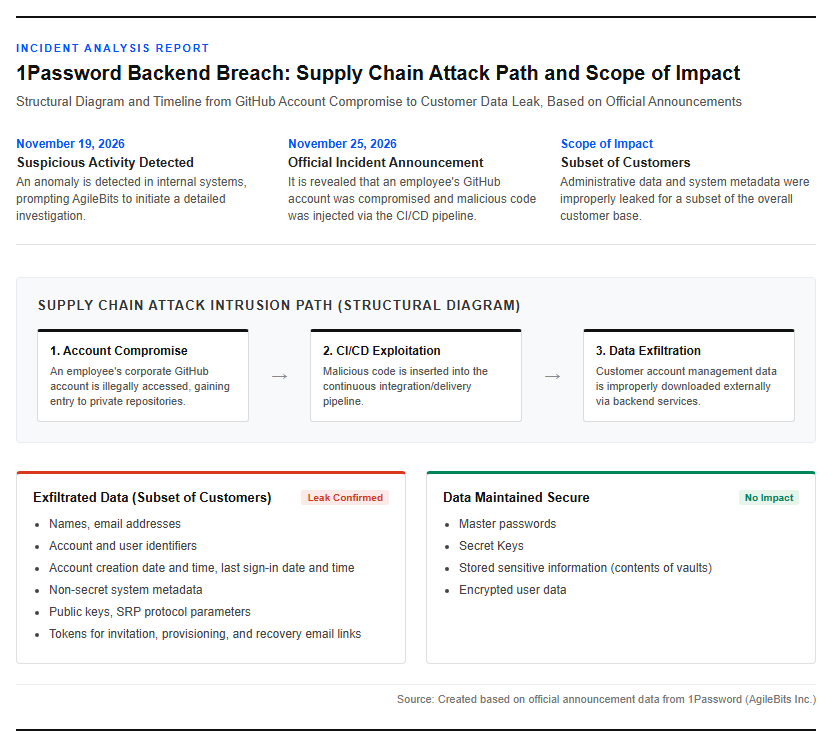
On November 19, 2026, 1Password (operated by AgileBits Inc.), headquartered in Toronto, Canada, detected suspicious activity in its internal systems and initiated a detailed investigation. According to an official announcement on November 25 of the same year, it was found that the attacker compromised an employee’s corporate GitHub account and accessed private source code repositories. By exploiting this access privilege, the attacker planted malicious code in the continuous integration and continuous delivery (CI/CD) system and backend services, and illicitly downloaded customer account management data.
The leaked information includes customers’ names, email addresses, account and user identifiers, account creation dates, last sign-in dates, and non-secret system metadata used for signing in to 1Password. In addition, public keys designed with the premise of public disclosure, parameters for the Secure Remote Password (SRP) protocol to safely perform password authentication, and tokens contained in certain invitation, provisioning, and recovery email links were also copied. The company explained that the affected customers represent a subset of the total. Please refer to the architectural diagram below.
The clear boundary between leaked information and safe critical assets
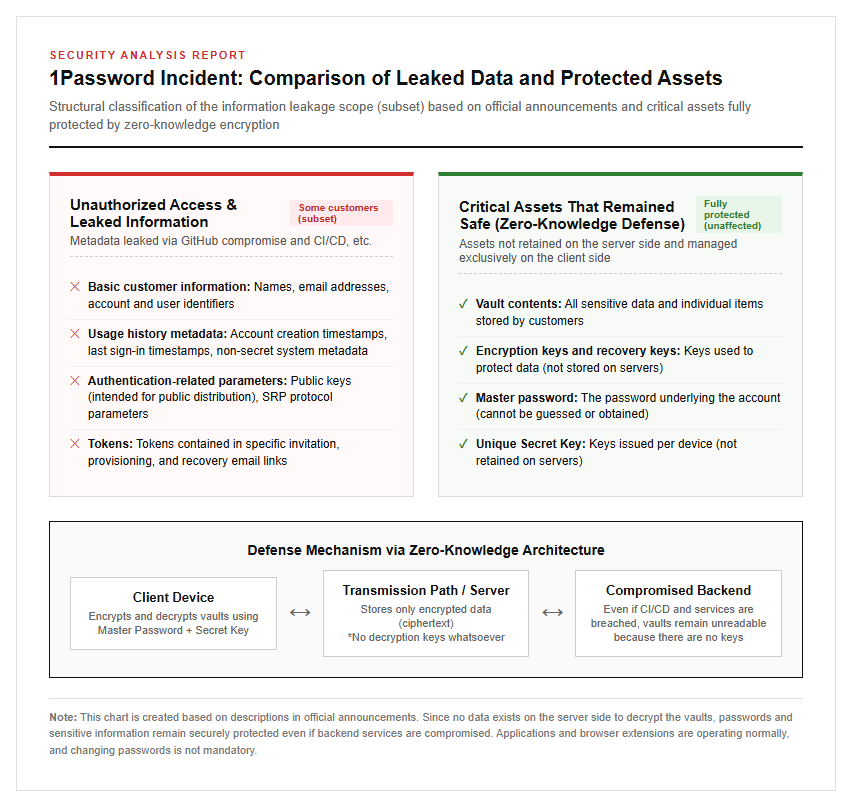
While damage was caused by the cyber attack, 1Password emphasized the security of the critical assets that customers are most concerned about. The contents of the “Vaults” storing customers’ passwords and confidential information, individual items registered in the vaults, encryption keys for protecting encrypted data, and account recovery keys were not affected in any way and were not accessed or viewed by third parties.
The company adopts a design that does not store customers’ account master passwords or unique Secret Keys issued per device on the server side at all. Therefore, even if backend services or CI/CD infrastructure are compromised, encryption keys for decrypting the vaults do not exist on the servers. Furthermore, the leaked public keys are inherently public in nature, and the SRP parameters alone make it impossible to break into an account. The company has announced that the main application and browser extensions are operating normally, and users do not need to change their registered passwords.
Defensive structure of zero-knowledge architecture and technical details of authentication tokens
Why the Vault remained safe: The mechanism of zero-knowledge encryption
The technical basis for protecting the secrets of the Vault in this incident lies in the “Zero-Knowledge Architecture” that 1Password has adopted since its founding. In the zero-knowledge design, the generation and holding of keys required for encrypting and decrypting vaults are performed entirely and exclusively on client devices. The server side only plays the role of storing encrypted data (ciphertext) and has no means to access the master password or the 128-bit Secret Key required for decryption.
In a security breach case of a competing service (LastPass) that occurred in 2022, it was reported that attackers stole the encrypted vault data itself from backups on cloud storage, which later led to secondary damages such as cryptanalysis and cryptocurrency theft. In contrast, in this 1Password case, not only was access to the vault data itself blocked, but even if the data had been stolen, a dual cryptographic protection mechanism functioned, which cannot be decrypted unless both the Secret Key and the master password are present. Please refer to the next architectural diagram.
Risks of invitation and recovery tokens and technical countermeasures of making confirmation codes 10 characters long
Among the leaked items, the “invitation, provisioning, and account recovery tokens” included in email links underwent technical evaluation. Provisioning tokens are used when configuring SCIM Bridge or hosted provisioning, and users who were in this state at the time of the incident were limited to a very small number of specific users. The company has completed individual notifications to the affected users.
According to the company’s explanation, these tokens alone do not grant the authority to compromise an account. To complete the process, they must be combined with Single Sign-On (SSO) authentication or a verification code sent to the registered email address. As a preventive measure, 1Password has upgraded the specification of the email-sent verification code from the traditional “6-digit number” to “10-character alphanumeric.” By raising the difficulty from a 6-digit number brute-force combination (1 million possibilities) to a 10-character alphanumeric combination ($62^{10}$ possibilities = approximately 83.9 quintillion possibilities), it has made guessing via brute-force attacks computationally practically impossible.
Lessons from the Development Supply Chain and Future Security Measures
The Importance of CI/CD Pipeline Protection and Developer Identity Management
This incident highlights the risks of supply chain attacks and developer identity management in modern cloud-native development environments. The attackers used an individual employee’s GitHub account as a foothold for intrusion, leveraging trusted developer privileges to laterally move into the CI/CD pipeline. Because the CI/CD environment contained infrastructure-related credentials necessary for building and deploying products, 1Password executed a full rotation (re-issuance) of potentially impacted internal infrastructure credentials.
Lessons for enterprises and developers include the necessity of going beyond mere perimeter defense to enforce stricter Multi-Factor Authentication (MFA) for developer accounts, eliminating static secrets using OpenID Connect (OIDC), and thoroughly enforcing least-privilege access from CI/CD environments to production environments. 1Password also disabled the compromised GitHub account, blocked unauthorized access, strengthened internal monitoring logs and endpoint controls, and completed containment measures verified by an external, independent security firm.
Future Outlook and Key Focus: Vigilance Against Secondary Phishing Attacks and Organizational Defense Measures
The greatest future risk and point of focus is the expansion of targeted phishing attacks (social engineering) exploiting the leaked list of names and email addresses. There is a risk that customers identified as 1Password users may be lured into sophisticated fake emails or fake websites disguised as account recoveries or security warnings. The company has explicitly stated that 1Password will never ask users for their password or Secret Key via email or phone.
As a practical defense measure that customers and system administrators should take, it is recommended not to blindly click links within emails, but rather to access services via the official app or a bookmark URL entered manually. Furthermore, in the event of receiving unfamiliar recovery requests or invitations, it is important to report them to the internal IT department and establish operational rules to verify them through independent communication channels. 1Password plans to publish a detailed technical blog within a few weeks after completing the full investigation, and follow-up analysis from the technical community is drawing attention.
Reference Pages
- 【Update on a security incident involving 1Password’s backend systems.】https://1password.com/blog/update-on-nov-2026-security-incident
【#Security #1Password #DataBreach #GitHub #SupplyChainAttack #ZeroTrust】
コメント