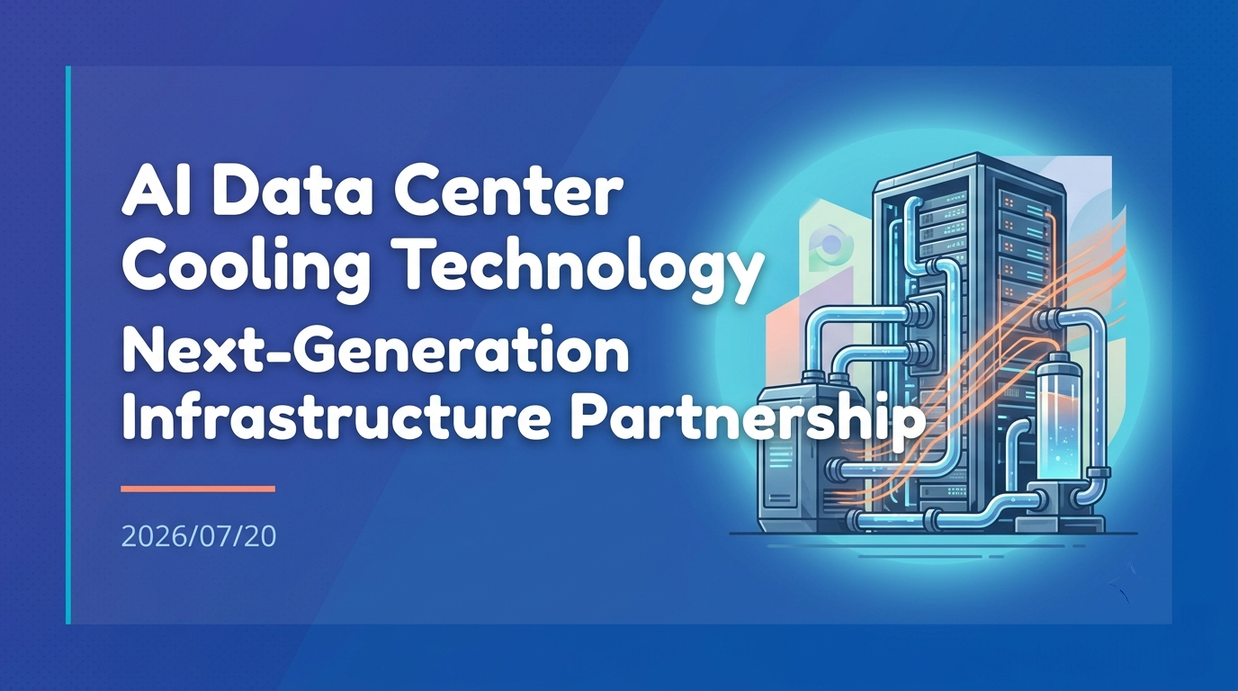
Mitsubishi Heavy Industries has officially joined as a cooling system provider partner for the construction of Nvidia’s next-generation data center, the “AI Factory,” in the United States. The background to this partnership lies Japan’s technological capability in solving the extremely difficult physical infrastructure challenge, such as controlling the explosive heat generated by the dramatic performance improvements of AI semiconductors.
- Collaboration with NVIDIA and shipment of 10MW-class turbo chillers
- Rapid deployment with the modular cooling system “MCP”
- AI racks: The ‘120kW wall’ and the limits of air cooling
- Contributing to a 300-fold improvement in water use efficiency (WUE)
- A total solution integrating cooling, power, and control
- Shift from equipment sales to a high-profit model supporting operations
Collaboration with NVIDIA and shipment of 10MW-class turbo chillers
Mitsubishi Heavy Industries announced that it will collaborate with NVIDIA to provide cooling solutions for the next-generation AI data center “AI Factory,” proposed by NVIDIA, in order to meet the rapidly growing demand for AI infrastructure. Mitsubishi Heavy Industries will join the ecosystem as a partner in the “Power & Cooling” category, supporting the NVIDIA DSX platform, which integrates design, simulation, and operations.
As the first step in concrete efforts, the company shipped a 10-megawatt (MW) class turbo chiller test unit for the U.S. market. This large refrigeration unit is scheduled to arrive at the Port of Brunswick, Georgia, USA around July 2026, marking a significant milestone in building next-generation AI infrastructure. Turbo chillers are core products that Mitsubishi Heavy Industries boasts high reliability cultivated through mission-critical equipment, accelerating the deployment of large-scale cooling systems centered around them.
Rapid deployment with the modular cooling system “MCP”
Mitsubishi Heavy Industries is strengthening the development and deployment of modular cooling systems called the “Modular Chiller Plant (MCP),” which pre-integrates pumps, heat exchangers, and control devices in addition to turbo chillers. Since MCP is shipped as a packaged system at the factory, on-site installation is easy, greatly contributing to shortening data center construction periods. The following image shows the structure of the modular cooling system.
This system is designed to scale incrementally according to fluctuating AI processing loads, enabling flexible operation in increasingly complex AI infrastructure environments. Currently, MCP is progressing to obtain various local safety and regulatory certifications, including UL certification, in preparation for commercial deployment in the U.S. market. The shipment of this 10MW-class turbo chiller marks an important step in obtaining these MCP certifications and supporting their future adoption in large-scale data centers.
Cooling technology breaks through the “physical constraints” of AI evolution
AI racks: The ‘120kW wall’ and the limits of air cooling
The high-performance advancements of semiconductors supporting AI evolution are simultaneously causing explosive increases in power consumption and heat generation. Nvidia’s latest GPU platform, the Blackwell generation, has power consumption per rack exceeding 100 kilowatts (kW), reaching the 120kW level. Considering that conventional enterprise server racks consumed about 5 to 10 kW of power, AI-dedicated racks generate more than ten times the heat.
The cooling limit for typical air cooling methods is about 20kW, and thermal density exceeding 120kW is physically beyond the limits of air cooling. To break through this “120kW barrier,” liquid cooling (DLC) technology, which directly cools chips with liquid, is essential. Mitsubishi Heavy Industries’ thermal and fluid control technology for extreme environments of thousands of degrees, cultivated over many years in rocket engine and gas turbine development, is recognized as a decisive key to solving the physical thermal challenges faced by this AI data center.
Contributing to a 300-fold improvement in water use efficiency (WUE)
In large-scale data center operations, alongside improving cooling efficiency (PUE), a key challenge is the consumption of water resources for cooling. Traditional systems that combine air cooling systems with cooling towers (cooling towers) have consumed enormous amounts of water because they generate waste heat by evaporating water. In contrast, Mitsubishi Heavy Industries’ MCP dramatically improves water usage efficiency (WUE) by efficiently utilizing free cooling and adopting a closed-loop configuration.
According to NVIDIA, adopting a liquid-cooled platform can improve WUE by more than 300 times compared to traditional air-cooled + cooling tower systems. Mitsubishi Heavy Industries’ cooling system supports a mechanism that circulates liquid without evaporating water and dissipates heat through dry coolers and other means, simultaneously addressing water shortages in large-scale facilities and reducing environmental impact. The diagram below explains the process of improving water usage efficiency through liquid cooling systems.
Future Developments and Evolution into a Service-Based Business
A total solution integrating cooling, power, and control
Mitsubishi Heavy Industries’ strength lies in its ability to offer total solutions that integrate power infrastructure and digital control technology, not just cooling equipment alone. The company possesses an emergency and on-site power generation system using gas turbine generators for data centers, and is developing digital technology to centrally manage these systems together with cooling systems.
Furthermore, we plan to provide 800V DC (800VDC) power supply solutions, which have proven track record in large-scale power infrastructure and transportation systems, in collaboration with our partners. By optimally integrating and designing IT systems, power supplies, and cooling, we maximize energy efficiency across the entire AI factory and support the stable operation of high-density AI infrastructure. This enables us to provide significant added value to our clients, such as data center operators and partners like NVIDIA, by simplifying procurement and improving operational reliability.
Shift from equipment sales to a high-profit model supporting operations
This partnership with NVIDIA means more than just expanding hardware sales for Mitsubishi Heavy Industries. This also serves as a stepping stone toward a shift from the traditional “equipment sales” business to a “service-based business” that continuously supports the energy operations of data centers. Even after the data center construction rush has passed, it is expected that models that continuously generate revenue will be built during maintenance, inspection, and energy optimization phases.
In the medium- to long-term outlook, the next-generation GPU “Vera Rubin” generation, expected to launch after 2027, is projected to reach a power density of 600kW per rack, making cooling requirements even more demanding. Mitsubishi Heavy Industries aims to establish the de facto standard for next-generation cooling infrastructure capable of withstanding even higher density in the future, leveraging the insights gained through this partnership. The era is approaching in earnest when Japan’s heavy, long-standing industrial complex, physical-layer technological prowess, continues to support the heart of the world’s AI infrastructure.
Reference Page
- [Strengthening AI Data Center Cooling Business Through Promotion of 10MW-Class Turbo Chillers and MCPs, Supporting AI Infrastructure with Modular Cooling Systems and NVIDIA Ecosystem | Mitsubishi Heavy Industries] https://www.mhi.com/jp/news/260716.html
[#三菱重工 #NVIDIA #AIファクトリー #データセンター #冷却システム #液冷 #重電 #DX]

コメント