Tokyo Gas has been selected as a subsidy provider for the Ministry of Economy, Trade and Industry’s (METI) FY2026 Electricity and Gas Rate Burden Reduction Support Project. This comes amid the government’s emergency support measures to protect public livelihood from soaring fuel prices driven by the Middle East situation during the winter energy demand season and overall inflation.
- Selection for METI’s Project and the Automatic Discount Mechanism
- Full Details of Specific Discount Rates and Application Schedule
- Direct Reduction of Household Burdens and Ripple Effects on the CPI Price Index
- Utility Cost Competition and Customer Base Under Electricity and Gas Deregulation
- Exit Strategies for Institutionalized Subsidy Programs and Energy Cost Structures
- Tokyo Gas’s Medium-to-Long-Term Strategy and the Challenge of Carbon Neutrality
Selection for METI’s Project and the Automatic Discount Mechanism
On November 26, 2026, Tokyo Gas Co., Ltd. announced that it was selected as a business operator on November 25, 2026, under the FY2026 Electricity and Gas Rate Burden Reduction Support Project implemented by the Ministry of Economy, Trade and Industry. This support project is an emergency, transitional relief measure introduced by the government to rapidly alleviate the burden on households and businesses during the freezing winter months, in response to fuel price hikes and inflation caused by escalating international tensions in the Middle East. Specifically, the structure is designed so that participating retail businesses directly deduct amounts from electricity and gas bills based on the customer’s usage, with the government fully subsidizing the funding source for these discounts. The most important point of this support measure is that individual household and corporate customers who contract with Tokyo Gas for city gas or electricity do not need to go through any individual application procedures. Because discounts are automatically applied through meter-reading slips and billing statements, customers do not have to go through the trouble of submitting documents or registering on the web. Following its selection by the government, Tokyo Gas is promptly proceeding with preparations to reflect the discounts in its billing system, establishing a reliable livelihood support system coordinated with the administration.
Full Details of Specific Discount Rates and Application Schedule
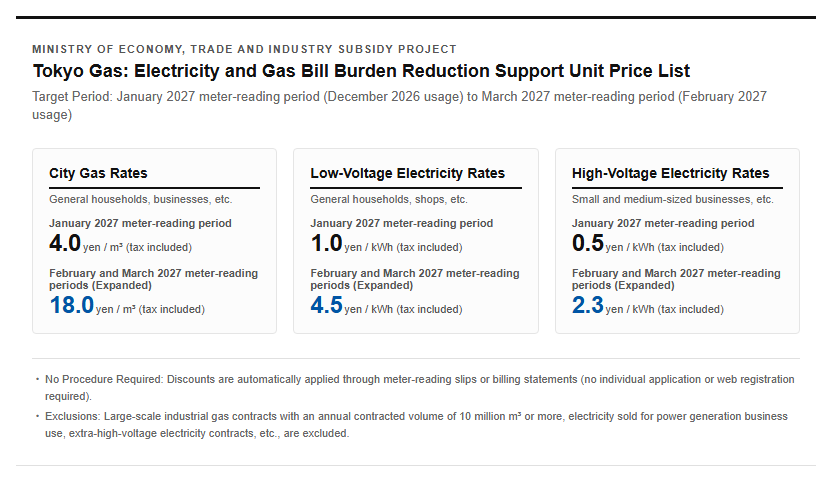
This burden reduction support measure will be applied for three consecutive months, from the meter-reading period in January 2027 (for usage in December 2026) to the meter-reading period in March 2027 (for usage in February 2027). A major feature is that the discount rates are set in two stages to match the heating season when demand is high. In the first month, the January 2027 meter-reading period, city gas bills will be discounted by 4.0 yen per cubic meter (tax included), low-voltage electricity bills by 1.0 yen per kilowatt-hour (tax included), and high-voltage electricity bills by 0.5 yen (tax included). For the two-month period of the February 2027 and March 2027 meter-readings when heating demand peaks, support will be significantly expanded: city gas bills will be discounted by 18.0 yen per cubic meter (tax included), low-voltage electricity bills by 4.5 yen per kilowatt-hour (tax included), and high-voltage electricity bills by 2.3 yen (tax included). The targets are households and businesses contracting with Tokyo Gas for city gas or electricity, while large industrial gas contracts with an annual contract volume of 10 million cubic meters or more, electricity sales for power generation businesses, and extra-high-voltage electricity contracts are excluded. Please refer to the figure below to check the changes in unit prices for your own contract.
Impact on Households and Prices and Structural Changes in the Market Environment
Direct Reduction of Household Burdens and Ripple Effects on the CPI Price Index
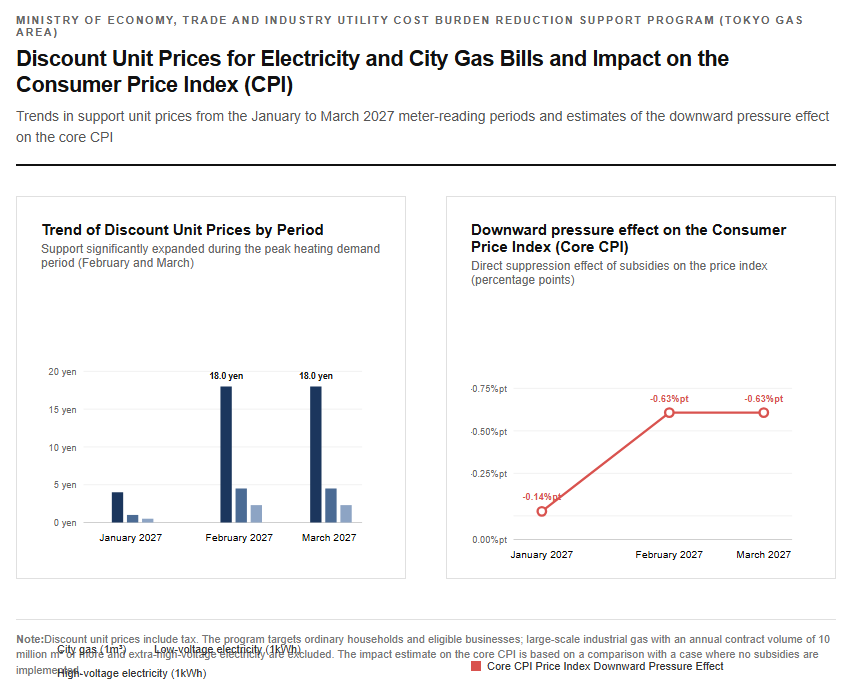
The government’s current support measure is estimated to reduce utility costs by a total of approximately 7,000 yen over three months for a standard household, with the total expenditure scale reaching approximately 500 billion yen. From a macroeconomic perspective, it is expected to have a strong downward push on the Consumer Price Index (core CPI). Specifically, compared to cases where no subsidy is implemented, it is estimated to directly lower the core CPI level by about 0.14 percentage points in January 2027, and by about 0.63 percentage points each in February and March. Mitigating the sudden surge in utility costs amidst prolonged inflation functions as a breakwater to prevent the erosion of real wages and stem an extreme cooling of personal consumption. Meanwhile, among consumers, household defense awareness is taking root to enhance “energy performance” (Enepa) not just through simple power-saving or endurance, but by improving home insulation and introducing high-efficiency energy-saving equipment. As the government’s generous lump-sum subsidies intersect with defensive actions by consumers, the numerical changes in the utility cost reduction effects are as shown in the graph below.
Utility Cost Competition and Customer Base Under Electricity and Gas Deregulation
Since the complete deregulation of retail electricity and city gas, the household energy market has become a battleground for the roughly 10 trillion yen “utility cost” market. As alliances such as the one between TEPCO Energy Partner and Nihon Gas (Nichigas) mount an offensive into Tokyo Gas’s supply territory, industry leader Tokyo Gas has pushed forward with defense and new customer acquisition, backed by its solid customer base. Today, the Tokyo Gas Group holds approximately 8.826 million retail city gas customers and 4.152 million retail electricity customers, primarily in the Tokyo metropolitan area, bringing their combined accounts to roughly 13 million. In recent years, the company has broken away from merely reselling energy, promoting diversified rate plans that leverage digital customer touchpoints like “myTOKYOGAS” and the next-generation core system “Kraken.” Furthermore, under its solution business brand “IGNITURE,” it is accelerating a cross-selling strategy designed to increase average revenue per user (ARPU) and prevent switching to competitors by packaging value-added offerings centered on decarbonization, optimization, and resilience. Behind the temporary rate reductions driven government subsidies, the defensive battle for customers among operators is growing increasingly sophisticated.
Medium-to-Long-Term Outlook and the Challenge of Perpetuating Subsidies
Exit Strategies for Institutionalized Subsidy Programs and Energy Cost Structures
While the current electricity and city gas bill support measures are highly effective, emergency evacuation measures to prevent sharp increases in household burdens, strong concerns have been pointed out regarding the fact that these support measures are becoming established as routine summer and winter events. The series of sudden price change mitigation measures, which began in January 2023, have been repeated intermittently—with temporary pauses and reductions along the way—placing a massive, continuous burden on national finances. Although uniform rate subsidies have the advantage of rapidly delivering support to a wide range of recipients, households that consume more energy receive larger subsidies, creating the harmful side effect of weakening the price signals for energy conservation aimed at decarbonization. Unless Japan’s energy structure—which depends on overseas resource prices subject to Middle East risks and exchange rate fluctuations—is transformed, it will be difficult to break away from temporary fixes funded by the national budget, making the formulation of a subsidy exit strategy an urgent task. Moving forward, sustainable institutional designs that do not inhibit market functions will be required, such as shifting toward focused support for low-income households and establishing clear rules for triggering and ending programs.
Tokyo Gas’s Medium-to-Long-Term Strategy and the Challenge of Carbon Neutrality
Toward a fundamental structural transformation that does not rely on such policy subsidies, the Tokyo Gas Group has set forth its management vision, “Compass2030,” accelerating investments in structural reform and decarbonization. While maintaining the earnings foundation of its existing city gas and electricity businesses, the company is rushing to establish its solutions business as a third pillar of revenue. Specifically, it is taking a leading role in building a global value chain for synthetic methane (“e-methane”) to decarbonize city gas, establishing international rules through the international alliance “e-NG Coalition,” and introducing clean gas certificates. Furthermore, it is steadily boosting its earning capacity in the GX (Green Transformation) field through renewable energy power source development, participation in offshore wind power generation projects, and energy management businesses utilizing grid-scale storage batteries. Even during the support period when the government’s rate surge mitigation measures are applied, Tokyo Gas plans to fulfill its commitment to the stable supply of infrastructure while advancing business operations that balance the realization of a medium-to-long-term decarbonized society with the enhancement of corporate value.
References
- [Regarding Selection for the “FY2026 Electricity and Gas Bill Burden Reduction Support Program Subsidy” – Tokyo Gas] https://www.tokyo-gas.co.jp/news/topics/20261126-08.html
- [To All Electricity and City Gas Users | Electricity and Gas Bill Support | Agency for Natural Resources and Energy, Ministry of Economy, Trade and Industry] https://denkigas-gekihenkanwa.go.jp/
[#TokyoGas #ElectricitySubsidy #GasSubsidy #EnergySupport #EconomicNews #InflationCountermeasures]

コメント