
A serious change has occurred in the fishing trends of the popular fish supporting Japan’s dining table, the sardines. The end of the long-standing Kuroshio Great Meandering and the resulting changes in sea surface temperature have led to an extreme polarization between record poor catches on the Pacific side and record abundant catches on the Sea of Japan side, which has had a significant impact on related industries.
- Severe Fishing Failure Hitting Major Pacific Fishing Ports
- Record-breaking catch on the Sea of Japan side for the first time in 30 years
- The longest Kuroshio Current meandering event will end in 2025
- Delays in northbound migration caused by low sea temperatures
- Domestic canned food production has declined for seven consecutive years.
- Challenges in Stabilizing Fisheries Management and Public Support
- Similarities with the Resource Decline Period of the 1990s
- Sustainable resource management based on scientific knowledge
Severe Fishing Failure Hitting Major Pacific Fishing Ports
Entering 2026, Japan’s sardine fishing has suffered a devastating blow on the Pacific side. According to data from January to April 2026 released by the Fisheries Information Service Center (JAFIC), Choshi Port in Chiba Prefecture, which boasts one of the highest domestic catches, landed about 17,033 tons. This is an extremely low level, only 19%, compared to about 88,000 tons in the same period last year. Even more severe is Ishinomaki Port in Miyagi Prefecture, where the volume landed during the same period was about 1,040 tons, a sharp drop to just 6% of the previous year’s approximately 17,400 tons.
With the disappearance of the maiwhi that once filled the harbor, fisheries professionals on the Pacific side are increasingly feeling a sense of crisis. Among major fish species, sardines account for the largest share of the country’s total catch, and their abundance directly affects the local fisheries economy. Extreme declines in landings in major production areas have led to supply shortages to processing and distribution operators, causing price instability in wholesale markets. This decline, especially during the peak period from January to April, has spilled over as a significant loss to the entire regional economy.
Record-breaking catch on the Sea of Japan side for the first time in 30 years
In contrast to the difficulties on the Pacific side, fishing ports on the Sea of Japan side are experiencing record-breaking abundant catches of Japanese sardines. At Sakai Fishing Port in Sakaiminato City, Tottori Prefecture, the catch volume from January to April 2026 reached approximately 44,840 tons, about 1.7 times the average year. In the city, it is customary to raise the ‘Big Catch Flag’ at the city hall when a day’s catch exceeds 1,000 tons, but by May 25, 2026, it has been raised 42 times, surpassing the previous record of 37 times set in 2013. This is the first time in about 30 years that such a lively atmosphere has returned to Sakai Fishing Port.
This abundant catch has been confirmed not only in Sakaiminato but also across a wide area along the Sea of Japan coast, including Toyama Prefecture (February to May) and Ishikawa Prefecture (January to April), with both recording catches about 1.7 times the average year. On site, orders for purchases are pouring in from distant regions such as the Kanto region, helping to supplement supply from the Pacific side, which is suffering from poor catches. The latest otolith analysis by a marine ecology research team at Kyoto University revealed that some groups of Japanese sardines that lived on the Pacific side have moved toward the Sea of Japan side, a trend that has rapidly intensified since 2023. The strong view that the abundant catch on the Sea of Japan side is supported by populations migrating from the Pacific through changes in migration routes.
Dramatic changes in the marine environment and their impact on migration routes
The longest Kuroshio Current meandering event will end in 2025
The biggest factor that has brought about dramatic changes in this sardine trend is the “normalization” of the marine environment. The Kuroshio Great Meander, which began in August 2017, lasted about 7 years and 9 months for the longest duration ever, and finally ended in April 2025. During this long meandering period, the northward side of the Kuroshio Current was prominent in the waters off Sanriku and Joban, with surface water temperatures 3 to 5 degrees above average, and even at depths of 100 meters, temperatures 8 degrees above average—unprecedented and abnormal water temperatures were recorded.
With the end of the Kuroshio Current meander, the influence of warm water that had covered the Sanriku Sea area until then has been removed, and from late 2025 to 2026, sea surface temperatures have dropped to normal levels. Sardine is a floating fish sensitive to temperature changes, and during previous periods of high water temperature, the location of spawning grounds and the timing of northward migration were significantly earlier. However, as water temperatures have returned to normal levels, fish movement patterns and visiting periods have shifted to pre-2022 levels or to new cycles different from those before. This dramatic change in sea surface temperature is a major factor hindering the formation of fishing grounds on the Pacific side.
Delays in northbound migration caused by low sea temperatures
The drop in sea surface temperature directly affects the northward migration mechanism aimed at feeding (foraging) of the sardines. During the period of continued high water temperatures from 2023 to 2024, schools of sardines passed off the coast of Sanriku earlier than usual and headed toward the eastern Hokkaido waters. However, due to the drop in sea surface temperatures after 2025, the pace of northward migration has slowed, and fishing grounds have not formed during the traditional peak fishing season.
In particular, the peak of catches off Choshi and Ishinomaki has become ambiguous, resolving the earlier end of the fishing season, while the crucial phenomenon of school migration has not recovered. This is not just a timing shift, but also supports the possibility that the low water temperature acts as a barrier, causing the fish to take routes away from the coast, and as mentioned earlier, the schools themselves may have made a significant detour toward the Sea of Japan side. At a major turning point in the marine environment, such as a “regime shift” (cyclical climate transition), the prolonged low sea temperatures have rendered traditional fishing methods and forecasting ineffective, which has become the biggest challenge in the business field.
Spillover effects on the seafood business and economy
Domestic canned food production has declined for seven consecutive years.
The poor catch of blue-backed fish such as sardines and mackerel has dealt a serious blow to the management of the processed food industry. According to production statistics released by the Japan Canned & Bottled Retort Food Association in June 2026, domestic seafood canned food production in 2025 will decrease by 2.6% year-on-year to approximately 64,857 tons. This marks the seventh consecutive year of production decline, with the main reason being the inability to secure blue-backed fish such as maiwashi, a key raw material.
Food manufacturers have responded to rising procurement costs caused by poor raw material yields by reducing content volume and repeatedly raising prices, but this has reached a point where self-effort alone can no longer absorb the costs. At wholesale sites such as Toyosu Market, shipments of Chiba Prefecture’s mai sardines and other products have been sluggish, and prices continue to tend to remain high. Sardine, once called the ‘rice of the sea’ and affordable and nutritious, has become more expensive and rare due to raw material shortages, causing consumers to hesitate to buy and resulting in a negative chain reaction of reduced sales for processing manufacturers. The situation of securing raw materials remains uncertain in 2026, raising concerns about further production declines.
Challenges in Stabilizing Fisheries Management and Public Support
Sudden fluctuations in catch volumes threaten the survival of fishery operations. To support this, the government operates the “Fisheries Income Stabilization Project” based on the Fisheries Act. This system allows fishers handling fish species with highly variable resources, such as sardines, to receive a portion of their income during poor catches. Specifically, the standard is based on the average income over the past five years, and if it falls below that, compensation is provided from sources such as ‘Tsumitate Plus’.
However, if the current sluggish catch continues to decline for several years, institutional issues arise. Since the “standard income” that serves as the basis for compensation is calculated based on past performance, if poor catches continue, the baseline value itself drops, and the actual amount of compensation received decreases over the long term. Among fisheries stakeholders, there are calls for special measures that set the minimum contract amount from previous contracts, similar to those introduced in bluefin tuna fisheries. Furthermore, this support measure targets only “fishers,” and the lack of relief for “seafood processors” forced to halt operations due to raw material shortages is a major topic of debate regarding the overall sustainability of the seafood business.
Future Outlook and the Importance of Resource Management
Similarities with the Resource Decline Period of the 1990s
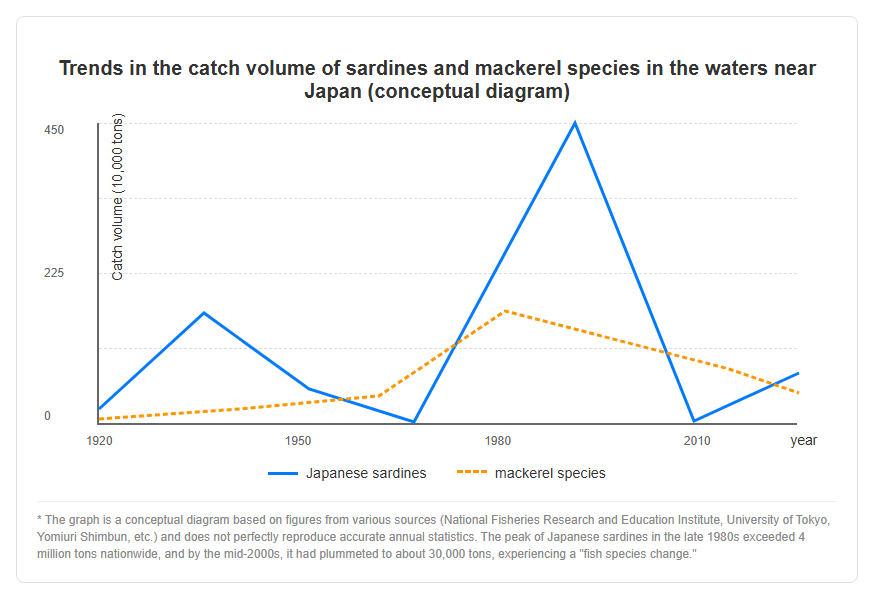
Experts have pointed out that the current trend of sardines closely resembles the historical resource decline that occurred in the early 1990s. According to the National Fisheries Research and Education Institute, Japan’s mai sardines catch reached its peak in the mid-1980s, exceeding 4 million tons annually, but rapidly declined in the 1990s. In the early stages of this decline, the Pacific side first suffered a severe poor catch, followed by a sharp drop in catches on the Sea of Japan side, dropping to just 27,600 tons nationwide by 2005.
At the time, sardine was even called a ‘phantom fish,’ but since the 2010s, resources have recovered again, and by 2025, nationwide catch volume is expected to reach about 708,000 tons. However, this record poor catch on the Pacific side largely overlaps with the previous process of resource collapse. If we are entering another nationwide decline phase, prices for farmed fish feed made from sardines, livestock feed, and processed foods will rise even further nationwide, potentially triggering a severe “blue fish shock” that shakes the entire supply system for meat and farmed fish.
Sustainable resource management based on scientific knowledge
The future focus is shifting to how to maintain and manage resources amid the ever-changing marine environment. The Fisheries Agency has set the TAC for the Pacific group of sardines for the 2025 management year (Reiwa 7) at approximately 663,000 tons. According to resource assessments, the estimated resources of the Pacific Group peaked at 5.9 million tons in 2022 and have declined to 4 million tons in 2024. The poor catch is likely due not only to seawater temperature but also to the decline in the stock itself.
Going forward, it will be necessary to analyze more precisely not only population numbers but also the impact of environmental factors such as low sea temperatures on fish growth and survival. Additionally, the use of “Resource Management Agreements” to encourage voluntary resource management by fishermen, and thorough evaluation using the scientific indicator CPUE (Catch Per Unit Effort), are also required. Rather than simply lamenting that “we can’t catch anymore,” the only way to protect the future of Japan’s seafood business is to view climate change risks as physical management risks and implement long-term data-driven adaptation measures. The following figure shows long-term catch fluctuations for sardines and mackerel, suggesting how industries should respond to major waves of resources.
[#マイワシ不漁 #黒潮大蛇行 #低海水温 #水産経済 #資源管理 #レジームシフト #缶詰不足 #漁業経営]


コメント