Nitto Denko will begin full-scale sales of transparent conductive films for perovskite solar cells (PSC), which are expected to be next-generation solar cells. The background is a strategy to make the company’s high-performance film technology a pillar of growth in the green sector, anticipating full-scale domestic commercialization starting in 2026.
- Strengths of the transparent conductive film “Elycrysta”
- The importance of film technology supporting flexible installation
- Trends of domestic manufacturers aiming for commercialization in 2026
- World-leading patent networks and the winning strategies of Japanese companies
- Medium-Term Management Plan “Nitto RISE 2028” and ESG Strategy
- Challenges Toward Mass Production of Golden Week and Roadmap to 2040
Strengths of the transparent conductive film “Elycrysta”
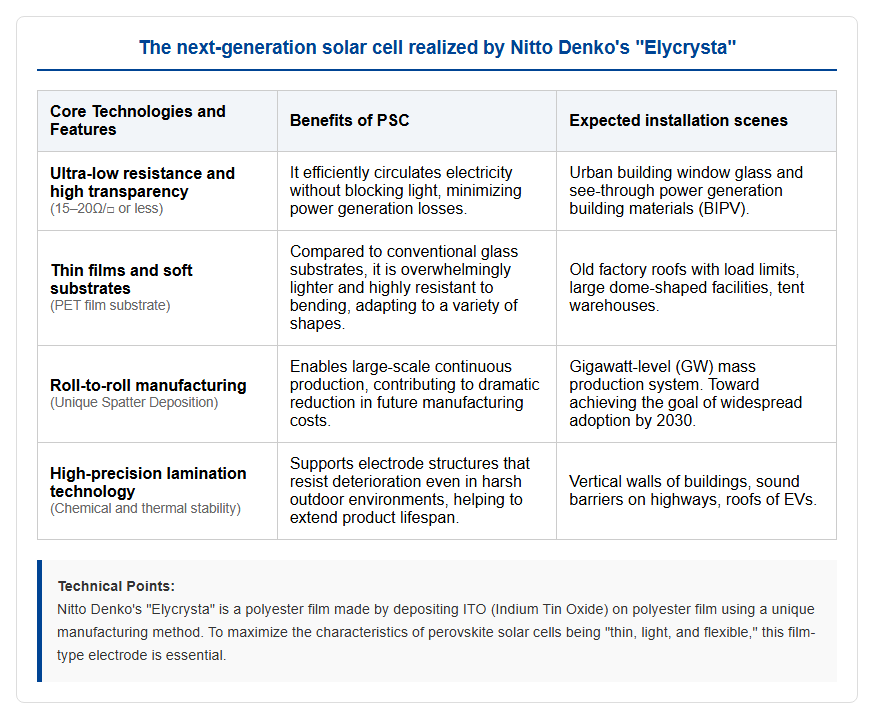
Nitto Denko’s transparent conductive film “Ecrysta” is a product that deposits an ITO (indium tin oxide) film on a polyester substrate using a proprietary sputter deposition method. This film achieves both high transparency and low resistance, and has previously held a significant market share mainly for touch panels. When used as electrodes in perovskite solar cells (PSC), low resistance values below 15–20Ω/□ and high transparency for efficiently capturing light are essential, and the company’s stacking technology meets these requirements with a high degree of expertise. In addition to mechanical and chemical stability, it also offers high dimensional stability against heat, making it an extremely suitable material for solar cell components requiring long-term durability.
The diagram below shows an image of the site where Nitto Denko’s technology is utilized.
The importance of film technology supporting flexible installation
The key difference between perovskite solar cells and conventional silicon-based solar cells is their characteristic of being “thin, lightweight, and bendable.” This makes it possible to install them on factory rooftops, building walls, and even window glass where installation was previously difficult due to load restrictions. To achieve this flexibility, flexible film substrates are required for electrode components rather than glass. Nitto Denko aims to contribute to solving market challenges such as large-area and mass production by applying the manufacturing processes of “thin film processing” and “roll-to-roll” that it has cultivated over many years in the display field to the PSC field. The company’s entry is not just about supplying materials; it also serves as a provision of converting technology that accelerates the social implementation of PSCs.
Japan’s technological superiority and rapid market expansion
Trends of domestic manufacturers aiming for commercialization in 2026
Japan’s perovskite solar cell market is at a major turning point between 2025 and 2026, transitioning from demonstration experiments to a full-scale social implementation phase. For example, Sekisui Chemical plans to officially launch the film-type PSC “SOLAFIL” business in March 2026, and companies like Panasonic HD also plan to start test marketing in 2026. The government has also set a goal to establish a gigawatt-level (GW)-class mass production system as early as 2030 and has introduced strong support measures. Against this backdrop, demand for high-performance components supporting module manufacturers, especially barrier films and transparent conductive films, is rapidly increasing, and Nitto Denko’s sales plans can be seen as a timely decision in response to the explosive growth in market demand.
World-leading patent networks and the winning strategies of Japanese companies
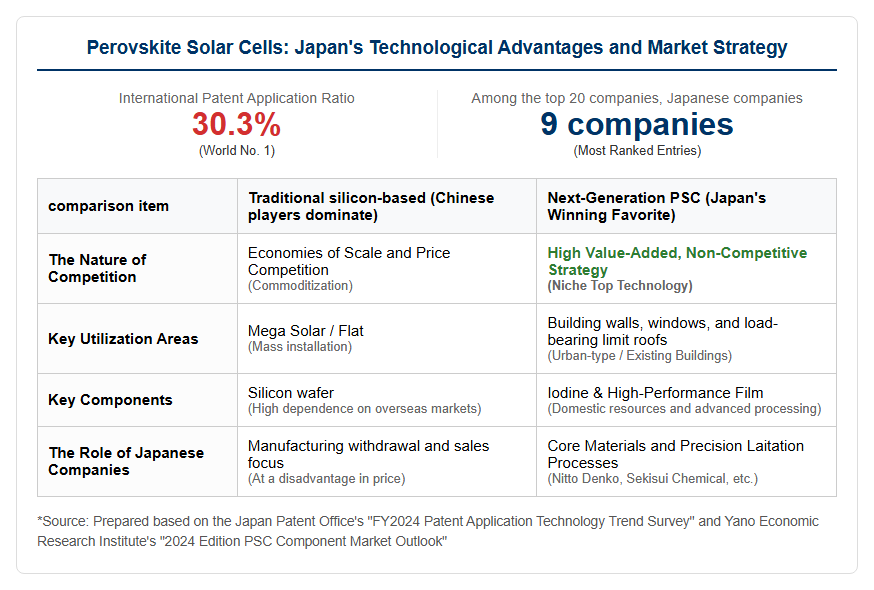
According to a survey by the Japan Patent Office, Japan ranks first in the world in the number of international exhibition development proposals related to perovskite solar cells, possessing overwhelming technological superiority. The proportion of applications reached 30.3%, with 9 of the top 20 companies being Japanese firms, including the name Nitto Denko. Japanese companies that once lost price competition to Chinese companies in silicon-based solar cells, now adopt a strategy of competing in high value-added areas such as “durability” and “diversity of installation locations” in perovskite solar cells. Advanced converting technology that precisely forms complex layer structures while maintaining flexibility is a domain unique to Japanese companies, and Nitto Denko’s conductive film serves as a key piece supporting this strategy.
The figure below is an example of material analyzing the latest technological trends.
Background of the Management Strategy and Future Outlook
Medium-Term Management Plan “Nitto RISE 2028” and ESG Strategy
Nitto Denko’s recent move aligns with its strategy of focusing on the “Green Tech” area in its medium-term management plan “Nitto RISE 2028.” The company has set its vision for 2030 as an “indispensable ESG niche top company,” positioning the expansion of environmentally friendly products as its growth axis. Specifically, they are promoting the creation of “double certified products” that combine environmental and human contribution products (PlanetFlags / HumanFlags) with their unique niche top strategy, and conductive films for PSC are expected to become a representative example of this. In terms of stock valuation, analysts have given it a rating of ‘3.6 (Somewhat Bullish),’ and the target price as of July 2026 is set at around 3,200 to 3,250 yen, earning a certain level of trust from investors for its contributions to the next-generation energy sector.
Challenges Toward Mass Production of Golden Week and Roadmap to 2040
The future focus is on cost reduction and improved durability toward the 2030 GW-class mass production system. Currently, even commercial products from Sekisui Chemical have a service life of about 10 years, making technological improvements to catch up with the traditional silicon-based 20 to 30 years of service urgent. For Nitto Denko, the challenge is how to secure ITO film manufacturing capacity while responding to the decline in material costs. There are forecasts that the PSC market will reach a cumulative installation volume of 20GW around fiscal year 2040, indicating extremely high long-term growth potential. Within an “All Japan” system where material manufacturers, component manufacturers, and module manufacturers collaborate, the kind of presence Nitto Denko asserts through conductive films will be the key to determining the success or failure of Japan’s renewable energy industry.
[#日東電工 #ペロブスカイト太陽電池 #透明導電性フィルム #再生可能エネルギー #カーボンニュートラル #日本発技術 #グリーンテック #次世代太陽電池]


コメント