On July 6, 2026, the government and ruling parties began final coordination to add a new bureau to the Ministry of Defense. This organizational restructuring aims to strengthen command center functions to respond to the tense security environment and embody a national strategy to foster the defense industry as a pillar of economic growth.
- The Ministry of Defense’s policy to expand bureaus and its immediate market impact
- Acceleration of defense capabilities promoted by the Takaichi administration
- Innovation in command and control through increased numbers of Joint Operations Command and Deputy Ministers
- Strengthening the Industrial Base as the “Defense Capability Itself”
- The Unmanned Asset ‘SHIELD’ Concept and the Social Implementation of AI Technology
- Introduction of Defense Surtax and Opaque Funding
- Fundamental Strengthening of the Human Base and Strategies for Reducing the Self-Defense Forces’ Personnel
The Ministry of Defense’s policy to expand bureaus and its immediate market impact
At the opening of the Tokyo Stock Exchange on July 6, 2026, defense-related stocks rose across the board following reports that the government and ruling party had begun considering establishing a new bureau within the Ministry of Defense. As of 9:11 a.m., the Nikkei Stock Average was up 573 yen from the previous day, with core defense companies such as Mitsubishi Heavy Industries, IHI, Kawasaki Heavy Industries, and Tokyo Keiki trading at high levels. This expansion is not merely an expansion of administrative functions, but is being seen by the market as an “upgrade” to accelerate budget execution and industrial development for next-generation defense capabilities. The government plans to clarify the division of roles with the existing Maintenance Planning Bureau and the Defense Logistics Agency while establishing a system to accelerate decision-making in new areas such as space, cyber, and electromagnetic waves. This move symbolizes Japan’s defense policy shifting its focus from equipment procurement to strengthening its industrial base itself.
Acceleration of defense capabilities promoted by the Takaichi administration
The Sanae Takaichi administration, inaugurated in October 2025, has clearly set a policy to shift Japan’s defense posture from a “passive refusal” to an “active deterrence.” The initial plan to achieve the defense-related budget target of 2% of GDP, which was originally planned by fiscal year 2027, was announced to be achieved two years ahead of schedule by fiscal year 2025. Accordingly, consideration is underway to revise three security-related documents, including the “National Security Strategy,” formulated at the end of 2022, within 2026. The addition of new stations is expected to serve as a practical foundation supporting this accelerated defense buildup plan. Prime Minister Takaichi aims to elevate Japan’s role in the Japan-U.S. alliance to an equal partnership, with constitutional revision and clarification of the Self-Defense Forces’ status in mind, and the reorganization of the ministry’s internal organization can be seen as part of this strategic move.
Innovation in command and control through increased numbers of Joint Operations Command and Deputy Ministers
The Ministry of Defense is simultaneously pursuing several major restructurings aimed at streamlining the organization and enhancing crisis management capabilities. In March 2025, a new “Joint Operations Command (JJOC)” was established to centrally command the Ground, Maritime, and Air Self-Defense Forces, separating the ministerial assistant duties and unit command duties previously handled by the Chief of Staff. Additionally, the bill submitted to the 221st Diet includes increasing the number of Deputy Defense Ministers from the current one to two to reduce the burden of crisis management for the Minister of Defense and ensure thorough handling of various situations. Furthermore, the Development Planning Bureau plans to establish new positions such as the “Counselor (Space Division)” and the “Pacific Defense Concept Office,” providing organizational support to enhance cross-regional operational capabilities. These reforms are expected to enable seamless command and control and policy formulation from peacetime to emergencies.
Business Structure and Technological Innovation in the Defense Industry
Strengthening the Industrial Base as the “Defense Capability Itself”
The government defines the defense industry as “defense capability itself,” making its maintenance and strengthening a national priority. In the FY2026 budget proposal, approximately 95.7 billion yen has been allocated to strengthen the defense production and technology base. This includes 30.4 billion yen in the “System Development Project to Strengthen the Production Base for Defense Equipment,” which supports supply chain resilience and manufacturing process efficiency. Please refer to the diagram below.
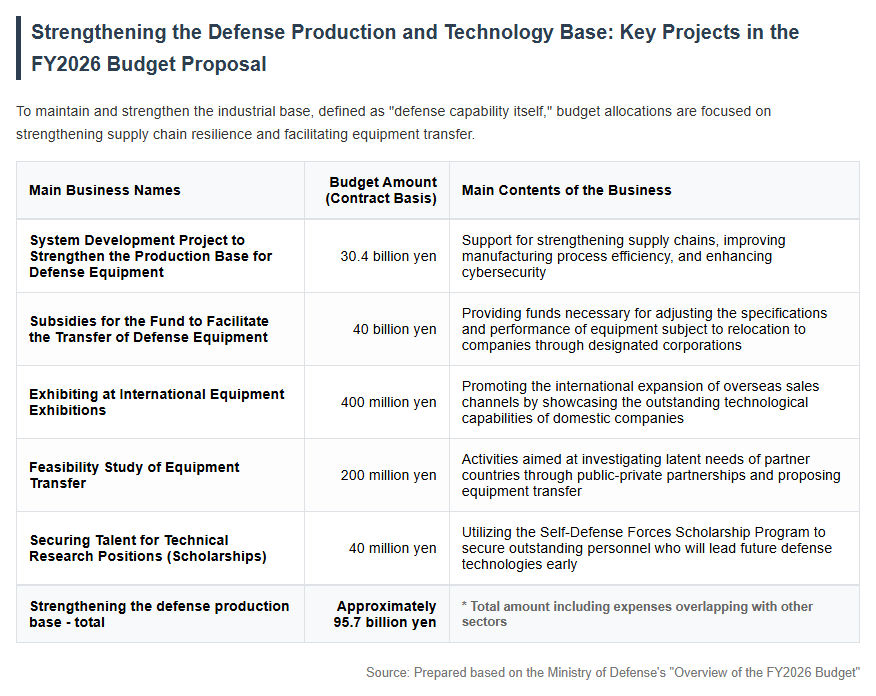
Additionally, Japan has relaxed the Three Principles on Transfer of Defense Equipment and is actively participating in international joint development, such as jointly developing the next-generation fighter jet (GCAP) with the UK and Italy. Regarding GCAP, which aims for deployment in 2035, a budget of approximately 160 billion yen is planned for fiscal year 2026. Furthermore, through the Government Security Capacity Enhancement Support (OSA) for supplying equipment to friendly countries, and through 40 billion yen in subsidies to funds to facilitate equipment transfers, efforts are being made to expand sales channels and improve profitability for the domestic defense industry.
The Unmanned Asset ‘SHIELD’ Concept and the Social Implementation of AI Technology
To overcome the severe constraints of population decline, the Ministry of Defense is placing AI and unmanned technologies at the core of future defense capabilities. The symbol of this is the multi-layered coastal defense system “SHIELD (Synchronized, Hybrid, Integrated and Enhanced Littoral Defense),” aiming to be established by March 2028. In the FY2026 budget proposal, approximately 100.1 billion yen has been allocated to expand drone assets such as unmanned aerial vehicles (UAVs), unmanned surface vessels (USVs), and unmanned submersible vessels (UUVs). These unmanned assets function as networks for monitoring and defending coastal areas without endangering the lives of Self-Defense Force personnel. Additionally, Japan-U.S. joint research is being promoted, such as the “SAMURAI Project,” which enables autonomous flight and accelerates AI-based situational judgment. The domestic UAV market is projected to reach approximately 327.5 billion yen by 2035, and there is also anticipation for building an ecosystem where advanced technologies cultivated in the defense sector will spread to civilian sectors.
Future developments and national challenges facing
Introduction of Defense Surtax and Opaque Funding
To cover the massive defense budget of approximately 43.5 trillion yen over five years, the government is accelerating considerations of tax measures to secure financial resources. By the end of fiscal year 2026, a budget equivalent to 81% of the development plan project cost is expected to be allocated, but long-term sustainability remains a challenge. According to government policy, it has been decided to gradually begin tax increases through additional taxes on corporate, tobacco, and income taxes starting January 2027. In particular, regarding income tax, the plan is to lower the rate of the Special Reconstruction Income Tax and extend the tax period, aiming to avoid a sharp increase in household burdens while imposing a new additional tax at a rate of 1%. However, public debt exceeding 240% of GDP, along with rising equipment purchase costs due to a weak yen and high prices, are major burdens in fiscal management. While public support for strengthening defense capabilities is at a record high, resistance to tax increases remains strong, drawing attention to future political steering.
Fundamental Strengthening of the Human Base and Strategies for Reducing the Self-Defense Forces’ Personnel
To address the severe personnel shortage, the Ministry of Defense has made “fundamental strengthening of the human base” one of its top priorities. The 2026 budget includes 581.4 billion yen for projects related to improving the treatment of Self-Defense Force personnel, enhancing living environments, and establishing new lifelong planning. Specific measures include increasing allowances for special operations and working in harsh environments, raising benefits for young retirees, and establishing a reemployment support system up to age 65. In terms of recruitment, we are expanding a scholarship program worth about 100 million yen and strengthening web advertising. In organizational management, thorough “labor-saving” is being promoted, accelerating the introduction of the new highly automated new “Mogami-class” escort ships, outsourcing base security to private companies, and AI-based administrative tasks. In March 2026, the “Japan Ground Self-Defense Force Supply Headquarters” will be established, and by centrally managing supply depots nationwide, logistics operations will be streamlined, optimizing the organizational structure itself.
💰 #防衛省 #組織改編 #防衛関連株 #経済安全保障 #高市早苗 #防衛増税 #AI技術


コメント