On August 22, 2026, the U.S. Trump administration imposed a 50% additional tariff on imports from Canada, and trade negotiations collapsed at the last minute. Behind this are unfair modifications to the agreement terms resulting from domestic U.S. trade pressure and the application of unusual legal authority that had remained dormant for years.
- Last-Minute Negotiation Collapse and Forced Imposition of 50% Tariffs
- The conflict and divergence in claims between the US and Canadian governments over the reasons for the breakdown
- The First-Ever Application of the “Ultimate Weapon” Article 338 and Its Characteristics
- The Scope of Canadian Products That Pierced the USMCA Shield
- The risk of a collapse in cross-border division of labor systems, led by the automotive industry
- Canada’s Proposed Countermeasures and the Path Forward for Market Diversification Away from the US
Last-Minute Negotiation Collapse and Forced Imposition of 50% Tariffs
At 12:01 a.m. EDT on August 22, 2026, the U.S. Trump administration officially enacted a measure imposing a 50% additional tariff on approximately $20 billion (approx. 3.2 trillion yen) worth of imports from Canada. Until just before the deadline, both governments held repeated cabinet-level trade talks in Washington, and on August 18, 2026, President Trump signed a proclamation extending the enactment deadline by three days in an effort to seek a consensus. However, even immediately before the enactment, the gap between the two countries’ positions could not be bridged, and negotiations completely broke down at the eleventh hour. With the enactment of this exceptionally high additional tariff measure of 50%, economic relations between the two countries, which have long benefited from North American free trade, are experiencing an unprecedented chill. The scale of approximately $20 billion subject to this enactment is equivalent to a little over 5% of the total annual U.S. imports of goods from Canada (approximately $381.9 billion based on 2025 results). Although certain natural resources such as crude oil and potash fertilizer were excluded, it is inevitable that this will bring serious uncertainty to the entire North American supply chain. In retaliation, the Canadian side announced a measure to impose a 50% retaliatory tariff on an equivalent scale of U.S. products starting the same day, clearly demonstrating its stance of immediate counteraction.
The conflict and divergence in claims between the US and Canadian governments over the reasons for the breakdown
Regarding the background of the breakdown in negotiations, both the US and Canadian governments have blamed each other, with their claims standing in direct opposition. Jamison Greer, the United States Trade Representative (USTR), criticized that despite the US side offering the most preferential terms among major exporting countries, the Canadian side made new demands at the final stage and withdrew existing promises, causing the agreement to fall apart. In response, Canadian Prime Minister Mark Carney strongly countered in an official statement that the US had suddenly changed its position and altered the terms at the eleventh hour. Prime Minister Carney explained that the changes proposed by the US were extremely unfair and uneconomic, fundamentally undermining the credibility of any agreement reached, and thus leading to the decision to “pause” the trade negotiations. Canada’s public broadcaster, CBC, reported that specific factors behind the breakdown included the eruption of dissent within the US government over the reduction of auto tariffs, as well as difficult negotiations surrounding state-level restrictions on the sale of alcoholic beverages. It is said that this lack of transparency in the decision-making structure led to the change in terms just before the agreement and the ultimate breakdown.
An Unusual Legal Basis: “Section 338 of the Tariff Act of 1930” and the USMCA Crisis
The First-Ever Application of the “Ultimate Weapon” Article 338 and Its Characteristics
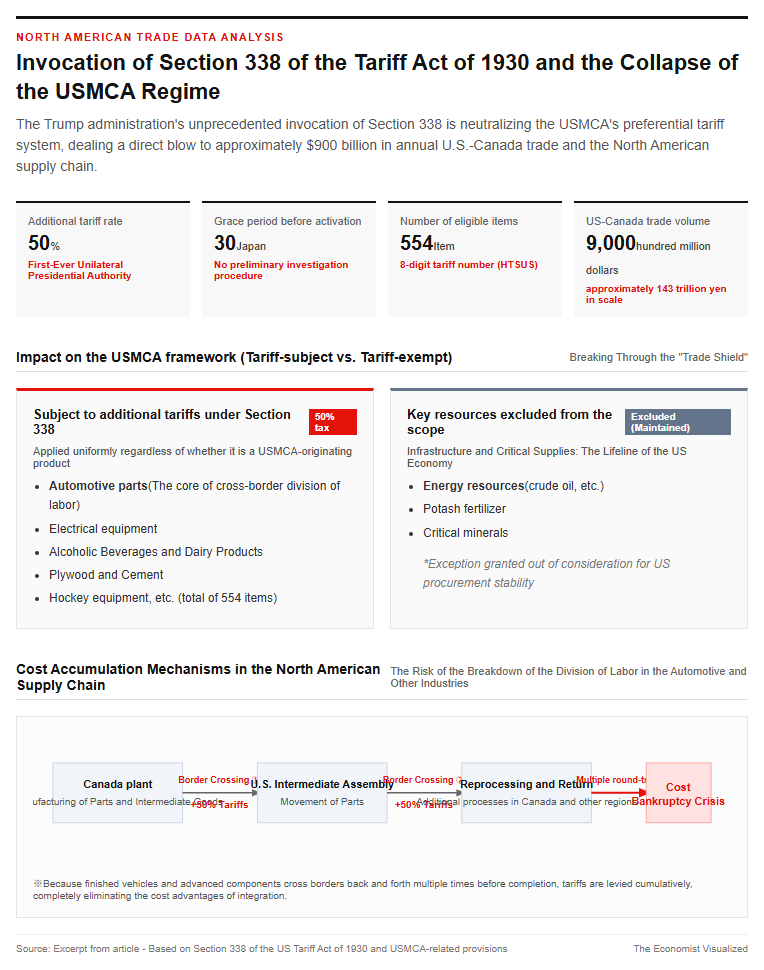
In this additional tariff measure, the legal basis applied by the Trump administration is Section 338 of the Tariff Act of 1930 (the so-called Smoot-Hawley Tariff Act). This law was enacted during the era of the Great Depression, and grants the President strong authority to impose additional tariffs of up to 50% on imports from a country at the President’s sole discretion, provided the President determines that U.S. commerce is suffering burdens or disadvantages due to discriminatory treatment or unequal taxation by other countries. The most distinctive feature of Section 338 is that, unlike general measures such as Section 301 of the Trade Act of 1974, it does not require detailed prior investigations or certification procedures by an independent administrative agency, and can be mandatorily invoked with a mere 30-day grace period following a presidential proclamation. This will be the very first time in U.S. trade history that Section 338 of the Tariff Act of 1930 has actually been applied and additional tariffs collected. The sudden invocation of this long-dormant, never-before-used provision has delivered a major shock to companies and investors around the world operating under the premise of a free trade system, and it is extremely likely to develop into legal battles regarding its validity.
The Scope of Canadian Products That Pierced the USMCA Shield
Another reason why this additional 50% tariff measure is considered extremely unusual is that it was enacted while ignoring the framework of the United States-Mexico-Canada Agreement (USMCA), which has long supported the integrated North American economic zone. Under conventional tariff measures (such as Section 301 of the Trade Act of 1974), products meeting the USMCA’s rules of origin were almost always excluded from the targets, and the USMCA has functioned as a kind of “trade shield.” However, the Section 338 measure is structured to be applied uniformly regardless of whether products originate within the USMCA, meaning that the superiority of the USMCA’s preferential tariff system has been completely neutralized. The specific scope of coverage includes a total of 554 8-digit Harmonized Tariff Schedule of the United States (HTSUS) codes, ranging from alcoholic beverages, dairy products, and auto parts to plywood, electrical equipment, hockey gear, and cement. Meanwhile, certain key natural resources that serve as a lifeline for the U.S. economy—such as energy resources (like crude oil), potash fertilizer, and critical minerals—have been excluded from the target list. The volume of goods and services trade between the U.S. and Canada reaches approximately $900 billion (about 143 trillion yen) annually, and the breaching of this shield is a serious development that threatens to shake the economies of both countries.
The Shock to the North American Supply Chain and Canada’s Survival Strategy
The risk of a collapse in cross-border division of labor systems, led by the automotive industry
North American manufacturing, particularly the automotive industry, has built an extremely highly integrated supply chain predicated on the constant crossing of borders by parts and intermediate goods among the United States, Canada, and Mexico. Because a single finished vehicle crosses the border multiple times before completion, the imposition of a massive 50% tariff at each border crossing would completely dismantle the conventional efficient “local production for local consumption model” and the cost advantages of integration. Japanese suppliers manufacturing parts in Canada and delivering them to finished vehicle plants in the U.S., as well as local Canadian manufacturers, face severe risks of surging manufacturing costs that threaten the very survival of their businesses. The figure below illustrates the structural trade barriers and cost-escalation mechanisms currently facing the North American supply chain.
Furthermore, this severe uncertainty is also freezing new investments within Canada. Canada had planned future electric vehicle (EV)-related manufacturing investments totaling approximately 46 billion Canadian dollars attracted since 2020, but concerns are growing that tariff-related investment plans will be delayed or cancelled one after another, raising fears of a medium- to long-term industrial decline.
Canada’s Proposed Countermeasures and the Path Forward for Market Diversification Away from the US
Faced with sudden tariff pressure and the severing of ties by the United States, Canadian Prime Minister Mark Carney is accelerating a sweeping transition to a “new industrial strategy” aimed at breaking away from an economic structure overly dependent on a single trading partner. Prime Minister Carney has stated clearly that he will not allow any nation to dictate Canada’s future, placing economic diversification as his top priority. In fact, Canada’s export value to non-U.S. markets increased by 11% in 2025, and efforts to strengthen economic partnerships with European and Asian countries are beginning to bear fruit. To date, Canada has selected a German company to build its submarines and expanded economic relations through visits to China, India, Saudi Arabia, and other nations. Furthermore, to strengthen its domestic market, Canada is promoting the elimination of interprovincial trade regulations that have long served as barriers under the Canadian Free Trade Agreement (CFTA), advancing efforts to revitalize the domestic market. In addition, the government has established a Major Projects Office and unveiled a C$115 billion infrastructure spending plan to expedite the approval of large-scale infrastructure, critical mineral, and oil pipeline developments, making haste to establish a resilient economy impervious to U.S. protectionism.
Reference page
- [White House: Proclamation on the Temporary Suspension of Additional Section 338 Duties on Canada (August 18, 2026)] https://www.whitehouse.gov/presidential-actions/2026/08/temporary-suspension-of-additional-duties-to-offset-canadian-discrimination-against-the-commerce-of-the-united-states-with-respect-to-alcoholic-beverages-dairy-and-motor-vehicles/
- [Office of the Prime Minister of Canada: Statement by Prime Minister Carney on Canada-U.S. Trade Negotiations (August 18, 2026)]https://www.pm.gc.ca/en/news/statements/2026/08/18/statement-prime-minister-carney-ongoing-canada-us-trade-negotiations
- [White House: Fact Sheet “President Donald J. Trump Imposes Additional Tariffs on Canada”] https://www.whitehouse.gov/fact-sheets/2026/07/fact-sheet-president-donald-j-trump-imposes-additional-tariffs-on-canada/
- US Government: Tariff Act of 1930, Section 338 (19 U.S.C. § 1338)
[#AdditionalTariffs #TrumpTariffs #Canada #RetaliatoryTariffs #USMCA #SupplyChain #EconomicNews #TradeWar]


コメント