On September 10, 2026, OpenAI launched “ChatGPT for Financial Services,” a specialized AI offering tailored for the financial sector. Powered by its flagship model “GPT-6 Astra” and direct integration with industry data, the platform is set to automate core analytics and deal-making workflows across Wall Street.
- Key Announcements: The Debut of ChatGPT for Financial Services
- The Flagship “GPT-6 Astra” and Technical Strengths of Native Data Integration
- The Rise of the “AI Associate”: Automating 100-Hour Workweeks for Junior Bankers
- Concerns Over “Cognitive Atrophy” and the Erosion of the Apprenticeship Model
- The Battle for Vertically Integrated Financial AI and Market Repercussions
- Legal Liability, Privacy Concerns, and the Future of Financial Practice
Key Announcements: The Debut of ChatGPT for Financial Services
On September 10, 2026, OpenAI officially announced “ChatGPT for Financial Services,” a specialized solution tailored specifically for financial institutions. Built upon the enterprise foundation of “ChatGPT Work,” the service is designed to automate core, labor-intensive workflows across investment banking and equity research. Shaped through design partnerships with major investment bank Morgan Stanley and independent advisory firm Evercore, the product directly addresses the daily challenges bankers face in data procurement and artifact creation.
Practical applications include screening potential M&A targets, building comparable company analyses, constructing financial models, and automatically generating pitchbooks aligned with firm-specific style guides. Tasks that once required junior analysts and associates to spend nights and weekends manually building discounted cash flow (DCF) models or formatting slides can now be executed seamlessly by AI. Below is a conceptual illustration of advanced financial analysis and report generation in action:
Nick Turley, Vice President of Product at OpenAI, likened the technology to a modern-day equivalent of the spreadsheet software that revolutionized Wall Street in the 1980s, highlighting its potential to dramatically boost banker productivity.
The Flagship “GPT-6 Astra” and Technical Strengths of Native Data Integration
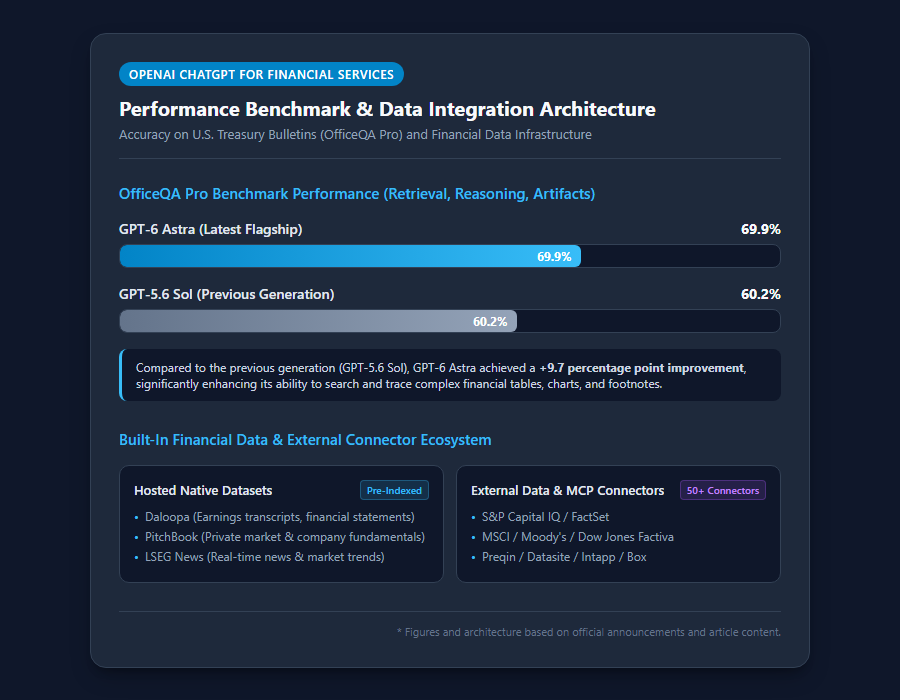
At the heart of the platform is OpenAI’s latest flagship model, “GPT-6 Astra.” The model delivers state-of-the-art performance across three core domains essential to financial services: information retrieval, financial reasoning, and high-quality artifact generation. On OpenAI’s “OfficeQA Pro” benchmark—which tests an AI agent’s ability to search and analyze complex tables, charts, and footnotes within U.S. Treasury Bulletins—GPT-6 Astra achieved an accuracy score of 69.9%, significantly outperforming the previous-generation “GPT-5.6 Sol” at 60.2%.
The platform’s primary technical advantage lies in its native integration with external financial data providers. Key datasets from Daloopa, PitchBook, and LSEG News are pre-indexed and hosted directly on OpenAI’s infrastructure. This allows bankers to instantly pull earnings transcripts, financial statements, and private market data without setting up separate connectors or negotiating individual vendor contracts. In addition to drastically reducing retrieval latency, this setup enables granular citation capabilities, allowing analysts to trace numbers and claims back to original filings and footnotes. Furthermore, the ecosystem supports seamless connectivity with over 50 external data sources, including S&P Capital IQ, MSCI, Dow Jones Factiva, Moody’s, FactSet, and Preqin.
Structural Shifts on Wall Street and “Project Mercury”
The Rise of the “AI Associate”: Automating 100-Hour Workweeks for Junior Bankers
Behind OpenAI’s push into financial automation is “Project Mercury,” an initiative previously developed under tight secrecy. Under this project, OpenAI contracted former investment bankers to train AI models directly on the intricacies of financial modeling and presentation building. The primary objective is to fully automate the routine, repetitive tasks that have long defined the entry-level banker experience.
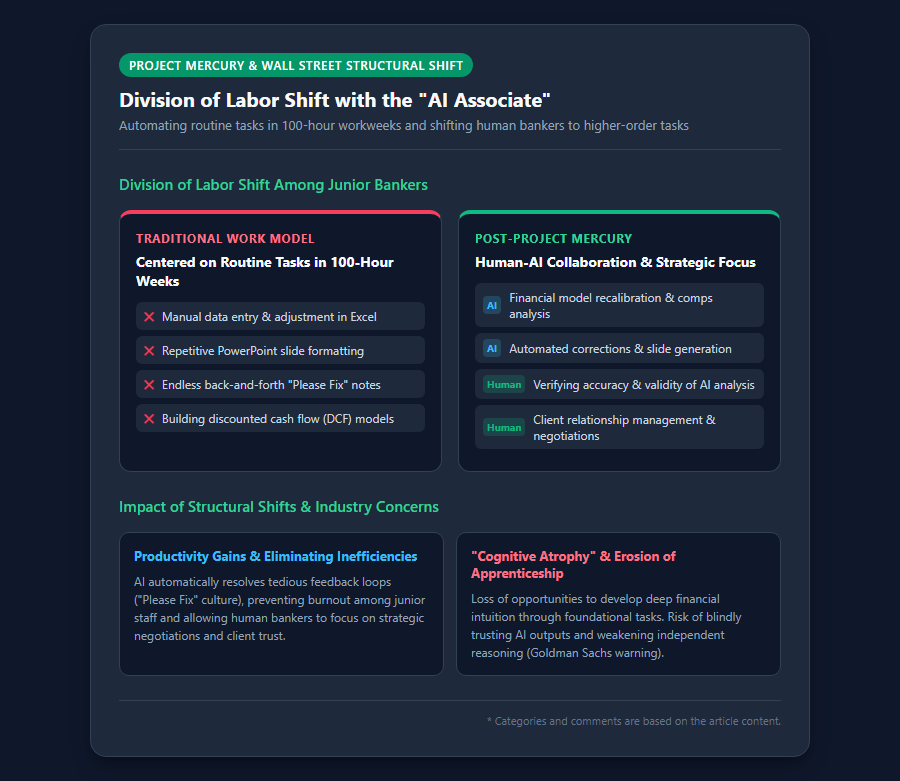
At investment banks, junior staff frequently endure grueling 100-hour workweeks, with the vast majority of time consumed by manual data entry in Excel and repetitive formatting in PowerPoint. The tedious culture of receiving endless granular revisions from senior managers is colloquially known as “Please Fix” culture. Autonomous agents developed under Project Mercury—effectively serving as “AI Associates”—can execute automated model adjustments and recalibrations based on managerial feedback, freeing human bankers to focus on strategic negotiation, deal structuring, and client relationship building. Below is an illustration of the future office environment where AI and human bankers collaborate:
By redefining the division of cognitive labor, the technology marks the beginning of a fundamental transformation in how financial services operate.
Concerns Over “Cognitive Atrophy” and the Erosion of the Apprenticeship Model
While efficiency gains are widely praised, industry veterans express deep concern over the long-term impact on Wall Street’s traditional talent development model. Historically, investment banking has relied on a rigorous apprenticeship system: junior bankers developed deep financial intuition and a sharp eye for corporate capital structures precisely through the painstaking process of manual data entry and model construction.
Chris Churchman, a partner overseeing major AI initiatives at Goldman Sachs, issued a stern warning regarding the risks of over-relying on AI for foundational tasks. He cautioned that delegating basic analytical processes could lead to “cognitive atrophy among the next generation of dealmakers,” diminishing their ability to reason independently and structure complex financial arguments. Because verifying the validity of AI-generated outputs requires deep domain expertise, there are fears that bypassing foundational tasks will erode essential judgment. Moreover, with multi-step research and presentation creation completed in minutes, banks may ultimately reduce junior hiring volumes altogether, forcing Wall Street to reconcile productivity gains against future leadership development.
Escalating AI Competition and the Outlook for Financial Institutions
The Battle for Vertically Integrated Financial AI and Market Repercussions
OpenAI’s expansion is part of a broader, fiercely competitive battle among major AI providers to dominate vertically integrated enterprise tools. Rival Anthropic previously launched “Claude for Financial Services,” deploying specialized agents connected to data sources like Moody’s and S&P Capital IQ. Meanwhile, Perplexity introduced specialized research tools for financial analysts, accelerating a multi-front war for financial infrastructure dominance.
For OpenAI, currently valued at \$840 billion (~¥132.5 trillion), capturing the financial enterprise market is a vital component of its revenue expansion strategy ahead of an anticipated initial public offering (IPO). The shift is already sending shockwaves across traditional financial data vendors, with FactSet seeing its stock drop following major AI tool announcements. Simultaneously, financial giants such as JPMorgan Chase and Goldman Sachs continue to advance their own proprietary AI initiatives, signaling an era where integrating cutting-edge AI models directly into IT infrastructure dictates competitive advantage.
Legal Liability, Privacy Concerns, and the Future of Financial Practice
Despite rapid adoption, significant legal, regulatory, and privacy hurdles remain. “ChatGPT for Financial Services” incorporates enterprise-grade governance features inherited from ChatGPT Enterprise, including role-based access controls, robust data encryption, and exportable audit logs for compliance workflows. OpenAI also guarantees that customer business data is not utilized to train its models by default.
However, consumer-facing offerings like “ChatGPT Finance” have faced scrutiny over privacy controversies, including class-action lawsuits concerning historical tracking scripts, which heightened user skepticism around financial data handling. More critically, AI tools do not operate as licensed investment advisors and hold no legal fiduciary duty toward users. If an AI model experiences “hallucinations” or outputs erroneous data that lead to flawed financial decisions, significant legal gray zones persist between vendor disclaimers and actual liability. Moving forward, the industry is expected to settle into a hybrid operational model—one where AI handles rapid data processing while licensed human professionals retain ultimate oversight and fiduciary accountability.
References
- [OpenAI Introducing ChatGPT for Financial Services] https://openai.com/index/introducing-chatgpt-financial-services/
[#OpenAI #ChatGPT #FinancialAI #InvestmentBanking #GPT6Astra #ProjectMercury]
コメント