SpaceX announced that from December 2025 to May 2026, it intentionally re-entered the atmosphere and incinerated a total of 260 Starlink satellites. This large-scale cycle, which can be called “space depreciation,” highlights the reality that the company’s infrastructure business is shifting from the construction phase to the maintenance phase, along with the new management and environmental risks that come with it.
- 260 units retired in six months as a ‘revolution in orbit’
- Controlled incineration and hardware reliability
- Short lifespan of just five years and increased infrastructure maintenance costs
- Operational Load and Risks of Shortened Lifespan for Second-Generation (V2) Satellites
- Market valuation and challenges ahead of a .7 trillion IPO
- Incineration leaves behind ‘invisible’ pollutants
- Regulatory delays and concerns over ‘space land grabbing’
- The entry of Amazon’s “Kuiper” and intensifying competition
- Business model diversification and sustainability of profitability
260 units retired in six months as a ‘revolution in orbit’
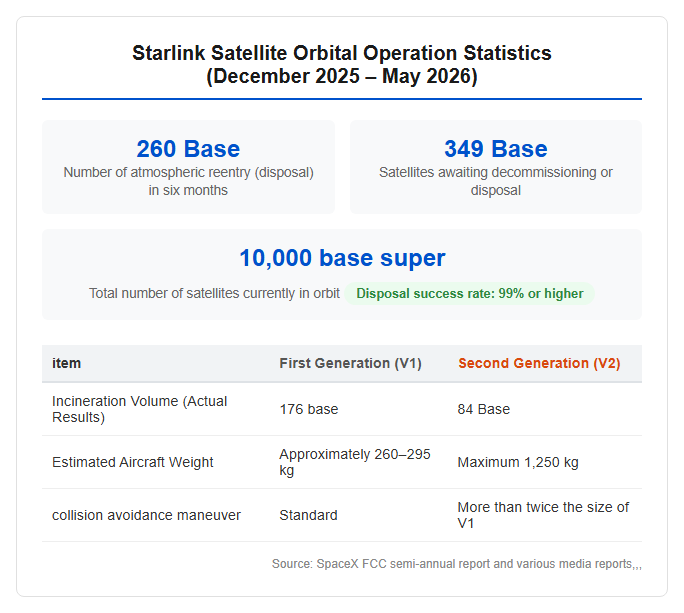
According to SpaceX’s semi-annual report submitted to the U.S. Federal Communications Commission (FCC), a total of 260 Starlink satellites deliberately deorbited and burned up in Earth’s atmosphere during the half-year period from December 2025 to May 2026,,。 This is an increase from 218 units in the previous six months (June to November 2025), indicating that the pace of retirement is accelerating alongside network expansion,,。 Of the 260 units this time, 176 were first-generation (V1) and 84 were the higher-performance second-generation (V2),,。 Additionally, an additional 349 units were withdrawn from service during this period, and these are expected to be disposed of within a few months,,。 Currently, with over 10,000 satellites in low Earth orbit, these regular retirements and re-entry have become an inevitable routine. Astronomer Jonathan McDowell points out that although the retirement of early older aircraft has largely been completed, the reentry rate remains high,,。
Controlled incineration and hardware reliability
The disposing of the Starlink satellite is carried out by a controlled maneuver using the onboard propulsion system. The satellite descends to a dense layer of the atmosphere, where extreme frictional heat completely incinerates 100% of the spacecraft,,。 SpaceX reports that the risk of debris falling to the ground due to this process is zero,,。 According to the company’s report, the reliability of this disposition exceeds 99%, significantly exceeding the FCC’s minimum standard of 95%. First-generation aircraft weigh about 260–295 kg, while second-generation aircraft can weigh up to 1,250 kg, but recovering these is technically difficult and cost-effective, making atmospheric incineration the only realistic option. The diagram below captures SpaceX satellites deployed in orbit.
The Business Impact of ‘Space Depreciation’
Short lifespan of just five years and increased infrastructure maintenance costs
The most distinctive and concerning aspect of Starlink’s business model is the speed of “space depreciation.” While ground-based fiber optic infrastructure can be used for decades, Starlink satellites are designed for a lifespan of about five years,,,。 When fuel runs out or the system ages, satellites must be replaced immediately. As of June 2026, of the more than 10,400 satellites in orbit, about 2,000 will reach the end of their service life each year, and simply maintaining the network will continue to incur enormous costs for reproduction and relaunches. In fact, in 2025, SpaceX’s connectivity division will have recorded approximately $4.2 billion in capital expenditure (CAPEX), but the majority will be spent on maintaining and upgrading existing infrastructure rather than expanding the network. This means Starlink has completed its early startup phase and transformed into a mature but highly capital-intensive infrastructure business.
Operational Load and Risks of Shortened Lifespan for Second-Generation (V2) Satellites
Data shows that the latest second-generation (V2) satellites boast more powerful communication capabilities, but their operational complexity is increasing. According to the FCC report, V2 satellites performed 142,015 collision avoidance maneuvers in six months, more than twice the frequency of the first generation. This sharp increase in maneuver frequency is presumed to be due to overcrowding in orbit and the complex networking of V2 in lower orbits. However, frequent orbital corrections can lead to early depletion of propellant, which in turn significantly shortens the satellite’s useful lifespan. The fact that commercial value from performance improvements is being offset by higher operational costs and shorter exchange cycles is becoming a new risk factor for investors.
Market valuation and challenges ahead of a .7 trillion IPO
SpaceX is eyeing an initial public offering (IPO) with a market capitalization exceeding $1.7 trillion, but market opinions are divided. Starlink’s 2025 sales are expected to reach $11.39 billion, a 50% year-over-year increase, making it a major source of revenue and accounting for over 60% of SpaceX’s total revenue. However, the average cost per user (ARPU) has been declining from about $99 in 2023 to $66 by the end of March 2026. This is because the axis of growth is shifting toward low-income regions. Michael Field, strategist at Morningstar, points out that Starlink’s price-to-sales ratio (PSR) has reached about 107 times, which is “too high” compared to Nvidia’s roughly 21 times. Going forward, investors will be forced to reassess not only the “growth story” of user growth, but also the real “capital efficiency” of satellite replacement costs.
Environmental Impact on the Upper Atmosphere and Regulatory Gaps
Incineration leaves behind ‘invisible’ pollutants
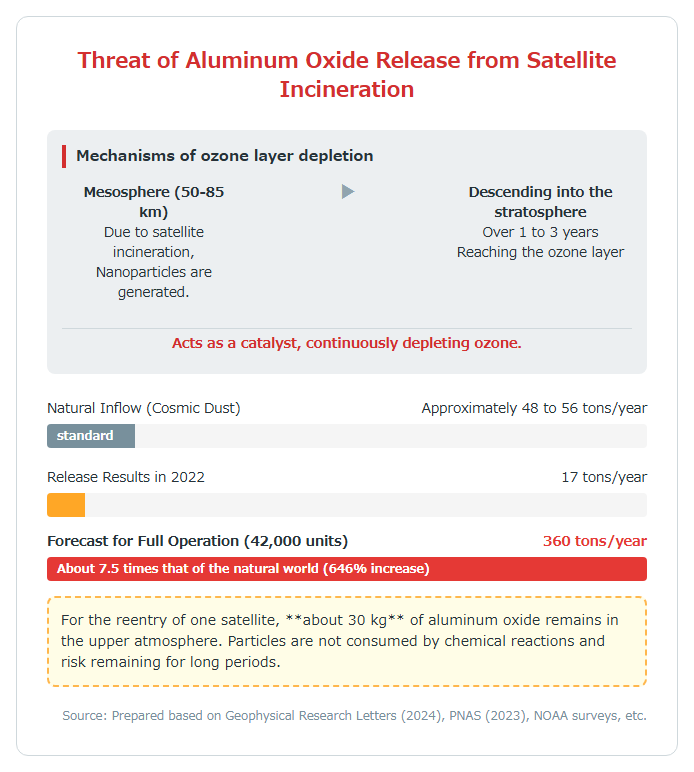
SpaceX claims that the complete incineration of satellites by re-entering the atmosphere is a clean method, but new concerns are growing among scientists,,。 When a satellite burns out, the metals in the spacecraft, such as aluminum, are transformed into fine ‘aluminum oxide’ nanoparticles and released into the upper atmosphere,,。 According to research, about 30 kg of aluminum oxide accumulates in the mesosphere (altitude 50–85 km) for every satellite re-entry. These substances descend into the stratosphere over several to decades and may act as catalysts for chemical reactions that destroy the ozone layer,,。 If 42,000 satellite constellations operate at full capacity in the future, it is predicted that over 360 tons of aluminum oxide will be released annually, a staggering figure exceeding the natural inflow of cosmic dust by 646%. The following image shows the traces left in the atmosphere during rocket launch.
Regulatory delays and concerns over ‘space land grabbing’
Legal regulatory frameworks have not kept pace with these environmental risks,,。 Historically, the U.S. Federal Communications Commission (FCC) has excluded satellites from detailed environmental reviews under the National Environmental Policy Act (NEPA), considering that activities in space constitute “extraterritorial activities beyond U.S. jurisdiction,,。 Currently, a new proposal to exclude space-based operations from NEPA is under consideration, and if adopted, operators like SpaceX would continue to avoid detailed reporting obligations on impacts on the upper atmosphere. Experts describe this situation as “land grabs by orbits and frequencies,” sounding the alarm against companies trying to create fait accomplies before international rules are established. The insurance industry is also increasingly concerned that the risk of a collision chain (Kessler syndrome) caused by congestion on track cannot be accurately priced with existing models,,。
Future Outlook and Key Points to Watch
The entry of Amazon’s “Kuiper” and intensifying competition
In the satellite internet market, where Starlink has dominated, a powerful rival is emerging,,。 Amazon’s Project Kuiper has launched over 390 satellites as of July 2026 and aims to build more than 3,200 constellations in the end. Amazon has already booked nearly 100 rocket launches, including, ironically, SpaceX’s Falcon 9. While Starlink’s dominance remains unwavering, Amazon’s entry not only triggers price competition but also accelerates competition for limited orbital resources and frequency bands, potentially leading to further increases in collision avoidance maneuvers and shorter satellite lifespans,,。
Business model diversification and sustainability of profitability
SpaceX is strengthening its entry into the less price-elastic military and government markets to offset the decline in ARPU for consumer broadband. The secure military network Starshield has already secured $537 million in defense contracts through 2027. Additionally, the “Direct-to-Cell” service, which communicates directly with regular smartphones, is being developed in partnership with carriers such as T-Mobile. These B2B and B2G (government-to-government) businesses are expected to become sources of high profitability and stable maintenance costs. Going forward, whether Starlink can maintain high profitability while outperforming competitors while bearing the destiny of “disposable infrastructure,” and how it fulfills its social responsibility for environmental impact, will be key to justifying its $1.7 trillion corporate valuation,,。
[#SpaceX #Starlink #宇宙ビジネス #人工衛星 #環境問題 #IPO #インフラ]

コメント