US Treasury Secretary Scott Bessent has issued an extraordinary warning demanding that Japan pivot away from its reflationary stance of aggressive fiscal spending and monetary easing. Driven by concerns over domestic inflation and bilateral trade imbalances, Washington’s pressure extends far beyond temporary yen stabilization via coordinated interventions, directly pushing for fundamental policy reforms and interest rate hikes by the Bank of Japan.
- Treasury Secretary Bessent’s Direct Criticism of Japan’s Macroeconomic Strategy
- Underlying Frustrations Over the Bilateral Trade Deficit Under the Second Trump Administration
- Coordinated Yen-Buying Interventions as a Temporary Quick Fix Rather Than a Permanent Solution
- Questions Over the Bank of Japan’s Independence and Growing Expectations for a September Rate Hike
- Rising Warnings Over the Takaichi Administration’s Fiscal Expansion and Yield Spikes
- Spending Containment and Fiscal Consolidation Pressures on the Fiscal Year 2027 Budget
- Navigating the Transition to a Positive Interest Rate Regime and the September BOJ Meeting
Treasury Secretary Bessent’s Direct Criticism of Japan’s Macroeconomic Strategy
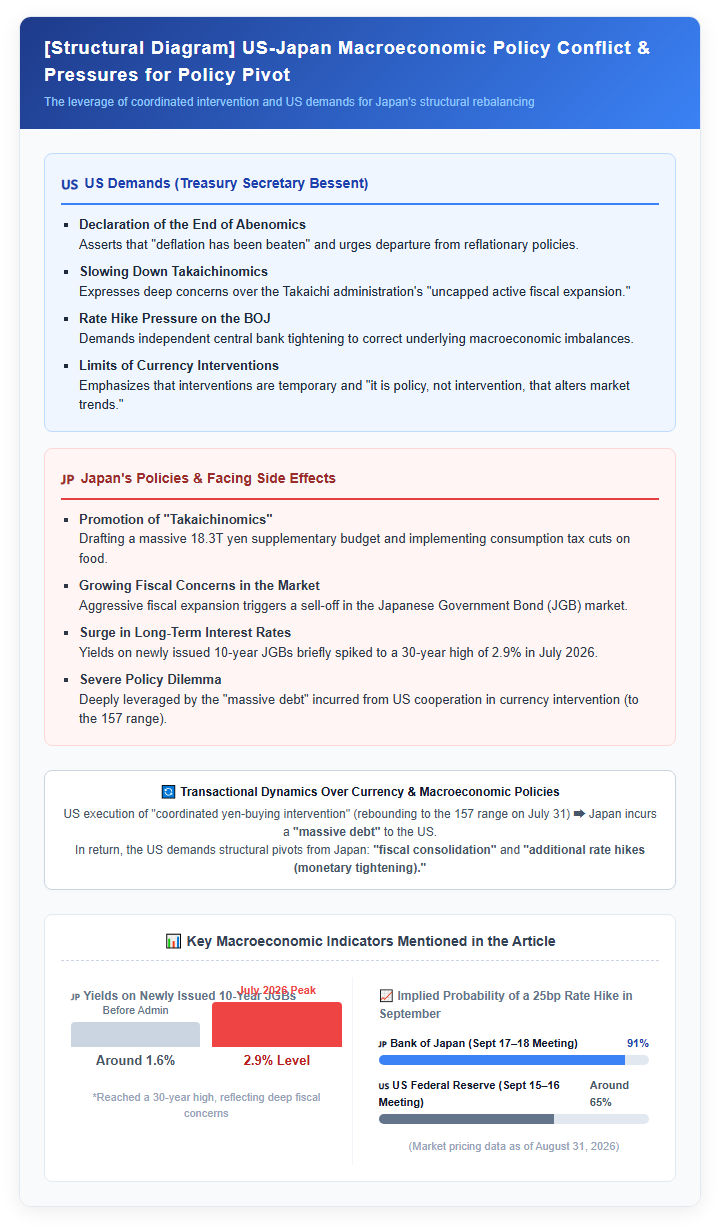
In interviews on August 30 and 31, 2026, followed by a press conference on September 1 after the G20 Finance Ministers and Central Bank Governors Meeting, US Treasury Secretary Scott Bessent openly criticized Japan’s economic policy. While acknowledging that Abenomics—the economic framework pioneered by the late Prime Minister Shinzo Abe in 2013 featuring massive monetary easing and fiscal stimulus—had played a role in lifting Japan out of deflation, Bessent declared that its historical mission was fully accomplished. He urged a halt to the massive fiscal expansion spearheaded by the administration of Prime Minister Sanae Takaichi under her signature Takaichinomics policy of responsible active fiscal spending. For a high-ranking US official to publicly and specifically target the signature economic strategy of a close ally like Japan is an exceptionally rare occurrence. Refer to the structural diagram below.
Within the Japanese government, this public intervention is being viewed with deep concern, signaling a sharp escalation in Washington’s demands for a fundamental economic pivot.
Underlying Frustrations Over the Bilateral Trade Deficit Under the Second Trump Administration
The aggressive posture adopted by Treasury Secretary Scott Bessent is deeply rooted in the second Trump administration’s unwavering focus on reducing trade deficits. Washington views the prolonged depreciation of the yen as a major threat that undermines the competitiveness of American export industries. Consequently, the US has stepped up its vigilance against what it perceives as currency devaluation. This stance was formalized in June 2026 when the US Treasury Department designated Japan on its monitoring list for currency practices, citing violations of criteria regarding its bilateral trade surplus and current account surplus. The pressure intensified further on July 23, 2026, with the publication of the Foreign Exchange Policy Report, which directly targeted the yen’s movements, stating that excessive volatility is undesirable. This direct verbal intervention indicates that the US intends to use Japan’s structural macroeconomic policies as leverage in broader bilateral trade negotiations.
The Limits of Coordinated Intervention and Washington’s Demand for Structural Rebalancing
Coordinated Yen-Buying Interventions as a Temporary Quick Fix Rather Than a Permanent Solution
Following the joint statement issued by the US and Japanese finance ministers in September 2025, the two nations conducted an unprecedented coordinated yen-buying intervention on July 31, 2026. This joint market operation temporarily pushed the dollar-yen exchange rate back to the 157 yen level, putting a sharp brake on the disorderly depreciation of the Japanese currency. However, in a television interview on August 4, 2026, Treasury Secretary Scott Bessent emphasized that while interventions send strong signals to the market, only fundamental macroeconomic policy adjustments can alter long-term exchange rate trends. His message was clear: as long as Tokyo continues its aggressive fiscal expansion and ultra-loose monetary policy, market interventions cannot reverse the yen’s downward trajectory. By assisting in the currency intervention, Washington has effectively created a massive leverage point over Tokyo, using it as a debt to demand sweeping structural changes in Japan’s fiscal and monetary policy.
Questions Over the Bank of Japan’s Independence and Growing Expectations for a September Rate Hike
Treasury Secretary Scott Bessent has also directed highly direct inquiries toward Japan’s monetary policy. During an informal dinner in Tokyo in May 2026 with Japanese Finance Minister Satsuki Katayama, Bessent pressed for answers on why the Bank of Japan lacks genuine independence, urging the central bank to pursue aggressive interest rate hikes. He reiterated this stance during an August 31, 2026, interview, expressing confidence that both the Japanese government and the central bank would take appropriate measures to strengthen the yen. This has effectively backed BOJ Governor Kazuo Ueda into a corner while simultaneously providing external justification for a rate hike. Previously, the BOJ found itself politically paralyzed, struggling to raise rates due to domestic inflation risks while facing immense pressure from the Takaichi administration to maintain fiscal expansion. With direct, powerful pressure now coming from the US Treasury, Governor Ueda may find the political cover necessary to execute a rate hike at the upcoming monetary policy meeting scheduled for September 17 and 18, 2026.
Rising Warnings Over the Takaichi Administration’s Fiscal Expansion and Yield Spikes
Since taking office in October 2025, Prime Minister Sanae Takaichi has aggressively rolled out a series of fiscal packages and tax cuts. Last winter, her cabinet approved a supplementary budget with expenditures totaling 18.3 trillion yen, the largest fiscal expansion since the COVID-19 pandemic. This expansionary stance was further cemented on July 30, 2026, when she formally announced plans to implement consumption tax cuts on food products. This unconstrained spending has triggered severe anxiety in the Japanese government bond market. Yields on newly issued 10-year JGBs, which hovered around 1.6% prior to the inauguration of the Takaichi administration, surged to a 30-year high of 2.9% in July 2026. Refer to the JGB yield trend chart below.
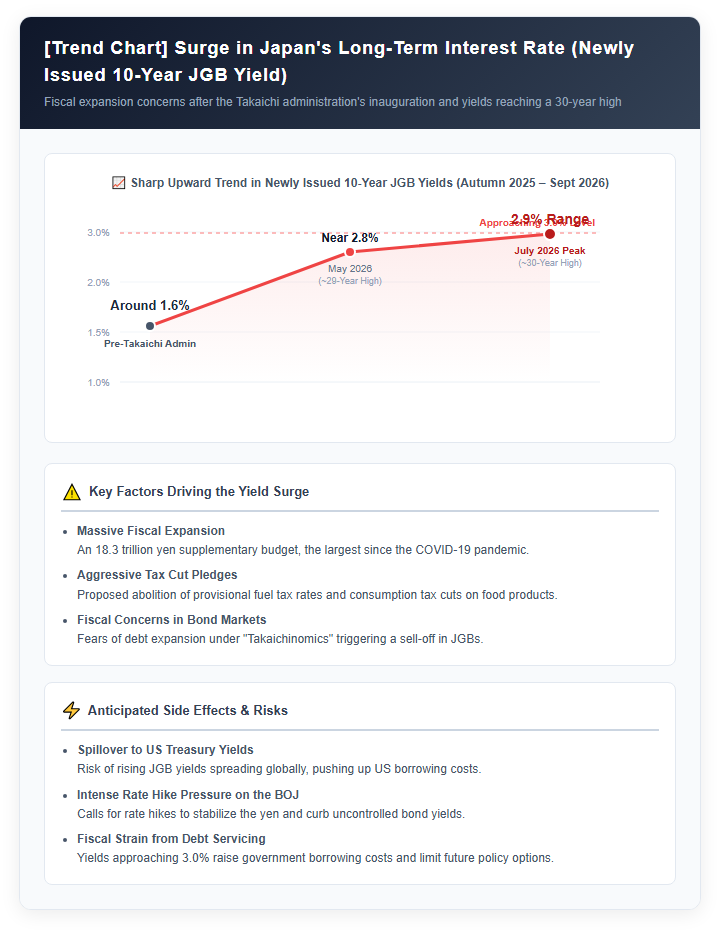
Washington is deeply concerned that this sudden spike in Japanese yields could trigger a broader global sell-off, pushing up US Treasury yields and increasing borrowing costs within the United States. Bessent’s warnings are a defensive measure to insulate US credit markets from Japan’s fiscal instability.
Macroeconomic Crossroad and Future Policy Outlook for the Japanese Economy
Spending Containment and Fiscal Consolidation Pressures on the Fiscal Year 2027 Budget
The fiscal restraint demanded by Washington is directly impacting Tokyo’s drafting of the fiscal year 2027 national budget. In its Basic Policy on Economic and Fiscal Management and Reform approved in July, the Takaichi administration envisioned mobilizing over 370 trillion yen in combined public and private investment by fiscal year 2040, focusing heavily on crisis management and strategic growth sectors. However, in the wake of Bessent’s sharp critique, compiling an overly expansionary budget that further degrades Japan’s debt-to-GDP ratio has become politically unfeasible. Finance Minister Satsuki Katayama sought to manage expectations during a press conference on August 25, 2026, stating that any new fiscal outlays must strictly serve to catalyze private investment and guarantee sustainable economic growth. Japan now faces the daunting task of preserving its macroeconomic autonomy while adjusting to the fiscal consolidation demands imposed by its primary western ally.
Navigating the Transition to a Positive Interest Rate Regime and the September BOJ Meeting
The immediate focal point for bilateral economic relations is the upcoming Bank of Japan monetary policy meeting scheduled for September 17 and 18, 2026. As of August 31, 2026, interest rate swap markets are pricing in a 91% probability that the BOJ will implement a 25 basis point policy rate hike to narrow the yield differential with the United States. With Washington’s support for monetary tightening now public, the BOJ is set to accelerate its transition toward a normalized interest rate environment. However, rapid rate hikes risk harming domestic small businesses and heavily indebted households, potentially chilling domestic consumption. The Japanese government must somehow balance these domestic economic vulnerabilities with the urgent external demand to halt yen depreciation. The bilateral discussions between Governor Ueda and Treasury Secretary Bessent at the G20 meeting in late August will likely set the definitive course for Japan’s monetary policy in the autumn of 2026.
References
- 【The Japan Research Institute, Limited】https://www.jri.co.jp
- 【Institute for International Monetary Affairs】https://www.iima.or.jp
【#EconomicPolicy #USJapanRelations #MonetaryPolicy #CurrencyIntervention #FiscalReconstruction #YieldSpike #G20】

コメント