Masayoshi Son, Chairman and President of SoftBank Group, has expressed strong enthusiasm for investing in Tokyo Electric Power Company Holdings. Behind this is a massive vertical integration initiative that brings in the essential power infrastructure for driving next-generation artificial intelligence (AI) strategies within its own group.
- Surprise announcement at the shareholders’ meeting and purpose of the investment
- Current status of capital alliance negotiations among the five camps
- Power shortages as bottlenecks in AI data centers
- Transformation into an infrastructure company and vertical integration strategy
- Compensation Burden and the Issue of Decommissioning Fukushima Daiichi Nuclear Power Plant
- Economic Security and Regulatory Barriers under the Foreign Exchange Act
- The possibility that power companies could transform into “AI stocks”
- Final decision on partners and impact on the Japanese economy
Surprise announcement at the shareholders’ meeting and purpose of the investment
Masayoshi Son, Chairman and President of SoftBank Group (SBG), officially announced for the first time his intention to invest in Tokyo Electric Power Holdings (TEPCO HD) at the annual shareholders’ meeting held in Tokyo on June 24, 2026. Mr. Son revealed to shareholders a concrete blueprint for increasing power generation and establishing large-scale AI data centers in Japan if TEPCO HD joins the SoftBank group.
Currently, TEPCO HD is advancing a fundamental management restructuring plan, including capital acquisition from external companies, to cover decommissioning costs and compensation from the Fukushima Daiichi Nuclear Power Plant accident. During this partnership process, Mr. Son was involved with SoftBank (9434), a major mobile phone subsidiary under its umbrella. T) is in the final selection as a candidate for the “next owner,” suggesting that negotiations are in the final stages. Mr. Son also expressed strong concern about the current state of AI development in Japan, noting strict regulations and insufficient power supply, and plans to resolve this structural issue through a partnership with TEPCO HD.
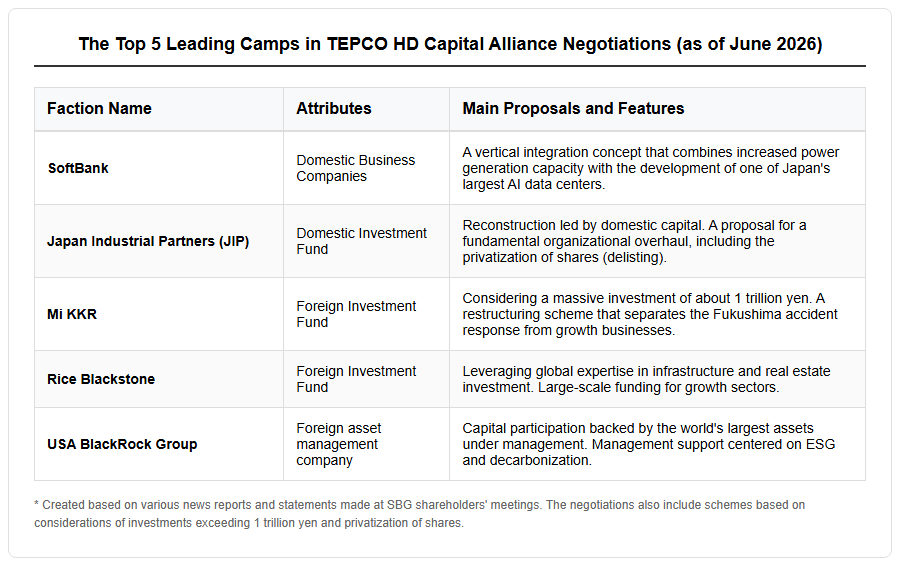
Please refer to the diagram below.
Current status of capital alliance negotiations among the five camps
The competition over TEPCO HD’s partner has become a fierce competition, with not only SoftBank but also major domestic and international investors stepping forward. According to reports as of June 2026, the following five camps are intensifying negotiations as leading candidates.
-
SoftBank (operating company)
-
Domestic investment funds such as Japan Industrial Partners (JIP)
-
US investment fund KKR (Kohlberg Kravis Roberts)
-
Blackstone, a U.S. investment company
-
BlackRock, a major U.S. asset management firm
Proposals from these camps are said to include considerations of massive investments exceeding 1 trillion yen and schemes based on the premise of making shares private. TEPCO HD will close applications at the end of March 2026, and the Alliance Review Committee, composed of outside directors, is carefully reviewing each company’s proposals. TEPCO is not only narrowing its partners to a single company, but is also considering partnerships with multiple companies, such as combining investment funds and energy companies.
SoftBank’s strategic background in seeking electricity
Power shortages as bottlenecks in AI data centers
Behind Mr. Masayoshi Son’s eagerness to invest in TEPCO HD is his conviction that electricity will become the greatest competitive resource in the AI era. Data centers used to operate generative AI and advanced robotics consume enormous amounts of electricity. No matter how high-performance GPUs (image processing units) you build or how massive your facility is, without the power to operate it stably, your AI strategy cannot succeed.
Until now, AI-related investments have mainly focused on semiconductors and optical communications, but as AI becomes more widespread throughout society, electricity—a physical limit—has emerged as a bottleneck. Mr. Son emphasizes that for Japan to not fall behind the world in AI development, it is urgent to establish both data centers and power supply. TEPCO HD maintains the transmission network and generation capacity supporting the Tokyo metropolitan area, Japan’s largest electricity demand area, making it an indispensable strategic partner for SoftBank as it seeks to deploy AI infrastructure domestically.
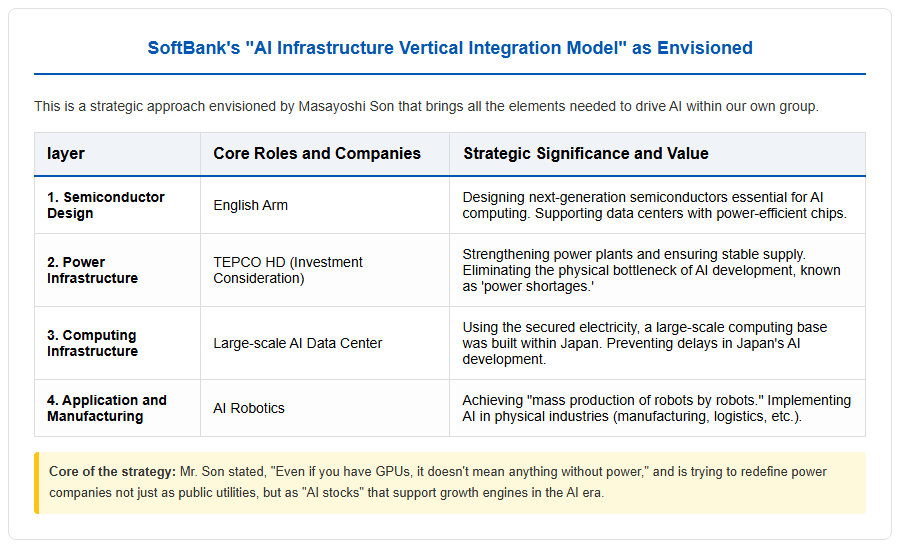
Please refer to the diagram below.
Transformation into an infrastructure company and vertical integration strategy
SoftBank Group is accelerating its transformation from a former telecommunications company to a next-generation infrastructure company centered on AI and semiconductors. This investment plan in TEPCO HD is positioned as a key piece in completing that strategy. The overall vision of the platform envisioned by Mr. Sun is a vertically integrated model that brings together the following elements within the company’s own group.
-
Semiconductor Design: Providing AI chips by its subsidiary Arm
-
Power infrastructure: Expansion of power plants and stable securing of electricity through TEPCO HD
-
Data Center Operation: Building Large-Scale Domestic Bases Using Secured Electricity
-
Robot manufacturing: mass production of robots equipped with AI
The 1.75 trillion yen acquisition of Vodafone’s Japanese subsidiary by Son in 2006 was called a “once-in-a-lifetime gamble” for SoftBank at the time. This involvement with TEPCO HD is a gamble of equal or even greater scale and risk, demonstrating Mr. Son’s strong determination to shift his main battlefield from communications to AI and power.
Challenges in Rebuilding TEPCO HD and Hurdles to Partnership
Compensation Burden and the Issue of Decommissioning Fukushima Daiichi Nuclear Power Plant
Partnering with TEPCO Holdings involves extremely complex and long-term risks. The biggest concern is how partners will assess and share the unprecedented heavy responsibility of compensation costs and decommissioning work related to the Fukushima Daiichi Nuclear Power Plant accident. The cost burden related to Fukushima is enormous and has been weighing on TEPCO HD’s financial base for many years.
TEPCO HD is currently considering an organizational restructuring plan to spin off growth businesses excluding the nuclear division and introduce external capital to rebuild them. However, while it bears the strong public burden of accident response, it also faces the contradictory challenge of how to ensure profitability as a private company. While there are voices in the market hoping that TEPCO HD may shift its evaluation focus from being a mere power company to an “AI infrastructure stock,” uncertainty surrounding the restart of the Kashiwazaki-Kariwa nuclear power plant, government involvement, and prolonged dividend defaults remain a burden for its investment potential.
Economic Security and Regulatory Barriers under the Foreign Exchange Act
Since the power industry is a critical infrastructure directly linked to national security, there are high political and legal hurdles for establishing capital alliances. In particular, under the Foreign Exchange and Foreign Trade Law (Foreign Exchange Law), when overseas investment funds acquire shares in important companies such as power companies, the government is required to conduct prior review.
Among the five leading candidate camps are foreign firms such as Blackstone and BlackRock in the United States, and if these companies become partners, close coordination with the government is required. On the other hand, even domestic companies like SoftBank are required to face political backlash against a single company holding control over highly public power infrastructure, as well as to public opinion concerned about the impact on public utility rates. TEPCO has also considered granting the government ‘golden shares’ with veto rights, making the selection focus on how to balance management autonomy with public oversight.
Future Developments and Key Points to Watch
The possibility that power companies could transform into “AI stocks”
The biggest focus going forward will be how the market will redefine power companies. Until now, TEPCO was often avoided as a quiet public equity stock carrying the negative legacy of the earthquake or as a high-risk policy stock. However, following Son’s remarks, momentum is growing for power companies to be re-evaluated as “essential infrastructure companies supporting growth engines in the AI era.”
If a partnership with SoftBank materializes and a business model integrating power and AI data centers is demonstrated, the valuation (investment scale) of the entire power industry could change dramatically. The deeper the competition in AI computing power, the higher the value of land, cooling facilities, and above all, power companies with powerful transmission networks and power sources will increase relatively. Investors’ attention is no longer just on the issue of restarting nuclear power plants, but is increasingly focused on upgrading the power grid to meet AI demand and the possibility of collaboration with data center operators.
Final decision on partners and impact on the Japanese economy
The selection of partners for TEPCO HD is expected to reach its climax in the latter half of 2026. Whether SoftBank is chosen as the “next owner” or a coalition with foreign funds and other energy companies wins will greatly influence Japan’s energy policy and the future of the AI industry.
-
Partner selection: Narrowing expected within a few months
-
Investment Form: Fundamental restructuring with privatization, or partial capital participation?
-
Data Center Concept: After the partnership is established, will domestic power plant expansion actually progress?
-
Regulatory Trends: Progress in Foreign Exchange Law and Power System Reform
Behind Mr. Son’s clear intention to “remain on the front lines of management for 10 to 15 years” is a strong determination to complete this massive power and AI initiative with his own hands. By controlling TEPCO HD, the “key point of Japan’s electricity,” SoftBank can secure the lead in the AI revolution to reclaim the lost 30 years. Every move is closely watched.
[#ソフトバンク #東京電力 #孫正義 #AIデータセンター #電力不足 #資本提携 #経営再建 #経済安全保障]
コメント