
Strategy (formerly MicroStrategy), a leading Bitcoin treasury, has carried out the largest Bitcoin sale in its history. This includes a shift in financial strategy to ensure dividend payments for issued preferred shares and the introduction of a new digital credit capital framework.
- Sale of 3,588 BTC and 6 million in fundraising
- Launch of the new “Digital Credit Capital Framework”
- Dividend payment obligations and a sharp decline in US dollar reserves
- Securing a safety net for 17 months, exceeding the target of 12 months
- Market Reactions and Downward Pressure on Bitcoin Prices
- The future of hybrid strategies that combine “accumulation” and “selling” in parallel
Sale of 3,588 BTC and 6 million in fundraising
On July 6, 2026, Strategy disclosed in filings with the U.S. Securities and Exchange Commission (SEC) that it sold a total of 3,588 BTC for approximately $216 million (approximately 35 billion yen) during the period from June 29 to July 5, 2026. This sale represents the largest disposal in both the amount and volume of the company’s Bitcoin holdings history. The specific selling process is divided into two phases: 1,363 BTC were sold on the market from June 29 to 30, and another 2,225 BTC from July 1 to 5. It has been disclosed that the funds raised from this sale will be directly allocated to dividend payments on multiple preferred shares (digital credit securities) issued by the company. Until now, the company had shown a strong determination not to sell Bitcoin, but after a small-scale trial sale of 32 BTC conducted in late May 2026, it has now moved on to a full-scale sale.
Launch of the new “Digital Credit Capital Framework”
This sale is based on the financial policy of the “Digital Credit Capital Framework,” newly approved by the Board of Directors on June 29, 2026. This new policy symbolizes the company’s shift from simply “buying and holding Bitcoin perpetually (HODL)” to an active phase of dynamically managing its capital structure. The board has approved the “BTC Monetization Program,” which allows up to $1.25 billion worth of Bitcoin to increase US dollar reserves, and this sale of 3,588 BTC marks the first exercise of this program. This shift was also accompanied by organizational changes such as the change of Chief Accounting Officer, adopting advanced financial methods that prioritized managing corporate liquidity and dividend obligations while maximizing Bitcoin exposure.
Financial Soundness and Building a ’17-Month Buffer’
Dividend payment obligations and a sharp decline in US dollar reserves
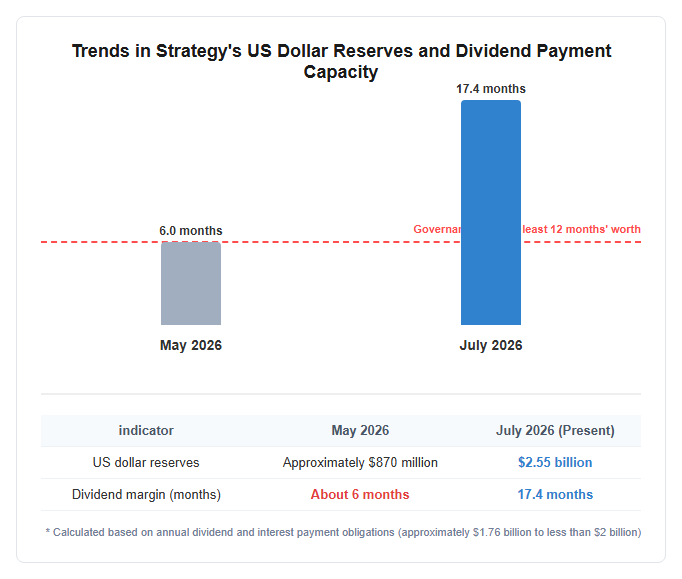
The main reason Strategy decided to sell Bitcoin was the massive cash dividend obligation on preferred stock. The company’s digital credit securities, such as “STRC” and “STRF,” promise investors dividend payments totaling approximately $1.76 billion to less than $2 billion annually. However, the cash flow from the company’s core software business alone was difficult to cover these payments, and the structure required external funding and converting Bitcoin into cash. As of May 2026, US dollar reserves have dropped to about $870 million, and dividend capacity has shrunk to just six months’ worth, raising concerns in the market about its solvency. This uncertainty led to a decline in the company’s securities prices (depeg), requiring quick cash securing to avoid financial deadlocks. Please refer to the diagram below.
Securing a safety net for 17 months, exceeding the target of 12 months
With this sale, Strategy’s US dollar reserves have recovered significantly to $2.55 billion as of July 5, 2026. Based on the current expected annual dividends and interest payments, this corresponds to a scale that covers approximately 17.4 months’ worth of payments. The board has set a strict governance policy to maintain a “minimum 12 months’ worth of reserves” at all times, and this sale functions as a financial optimization code to protect financial stability against Bitcoin’s extreme price volatility. According to analyses by Grayscale and others, investor confidence is restoring due to this reserve restructuring, and the prices of preferred shares issued by the company are also rebounding. As a giant entity holding about 4% of Bitcoin’s total supply, it can be said that a cold-blooded mathematical defense was implemented to prevent the risk of system collapse (default) before it occurred.
Market Impact and Future Strategic Outlook
Market Reactions and Downward Pressure on Bitcoin Prices
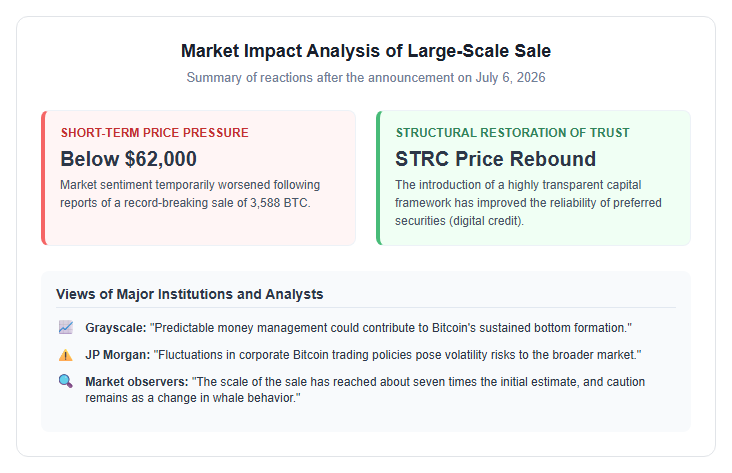
When news of Strategy’s large-scale sell-off spread, selling pressure surged in the Bitcoin market, causing the price to plunge below $62,000. The scale of the sell-off, which far exceeded market observers’ expectations, led to a short-term deterioration in sentiment. However, on the other hand, the company’s practice of “predictable fund management” based on a clear framework rather than “ad hoc selling” is expected to contribute to Bitcoin’s bottoming in the long term. Grayscale’s report assesses that actions aligned with this framework will lead to a recovery of market confidence. Meanwhile, major financial institutions like JP Morgan have warned that such firms’ Bitcoin trading policies could pose risks to the broader market, and it is certain that the company’s actions will continue to be a key indicator of overall market volatility. Please refer to the diagram below.
The future of hybrid strategies that combine “accumulation” and “selling” in parallel
Surprisingly, while Strategy is selling Bitcoin, it is also continuing to buy more in parallel. After the sale in May 2026, an additional 1,550 BTC was added, establishing a “circular” financial model where capital can be raised externally is increased, and when cash is tight, the holdings are converted into cash. A key point of interest going forward is the impact of the new accounting regulations (ASU 2023-08) introduced in December 2024. This would directly reflect Bitcoin’s unrealized gains in quarterly earnings, potentially dramatically boosting the company’s net profit through rising Bitcoin prices. Chairman Michael Saylor stated that his policy of positioning Bitcoin as a core asset will remain unchanged, and the success of active capital management—which aims for sustainable corporate growth while using different trading methods—will be a key factor.
[#ビットコイン #MicroStrategy #財務戦略 #仮想通貨 #経済ニュース #MichaelSaylor #デジタル資産 #資産運用]


コメント