
On September 16, 2026, Japan’s Financial Services Agency (FSA) held the first meeting of a Financial System Council working group to begin reviewing amendments to the Money Lending Business Act, aimed at making it easier for foreign financial institutions without physical business bases in Japan to participate in syndicated loans. The move comes amid expanding demand for large-scale funding—including record-setting corporate M&A deals—which has raised concerns that domestic banks alone may not be able to fully supply the necessary foreign currency and capital.
- Overview of the First Meeting and Objectives of Deregulation
- Current Barriers to Entry and the “Flexible Structure” Framework
- Record Corporate M&A Deals and Foreign Currency Liquidity Challenges
- Non-Bank Corporate Lending Gap: Japan vs. United States
- Feedback from Domestic and Overseas Institutions and Level Playing Field Debates
- Legislative Timeline for the 2027 Diet Session and Key Issues to Watch
Overview of the First Meeting and Objectives of Deregulation
On September 16, 2026, the Financial Services Agency (FSA) convened the inaugural meeting of the “Working Group on Capital Supply for Growth Companies” established under the Financial System Council. The working group initiated concrete discussions on revising regulations to facilitate the participation of foreign financial institutions without a physical business presence in Japan in syndicated loans for Japanese corporate borrowers. This represents the first major overhaul of the Money Lending Business Act in roughly two decades.
These deliberations put into action the policy directions outlined in the “Financial Strategy for Promoting Growth Investments” released in July 2026 and the “Financial Administration Policy” published on September 15, 2026. Historically, large-scale corporate financing in Japan has centered around domestic megabanks. However, rapidly responding to global business restructuring and large-scale growth investments requires a framework that can swiftly mobilize abundant overseas capital. To support government-led growth investment, the FSA intends to fundamentally review its regulatory framework for corporate lending.
- First meeting of the Financial System Council Working Group held on September 16, 2026
- Discussions focused on relaxing requirements for foreign financial institutions joining syndicated loans
- Reflects policy guidelines from July’s Financial Strategy and September’s Financial Administration Policy
Current Barriers to Entry and the “Flexible Structure” Framework
Under the current Money Lending Business Act, enacted in December 2006 primarily to resolve multiple debt problems through consumer protection and over-indebtedness controls, foreign financial institutions without a business base in Japan must obtain a foreign bank branch license under the Banking Act or register as a money lender under the Money Lending Business Act to extend direct loans to domestic companies. Registration as a money lender imposes uniform human and financial requirements—including establishing a domestic office, assigning experienced lending staff, appointing a designated Money Lending Business Manager, maintaining net assets of at least 50 million yen, and renewing registration every three years—creating a substantial barrier to entry for foreign institutions.
To address this, the FSA proposed a “flexible structure” (flexible regulatory framework) tailored to actual transaction risks. Under this framework, regulatory requirements would be relaxed for syndicated loans where the borrower is a large enterprise, a domestic entity holding statutory authority under Japanese law serves as the lead arranger or agent, and the foreign institution’s contractual role is strictly limited to executing the loan. Rather than deregulation without oversight, the FSA’s proposal maintains supervisory effectiveness by requiring foreign institutions to verify their legal establishment under foreign laws and designate a domestic representative, such as a law firm, to serve as a liaison with Japanese regulatory authorities.
Expanding Large-Scale Funding Needs and Market Structure Differences
Record Corporate M&A Deals and Foreign Currency Liquidity Challenges
The rapid push to revise the Money Lending Business Act is driven by a surge in capital demand stemming from large-scale corporate M&A and capital expenditure by Japanese enterprises. According to data presented by the FSA at the working group meeting, M&A deals involving Japanese companies reached a record 5,115 transactions in 2025 (up 8.8% year-on-year), with total transaction value surging 86.7% year-on-year to 37.9 trillion yen, both marking historical highs.
In particular, outbound acquisitions of foreign companies by Japanese firms (IN-OUT M&A) saw total deal value spike 87.6% year-on-year to 18.2 trillion yen, despite a slight 1.2% decline in transaction volume to 657 deals. Cross-border acquisitions of this scale frequently require securing massive amounts of foreign currency liquidity within tight timeframes. At the September 16, 2026 meeting, the Japanese Bankers Association (JBA) presented data showing an increasing volume of domestic syndicated loan formations. The JBA highlighted concerns that Japanese banks alone cannot fully satisfy large-scale foreign currency funding needs, submitting a formal request for legislative changes to expand the scope of eligible foreign financial institutions in syndicated loans.
- M&A value involving Japanese firms hit a record 37.9 trillion yen in 2025 (up 86.7% YoY)
- Outbound M&A (IN-OUT) deal value surged to 18.2 trillion yen (up 87.6% YoY)
- Japanese Bankers Association submitted a formal request citing inability of domestic banks alone to meet foreign currency needs
Non-Bank Corporate Lending Gap: Japan vs. United States
The scale of non-bank corporate lending in Japan remains small compared to major overseas markets. Financial Services Agency data indicates that the outstanding balance of corporate loans extended by money lenders in Japan stood at approximately 8 trillion yen as of 2025. In contrast, the US private credit market reached approximately \$1.4 trillion (around 225 trillion yen at an exchange rate of 155 yen per dollar), revealing a roughly 28-fold gap between the two markets.
Please refer to the following diagram.
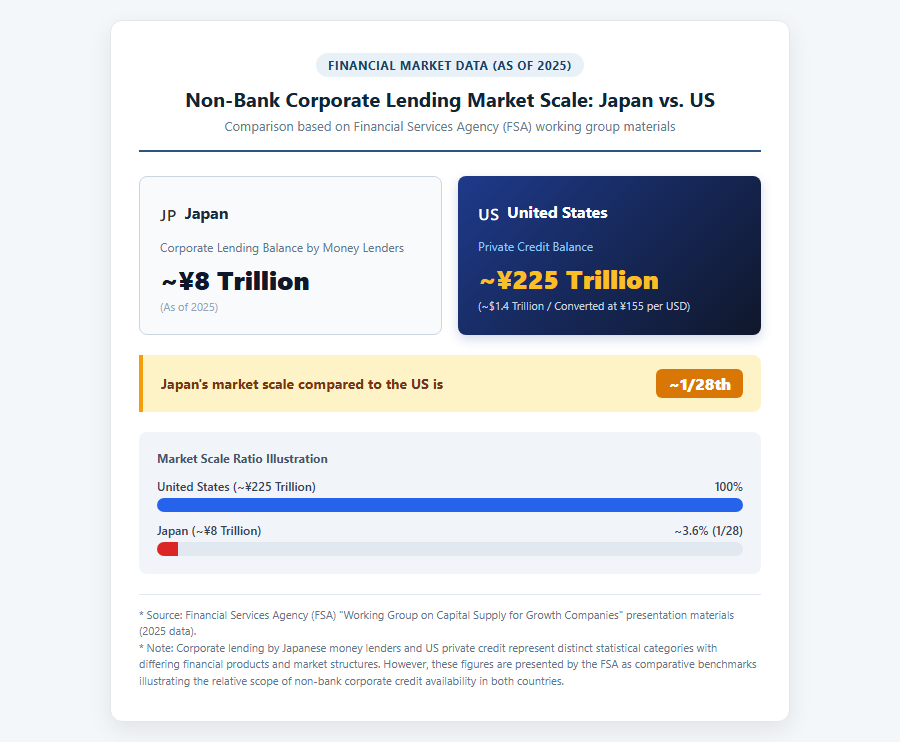
While a direct comparison is not exact due to structural differences in financial markets and financial instruments between Japan and the US, developing diverse financing channels beyond traditional bank loans is a critical priority for securing growth capital for Japanese businesses. The Japanese government has set a target of achieving 250 trillion yen in domestic investment by fiscal year 2040 under its growth strategy. Relaxing regulations under the Money Lending Business Act is expected to attract diverse capital providers, including foreign private equity funds and private debt funds, to the domestic market.
Industry Reactions and Outlook Toward the 2027 Ordinary Diet Session
Feedback from Domestic and Overseas Institutions and Level Playing Field Debates
Financial industry reactions to the proposed reforms are broadly positive, though issues regarding a level playing field have been raised. The Japanese Bankers Association welcomed the deregulation as a means to diversify corporate funding sources and facilitate smoother syndicated loan deal origination.
Conversely, the International Bankers Association (IBA) in Japan, while supporting the relaxation of entry barriers, emphasized the perspective of foreign banks that have already obtained banking licenses and established physical branches in Japan under strict regulatory compliance. The IBA pointed out that allowing foreign entities to enter without domestic bases under lighter requirements could create competitive inequities with existing institutions. A central focus for the working group will be balancing the attraction of foreign capital with a level playing field and effective regulatory oversight for incumbent institutions.
- Japanese Bankers Association welcomed regulatory relaxation for diversifying funding channels
- International Bankers Association expressed concerns over a level playing field with existing foreign banks with local branches
- Key focus remains balancing supervisory effectiveness with fair market competition
Legislative Timeline for the 2027 Diet Session and Key Issues to Watch
The FSA plans to flesh out detailed regulatory designs within the Financial System Council working group, aiming to submit a bill amending the Money Lending Business Act to the Ordinary Diet Session in 2027. The scope of legislative review extends beyond the Money Lending Business Act; it also encompasses potential revisions to the Non-Bank Corporate Bond Act to ease issuance requirements, making it easier for non-bank lenders and funds to raise capital through corporate bond issuances.
Please refer to the following diagram.
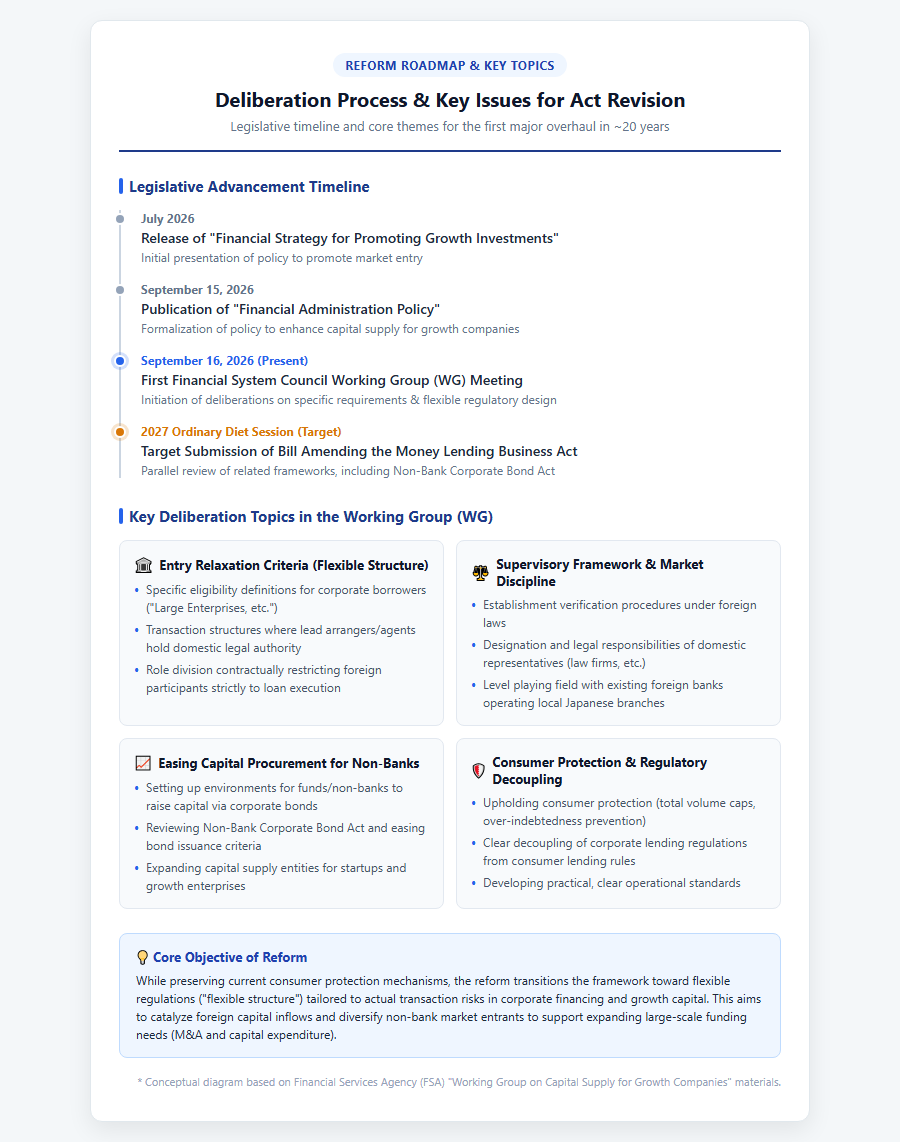
Key issues to watch in upcoming working group sessions include defining the specific criteria for “large corporate” borrower eligibility and establishing the precise roles and legal responsibilities of domestic representatives (such as law firms) acting as regulatory liaisons. Furthermore, regulators must establish clear practical standards that strictly maintain consumer protection provisions while decoupling corporate lending regulations. If enacted, this first major revision to the Money Lending Business Act in roughly two decades will mark a significant transformation in Japan’s growth capital supply architecture.
Reference Pages
- [FSA Legal Submissions Information] http://www.fsa.go.jp/common/diet/index.html
【#MoneyLendingBusinessActRevision #FSA #FinancialSystemCouncil #SyndicatedLoans #MA #GrowthCapital #ForeignFinancialInstitutions】

コメント