Panasonic Holdings has developed a groundbreaking new technology that reduces the power used for cooling data centers by about 60%. Behind this is the global challenge of increased server heat generation due to the rapid spread of generative AI, and the resulting enormous power consumption.
- The power of ‘water’ to achieve a 60% reduction in power consumption
- Social implementation of liquid cooling systems starting from the European market
- The “heat” barrier faced by generative AI-specialized facilities
- The growth strategy for ‘air, water, and food’ envisioned by Air Quality Air Conditioning Co.
- Global Competitiveness Created by the Fusion of Acquisitions and Technology Assets
- The shock of CES 2026 with comprehensive manufacturing capabilities
- The winning strategy of Japanese companies in the global market
- Realizing Green Impact by 2030
The power of ‘water’ to achieve a 60% reduction in power consumption
Panasonic HVAC&CC, a subsidiary of Panasonic Holdings responsible for air conditioning, has developed new cooling technologies for artificial intelligence (AI) data centers by July 2026. The biggest feature of this technology is that, compared to conventional methods that rely heavily on electricity for cooling, it can reduce the power consumption required for cooling by about 60%. Behind this astonishing energy-saving performance lies a unique approach that applies the technology of “absorption chillers,” which have been used for many years in office buildings and dome stadiums.
Specifically, the key point is to use “water” as the refrigerant. By passing a tube through which water circulates for the refrigerant into a vacuum room, the principle of heat of vaporization is maximized, which draws heat away from the surroundings as the water evaporates at low temperatures. Please refer to the diagram below.
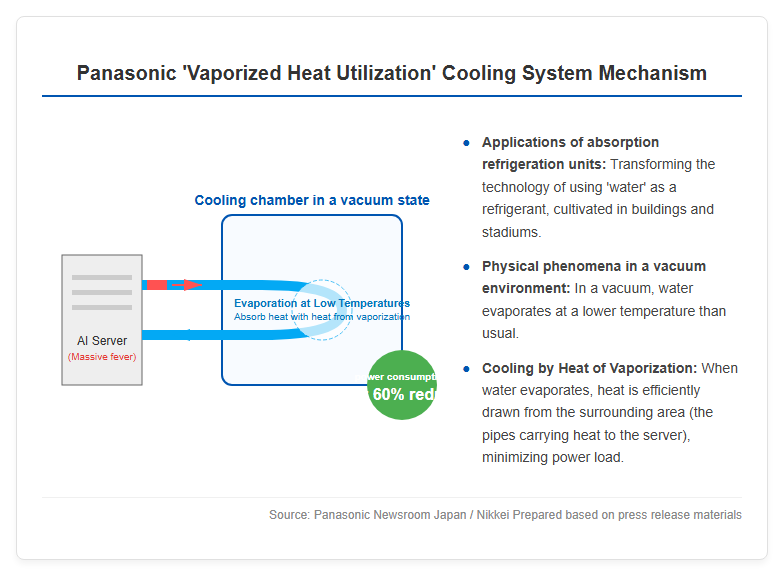
Traditional air cooling methods required large fans and cooling devices that consumed a lot of power to efficiently dissipate the vast heat generated by servers, but this new technology delivers high cooling capacity while minimizing power load by highly controlling natural physical phenomena.
Social implementation of liquid cooling systems starting from the European market
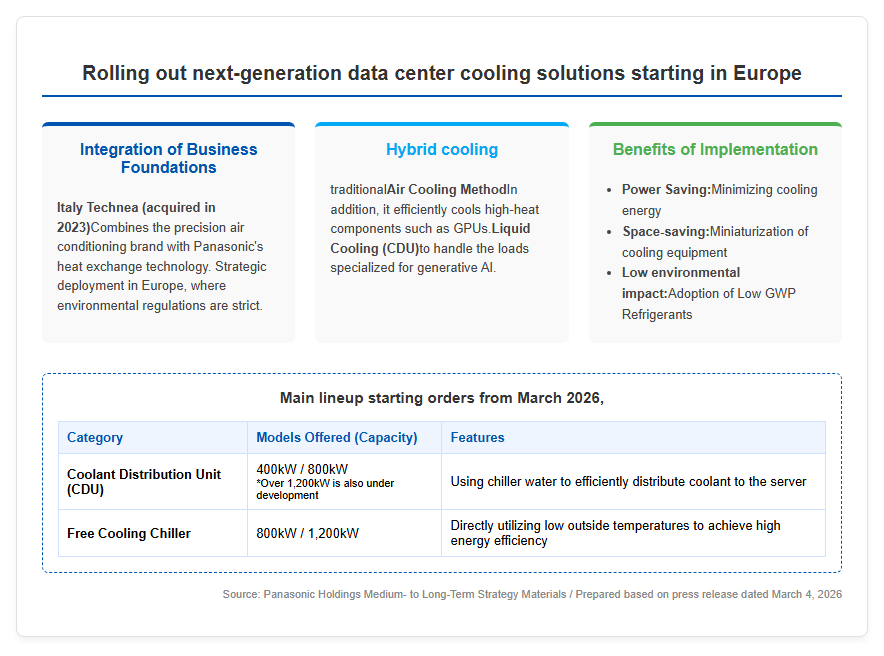
Panasonic has already begun full-scale deployment of solutions incorporating this cooling technology. On March 4, 2026, it announced the launch of its liquid cooling system business for generative AI data centers in the European market. Orders have started for two types of coolant distribution units (CDU) of 400kW and 800kW, and two chiller models equipped with free cooling functions, 800kW and 1,200kW. Furthermore, we are advancing the development of ultra-large capacity models exceeding 1,200kW, with orders scheduled to begin in March 2026.
The reason for choosing the European market as a leader lies in the region’s strict environmental regulations and high awareness of energy conservation. Leveraging the brand strength of Technea, an Italian precision air conditioning manufacturer acquired in 2023, we are accelerating hybrid proposals combining air and liquid cooling through local data center exhibitions such as World. This enables data center operators not only to reduce power consumption but also to benefit from space-saving through miniaturization of cooling equipment. Please check the following business development image.
The “heat” barrier faced by generative AI-specialized facilities
Why is there such a strong demand for innovation in cooling technology today? The reason lies in the characteristics of AI servers equipped with “GPUs (Image Processing Semiconductors),” which are essential for generative AI training and inference. Compared to conventional servers, AI servers have dramatically higher computing power, but their heat generation is extremely high, making it difficult to maintain performance with conventional air cooling methods alone. Many data centers were using excessive cooling to prevent system downtime caused by insufficient cooling, which had driven up electricity costs.
There are also changes in regulations. In Japan, under the revised Energy Conservation Law in 2025, data centers of a certain scale or larger established after 2029 will be required to keep the PUE (Power Usage Effectiveness), an indicator of power usage efficiency, to 1.3 or less. To approach the theoretical maximum efficiency of 1.0, improving the efficiency of cooling systems—which consume the most electricity outside of IT equipment—is an unavoidable challenge. Panasonic’s new technology is expected to be the trump card for breaking through this “heat wall.”
[Management & Strategy Background] Bringing home appliance technology to the core of B2B infrastructure
The growth strategy for ‘air, water, and food’ envisioned by Air Quality Air Conditioning Co.
Currently, the Panasonic Group is promoting “voluntary and responsible management,” where each operating company faces the industries it faces after transitioning to a holding company structure, thereby honing its competitiveness. Among these, Panasonic Corporation (operating company), which developed cooling technology, and its subsidiary Air Quality and Air Conditioning (HVAC) are positioned as key pillars driving the group’s growth. HVAC has set ambitious revenue targets for fiscal year 2030, aiming for an EBITDA margin of over 10%, with one of the key areas to achieve this being its data center solutions business.
Until now, Panasonic has had a strong image of B2C products such as home air conditioners, but now it is transforming its technological assets into infrastructure that supports B2B sites. In particular, hot water heating units (A2W) that apply heat pump technology, as well as industrial cooling systems like this, are at the core of our ‘Green Impact’ strategy, which balances contributing to a decarbonized society with business growth. The medium- to long-term strategy announced in June 2024 clearly states the policy to continue investing in differentiated technologies while flexibly responding to challenging market conditions.
Global Competitiveness Created by the Fusion of Acquisitions and Technology Assets
The early practical application of this cooling technology is largely driven by Panasonic’s strategic M&A efforts and the comprehensive manufacturing capabilities it has cultivated over many years. The Italian company Technea, acquired in 2023, has strengths in precision air conditioning for data centers, and the integration of its channels with Panasonic’s compressor and heat exchange technologies enabled rapid business launches in Europe.
Moreover, Panasonic not only owns the “box” called the cooling unit, but also owns the devices and materials used inside it itself. For example, the low-loss substrate material “MEGTRON,” which supports high-speed communication in AI servers, and the conductive polymer capacitor “SP-Cap,” which contributes to the stabilization of power supply circuits, boast top-class market shares in the industry. Panasonic’s unique strength lies in its ability to comprehensively provide the elements that support stable operation of data centers, ranging from cooling systems and power stabilization devices to semiconductor manufacturing equipment, which is not just a simple air conditioning manufacturer.
The shock of CES 2026 with comprehensive manufacturing capabilities
At “CES 2026” held in Las Vegas, USA in January 2026, Panasonic Group showcased AI infrastructure solutions under the theme “The Future We Make.” At the event, not only the newly developed cooling system but also storage systems that can be installed inside server racks and security technologies to protect physical infrastructure from cyberattacks were showcased, attracting significant attention from visitors. The exhibition booth is as follows.
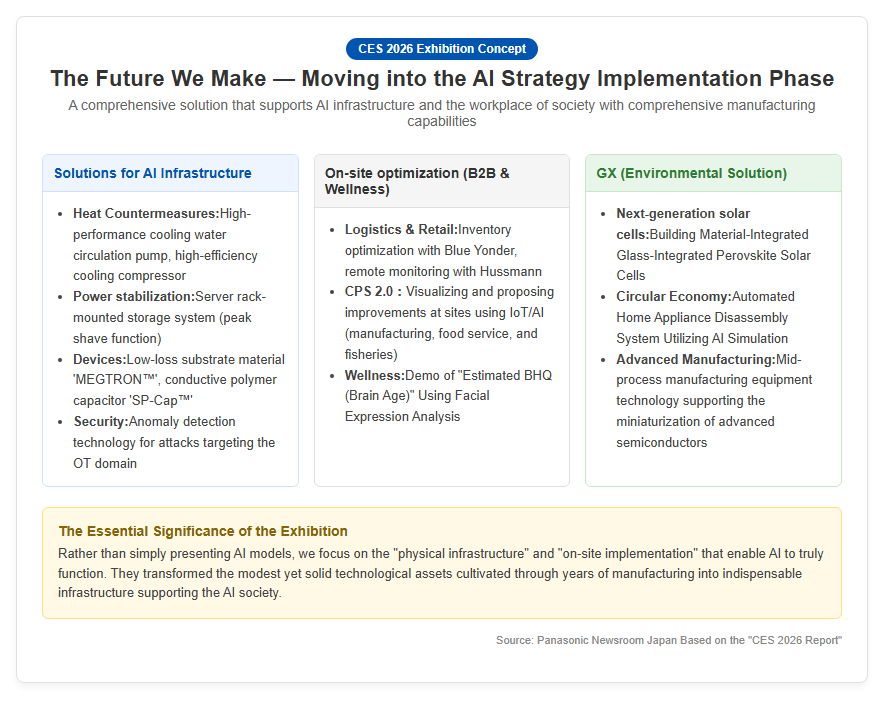
The exhibition at CES marked Panasonic’s shift in its AI strategy from the “conceptual” phase to the “implementation” phase. Rather than simply developing AI models, their approach to AI from both hardware and software aspects that serve as the “foundation” supporting society is highly regarded by many B2B customers. The modest yet solid technology cultivated over more than 70 years in the pump and air conditioning businesses has evolved into an indispensable infrastructure supporting the cutting-edge AI society behind the scenes.
[Future Outlook] A sustainable foundation led by Japanese players
The winning strategy of Japanese companies in the global market
In the data center cooling market, Japanese companies such as Daikin Industries and Nidec (formerly Nidec) are fiercely competing not only in Panasonic but also in Japan. Daikin is accelerating its global expansion by acquiring a North American liquid cooling vendor, while Nidec is leveraging its strengths in supplying fans for servers and components for direct liquid cooling systems. Thus, while American tech giants are leading the way in developing AI ‘foundational models,’ Japanese manufacturing technologies are once again at the global center in the infrastructure layer that physically ‘cools, transports, and supports’ these models.
Panasonic’s future focus will be on how far it can spread proposals as a “complete system” that optimizes energy operations across entire data centers, not just selling individual devices. Advanced control solutions are also being developed in collaboration with system integrators such as NTT Data, using AI to predict internal server thermal conditions and optimize cooling, with expectations for added value through the integration of hardware and software.
Realizing Green Impact by 2030
Under the long-term environmental vision “Panasonic GREEN IMPACT,” the Panasonic Group aims to reduce CO2 emissions from its business activities to net zero by fiscal 2030, thereby contributing to overall emission reductions in society. Data center electricity consumption is expected to increase to account for several percent of global total electricity consumption in the future, and the spread of energy-saving technologies in this field will directly contribute to reducing environmental impact on a global scale.
The cooling technology developed this time, which achieves 60% energy savings, is defined as infrastructure for realizing a sustainable digital society, going beyond mere business success. Going forward, the adoption of data centers will accelerate not only in Europe but also in North America, Asia, and within Japan. Panasonic’s challenge toward 2030 should serve as a touchstone for balancing the richness of our digital lifestyles with the health of the global environment.
[#パナソニック #データセンター #生成AI #省エネ #液冷システム #環境技術 #経済ニュース #GX]


コメント