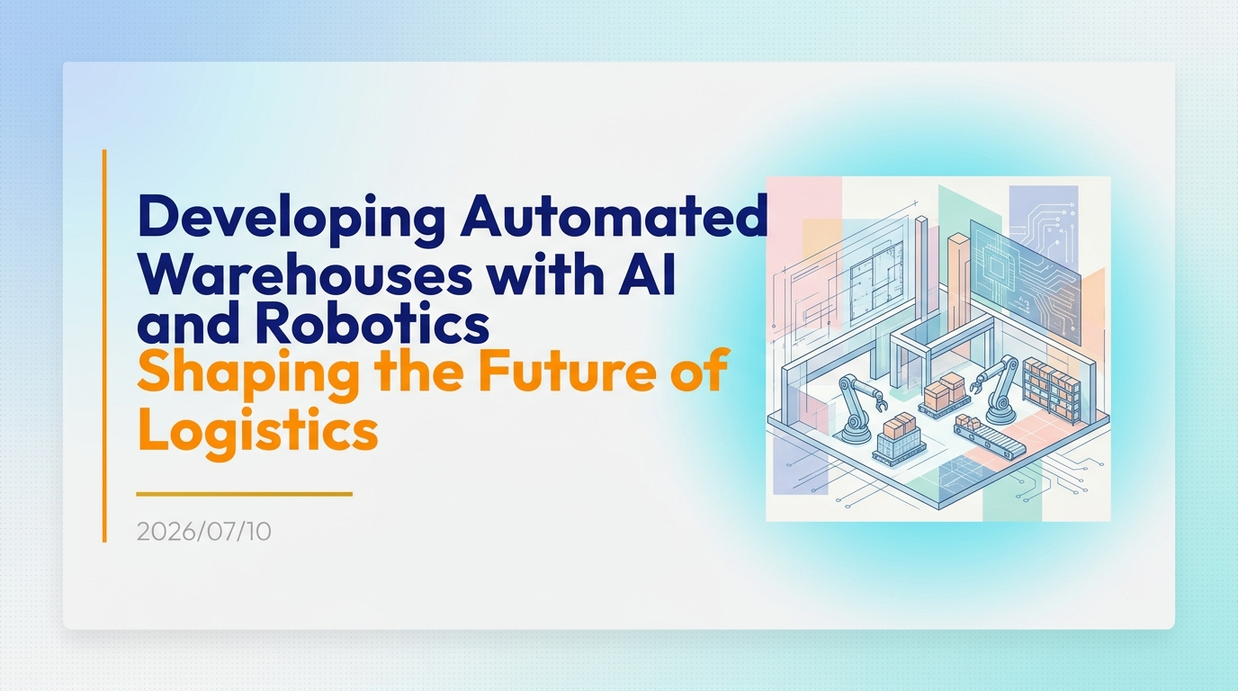
Taisei Corporation and Fanuc have developed an innovative automated warehouse that combines AI and industrial robots. Behind this are the urgent challenges of securing delivery hubs in urban areas due to a severe shortage of logistics drivers.
- Key points of development: Achieving twice the storage capacity compared to conventional models
- The Core of Technology: “Physical AI” through AI and Industrial Robots
- Underlying Structural Challenges: The Last Mile Wall
- Rapid Market Growth: Forecast of Logistics Facility Demand Toward 2030
- Legal Tailwind: Relaxation of Floor Area Ratio for Automated Rack Warehouses
- Future Developments: Smart Logistics Transforming Society
Key points of development: Achieving twice the storage capacity compared to conventional models
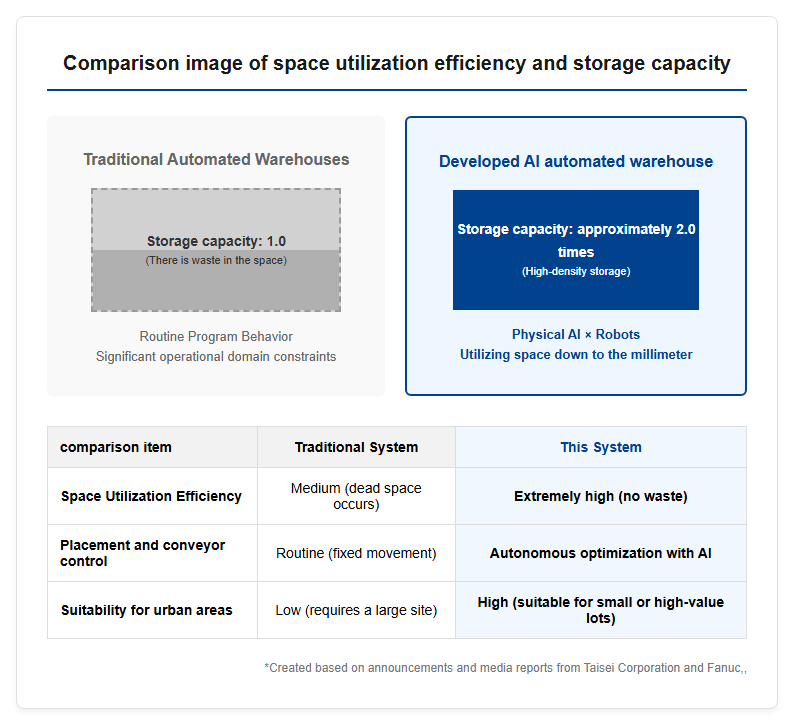
Taisei Corporation and Fanuc have jointly developed a new automated warehouse system that highly integrates AI (artificial intelligence) and industrial robots. The greatest feature of this system is its outstanding space utilization efficiency, allowing storage of about twice as much cargo compared to conventional automated warehouses despite the same footprint. Until now, in warehouses, due to limitations in the operating area of material handling equipment and the structure of shelves, it had become common for dead space to be unused near the ceiling or around the equipment. However, in this development, by combining FANUC’s precise robot control technology with Taisei Corporation’s accumulated architectural design expertise, it became possible to design spaces efficiently down to the millimeter level. This has paved the way for large-scale storage capacity even in high-priced urban areas and limited land areas. Please refer to the diagram below.
The Core of Technology: “Physical AI” through AI and Industrial Robots
The technical backbone of development is “physical AI” technology, where AI processes real-world data to control robots. Traditional automated warehouses mainly operated as standardized systems that operated according to predetermined programs, but in the new system, AI analyzes information such as the shape, weight, and outbound frequency of packages in real time to autonomously determine optimal placement. For example, frequently shipped items are automatically optimized for easy access in the front side, while items requiring long-term storage are moved to the back. Additionally, AI is involved in the operation of industrial robots themselves, transporting them along the most efficient routes while avoiding obstacles, thereby achieving both increased work speed and reduced power consumption. By integrating hardware such as FANUC’s robotic arms and automated guided vehicles (AGVs) with Taisei Corporation’s company-wide digital twin technology and DX strategy, a next-generation logistics infrastructure has been realized where the building itself functions as a single giant robot.
Logistics 2024 Issues and the Need for Urban Warehouses
Underlying Structural Challenges: The Last Mile Wall
The “2024 Problem” facing the construction and logistics industry is a powerful driving force behind the development of this automated warehouse. Since the overtime cap regulation for truck drivers was implemented in April 2024, improving transportation efficiency has become an urgent national issue. In particular, the “last mile” process, which delivers packages from the delivery point to the end consumer, is considered the most costly and labor-intensive part of the entire logistics network. If delivery hubs could be located closer to consumers in urban areas, it would be possible to shorten delivery distances and handle more deliveries with a limited number of drivers, but urban centers face a dilemma where land is extremely expensive, making traditional inefficient warehouses unprofitable. This technological innovation, which doubles storage capacity, is expected to make the deployment of such hubs in urban centers realistic, dramatically improve delivery efficiency, and directly contribute to maintaining the logistics network.
Rapid Market Growth: Forecast of Logistics Facility Demand Toward 2030
According to analysis by the economic forecasting AI “xenoBrain,” the domestic market size for logistics facility construction is expected to grow from the current approximately 1.426 trillion yen to approximately 1.6839 trillion yen by 2030, with approximately 18.08% growth over the next five years. This growth is driven by changes in consumer trends, such as the expansion of e-commerce (e-commerce) and online supermarkets, as well as an increase in single-person households. Additionally, according to a survey by Yano Research Institute, the logistics robotics market itself is rapidly expanding, and it is predicted that by fiscal year 2030, the domestic market size will reach 123.8 billion yen (about three times the forecast for fiscal year 2024). In this situation, in the context of a “labor crisis” where demand is expanding but the working population is declining, labor-saving and high-efficiency solutions utilizing AI robots are becoming not just a pursuit of convenience but an essential condition for maintaining social functions.
Deregulation and Future Outlook for Logistics Infrastructure
Legal Tailwind: Relaxation of Floor Area Ratio for Automated Rack Warehouses
In response to technological innovation, government institutional support is also progressing. On June 28, 2024, the Ministry of Land, Infrastructure, Transport and Tourism issued technical advice titled “Regarding the Operation of Floor Area Calculation in Warehouses Installing Automatic Racks,” reviewing the operation of floor area ratio regulations. Until now, even for building-type automated rack warehouses without floors, the total area was calculated assuming virtual floors were placed every 5 meters in height to calculate the total floor area for floor area ratio. However, with the improvement in the performance of the latest cargo handling robots, which have become common for operation at higher floor heights, the standard height was raised to 8 meters. Please refer to the diagram below.
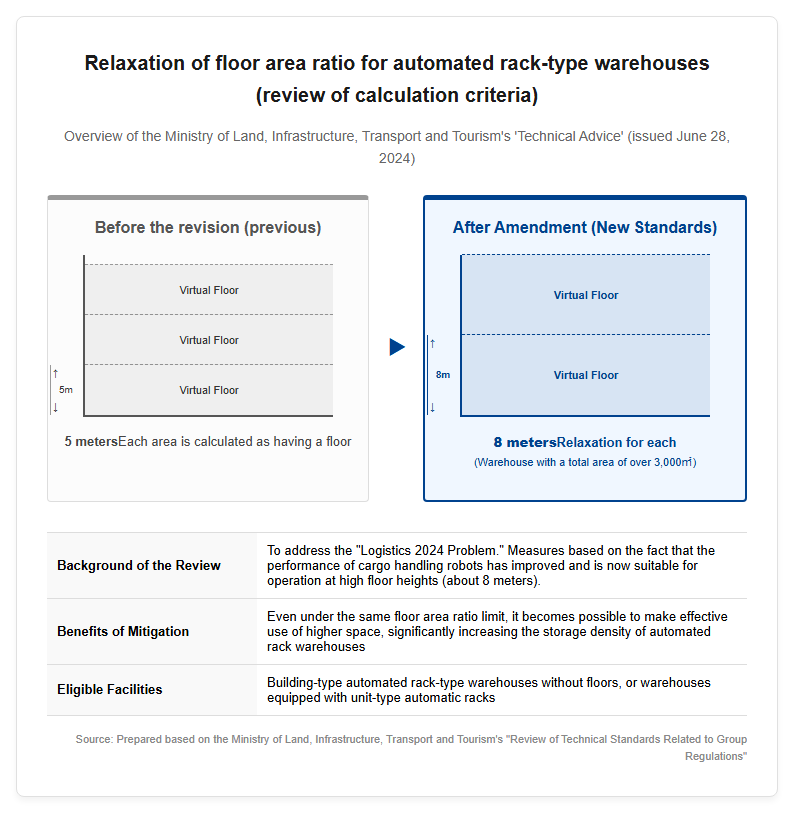
。 This regulatory relaxation has made it possible to build automated warehouses that utilize larger spaces within a certain site area, creating a legal environment that maximizes the potential of high-density storage systems developed by Taisei Corporation and Fanuc.
Future Developments: Smart Logistics Transforming Society
This development symbolizes the transformation of ‘production processes’ and ‘service solutions’ aimed at achieving Taisei Corporation’s long-term vision, ‘TAISEI VISION 2030.’ Going forward, not only Taisei Corporation but also cross-industry initiatives such as the ‘Construction RX Consortium’ will standardize robot technology and promote mutual use at other companies’ sites, Productivity improvements across the logistics industry will accelerate. Furthermore, for FANUC, expanding its business scope from traditional manufacturing FA (factory automation) to logistics facilities is an important step in embodying the company’s vision of “providing indispensable value through continuous technological innovation.” By highly integrating AI and robotics with architecture, the realization of a “smart logistics society” is imminent, allowing the limited urban spaces to be utilized more effectively, reducing driver burdens, and improving consumer convenience at a high level.
[#物流 #DX #大成建設 #ファナック #2024年問題 #AIロボット #自動倉庫 #スマート物流]


コメント