Mitsubishi Heavy Industries has successfully demonstrated a new technology that significantly reduces cooling energy in operating data centers. With the spread of generative AI making data center power consumption a global challenge, this method—which achieves efficiency without halting the operation of existing equipment—is expected to be a practical solution to enhance infrastructure sustainability.
- Demonstration Results at Fujitsu Akashi Data Center
- Integrated control eliminates the ‘waste’ of partial optimization.
- Significance of Application in Operational and Multi-Vendor Environments
- Management Policy: Innovative Total Optimization and New Organization
- Social implementation of liquid cooling and immersion technology that exceeds the limits of air cooling
- Expansion into Global Markets and Sustainable Infrastructure Outlook
Demonstration Results at Fujitsu Akashi Data Center
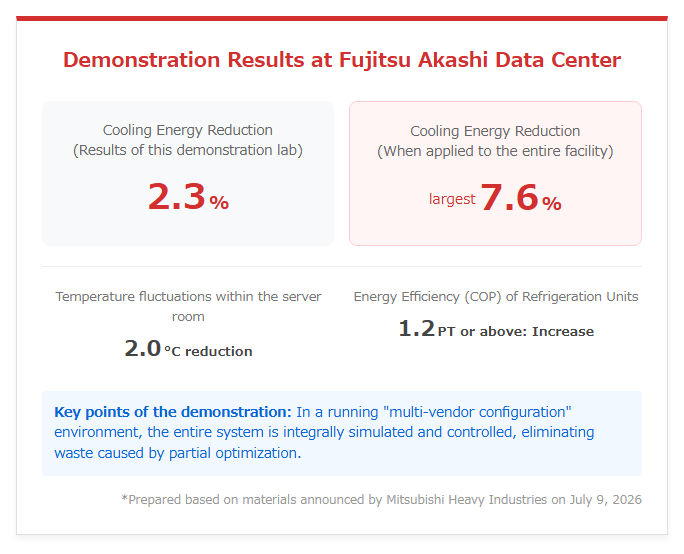
On July 9, 2026, Mitsubishi Heavy Industries announced that it had successfully demonstrated cooling energy reduction using operating equipment at the Fujitsu Akashi Data Center, operated by Fujitsu. In this demonstration, we targeted the existing environment of a “multi-vendor configuration” where equipment from multiple manufacturers coexisted, and adopted a method to control the entire system in an integrated manner. As a result, cooling energy was reduced by 2.3%, and when this control is applied throughout the data center, it was confirmed that up to 7.6% energy savings can be expected. In large-scale facilities that consume large amounts of electricity year-round, the cumulative cost savings and impact of reducing power load from a few percent can be extremely significant. Please refer to the diagram below.
This demonstration is highly significant in that it demonstrates effective data not only for newly built data centers but also for energy conservation of the many existing domestic infrastructures.
Integrated control eliminates the ‘waste’ of partial optimization.
The largest source of electricity in data centers is the cooling systems of IT equipment, accounting for over 60% of electricity usage outside of servers. In conventional operations, “common equipment” such as turbo chillers that cooled the entire facility and “air conditioners” placed in individual server rooms were each partially optimized and controlled separately. Additionally, to prioritize stable server operation, cooling was carried out with excessive margin on the security side, which led to wasteful energy consumption. In this demonstration, we used technology developed by Mitsubishi Heavy Industries’ General Research Institute, adopting an approach that simulates and controls the entire cooling system integrally rather than individually for each piece of equipment. Specifically, by identifying temperature fluctuations in the server room and finely adjusting airflow, we reduced the temperature variation by 2°C and expanded the range over which the entire system could operate efficiently. As a result, the COP for energy efficiency in refrigeration units has also improved by more than 1.2 points.
Significance of Application in Operational and Multi-Vendor Environments
The biggest feature of this demonstration is that it was conducted in a “multi-vendor configuration” environment that actually operates, without stopping data center operations. Unlike the approach of building cutting-edge new data centers, it is gaining attention as a practical solution to improve energy efficiency while effectively utilizing existing infrastructure. With the increase in AI workloads, operational conditions have become more sophisticated even in existing data centers, and traditional energy-saving methods have had limited effectiveness. Mitsubishi Heavy Industries leveraged its own cooling technology and expertise in layout and spatial design cultivated in power plants to address this technical solution from the energy demand side. Going forward, energy issues in data centers will require not only measures for the “producer” side such as the introduction of renewable energy but also technologies that thoroughly eliminate waste on the “users” side of electricity. Integrated control technologies cultivated over many years by manufacturers like Mitsubishi Heavy Industries will play a crucial role in supporting a sustainable social foundation in the AI era.
Mitsubishi Heavy Industries’ Management Strategy and Outlook for Next-Generation Cooling Technology
Management Policy: Innovative Total Optimization and New Organization
Mitsubishi Heavy Industries is strengthening its data center business as a pillar of its growth strategy. The management policy announced in May 2025 sets forth “Innovative Total Optimization (ITO),” promoting overall optimization and expansion of areas through strengthened collaboration between businesses. Based on this policy, starting April 2026, the company has reorganized its data center organization into business units and joined the Industrial Solutions domain. This is the first case where the company achieved independence and divisional transformation from an organization responsible for growth strategy, demonstrating the company’s seriousness. The data center market is expanding year by year, and Mitsubishi Heavy Industries aims to promote data center decarbonization from both power supply and energy savings perspectives by providing a “one-stop solution” that integrates power, cooling, and digital solutions. With a strong business foundation including over 10 trillion yen in order backlogs for fiscal year 2024, we are prepared to achieve a virtuous cycle of high-profit structure and growth investment.
Social implementation of liquid cooling and immersion technology that exceeds the limits of air cooling
In future data centers, the heat generation of the chips installed in each chip is expected to exceed 1000W, making it clear that conventional air cooling methods lack sufficient cooling capacity. In response, Mitsubishi Heavy Industries is advancing the development and implementation of next-generation technologies such as immersion cooling and direct chip cooling (DLC). In a demonstration with NTT Data, we built a “rack-type immersion cooling system” that immerses servers in insulating liquids, achieving a 92% reduction in cooling energy compared to our own building standards and a 173% improvement in operability. Additionally, in December 2025, we began commercial use of GPU servers using Japan’s first “two-phase DLC method” with the Exeo Group. This technology uses a refrigerant that changes from liquid to gas, achieving an exceptionally high heat transfer rate compared to air cooling, balancing stable operation of high-heat GPUs and energy savings. These technologies directly lead to dramatic improvements in PUE (below target 1.1), indicating overall power usage efficiency across data centers.
Expansion into Global Markets and Sustainable Infrastructure Outlook
Mitsubishi Heavy Industries is accelerating its business expansion into the global market, especially North America, where data center demand is strong, using its domestic achievements as a foothold. We have established a business base in the United States and are advancing the provision of solutions tailored to local needs. Global data center electricity consumption was about 1% of total power generation in 2018, but it is projected to increase to around 8% by 2030, indicating an extremely high global demand for energy-saving technologies. The company has declared net zero by 2040 to realize a carbon-neutral society, and decarbonizing data centers is one of its key challenges. The company’s strengths, covering everything from power systems to cooling equipment and the digital technologies that optimally control them, provide a significant advantage over competing overseas companies. Going forward, we plan to contribute to the development of a sustainable AI society by promoting the intelligence and autonomy of mechanical systems, building next-generation infrastructure that maintains high reliability while reducing environmental impact.
[#三菱重工業 #データセンター #省エネ #AIインフラ #PUE #冷却技術 #カーボンニュートラル #経済ニュース]
コメント