
Ukrainian President Volodymyr Zelensky expressed strong interest in cooperation with Japan’s Mitsubishi Heavy Industries regarding the licensed production of the U.S.-made surface-to-air missile system “Patriot.” Behind this is Ukraine’s urgent situation, where its interception capability is declining amid intensifying Russian missile attacks, and Japan’s historic shift in its defense equipment transfer policy.
- Key Points of the Event: Patriot Production in Ukraine and Japan
- Background: Ukraine faces a severe shortage of interceptor missiles
- Japan’s Role: Revision of the Three Principles on Transfer of Defense Equipment and the Mechanism of ‘Re-importing’
- Corporate Strategy: From Domestic Exclusive Sales to a Global Revenue Model
- Production Capacity Challenges: The Bottleneck Between Boeing Parts Supply and Increased Production
- Finance and Stock Price: Over 12 trillion yen in order backlog, market expectations
- Medium- to Long-Term Focus: Expanding from Licensed Production to Third-Country Transfer
- Risk Factors: Geopolitical Tensions and Russian Backlash
- Conclusion: The Need to Maintain and Strengthen Japan’s Defense Production and Technology Base
Key Points of the Event: Patriot Production in Ukraine and Japan
On July 9, 2026, Ukrainian President Zelensky stated that he is interested in the experience and cooperation of Mitsubishi Heavy Industries, which licenses the production of interceptor missiles for the Patriot surface-to-air missile system with the United States, which has reached a political agreement with the United States. Zelensky told reporters, “I want to share the experience. It depends on the Japanese side’s intentions,” revealing that he is seeking Japanese expertise in the process of finalizing technical details.
Regarding the Patriot interceptor missile “PAC3,” the U.S. has already announced its intention to grant it to Ukraine, and it is expected that Ukraine will receive it within a few days. Mitsubishi Heavy Industries has long licensed production of PAC2 and PAC3 at facilities such as the Komaki Kita Plant of the Nagoya Induction Propulsion System Manufacturing Plant, and its production track record and technological accumulation are highly regarded internationally. This statement indicates that the technological capabilities of Japanese private companies have emerged as an indispensable element in building production bases within Ukraine.
Background: Ukraine faces a severe shortage of interceptor missiles
Behind President Zelensky’s intense attention to Mitsubishi Heavy Industries lies the critical situation of a significant decline in Ukraine’s air defense capabilities. Ukraine is exposed to large-scale attacks by Russian forces using ballistic and hypersonic missiles, with a shortage of interceptor missiles as a critical weakness. According to the news site Ukraine Pravda, in the large-scale attack carried out in the early hours of July 6, 2026, not a single one of the 29 missiles was intercepted.
The decline in interception capability is reflected in the numbers: the interception rate for ballistic missiles, which was 44 percent on June 15, 2026, plummeted to 17 percent on July 2. This decline in interception rates directly leads to civilian casualties, and since July 2026, the number of deaths from attacks has already exceeded 50. The Ukrainian Ministry of Defense has requested urgent support for interceptor missiles from about 40 countries, making the early establishment of domestic production systems a top priority to contain Russia’s sole strength.
Japan’s Role: Revision of the Three Principles on Transfer of Defense Equipment and the Mechanism of ‘Re-importing’
On December 22, 2023, the Japanese government revised the Three Principles on Transfer of Defense Equipment and operational guidelines, allowing the export of finished products of licensed-produced equipment to the licensing countries. This historic policy shift opened the way for Mitsubishi Heavy Industries to export Patriot missiles produced by Mitsubishi Heavy Industries to the United States. The U.S. is advancing plans to supply PAC-3 from Japan to maintain its own inventory and supply the surplus to Ukraine.
Until now, Japan had limited exports of licensed products to parts only, but the first export ban on finished products under this revision was the export of Patriot to the United States. However, under current rules, direct exports to countries where “actual combat is taking place” are still not permitted, so Japanese-made missiles do not reach Ukraine directly; instead, they are delivered to the United States first. The following diagram shows the transition of Japan’s defense equipment transfer.
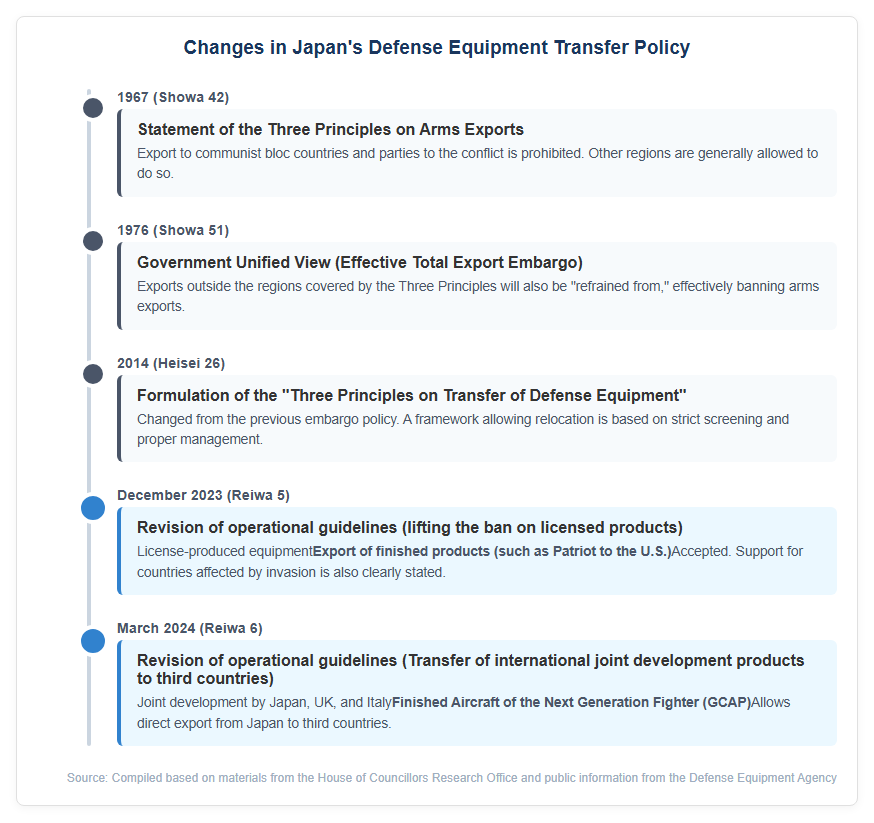
By establishing this framework, Japan is rapidly expanding its role in international security as an indirect actor in supporting Ukraine.
Market and Industry Impact: A Turning Point for Mitsubishi Heavy Industries and Japan’s Defense Industry
Corporate Strategy: From Domestic Exclusive Sales to a Global Revenue Model
Mitsubishi Heavy Industries, which drives Japan’s defense industry, is dramatically shifting its business model from “domestic exclusivity” to “global expansion” in response to significant easing of government arms export restrictions. For the company, which leads the country with Ministry of Defense contracts totaling 1.4567 trillion yen in fiscal year 2024, this deregulation is not just about expanding sales channels, but also presents an excellent opportunity to transform its defense business from a low-profit model into a powerful revenue pillar.
Specifically, in addition to exporting Patriots to the U.S., there are numerous major projects such as exporting frigates to Australia and developing next-generation fighter jets (GCAP) by Japan, the UK, and Italy. To respond to these developments, Mitsubishi Heavy Industries plans to increase its workforce in the aviation, defense, and space business from 7,868 in fiscal 2024 to about 10,000 in fiscal 2026. Sales in this segment, which once hovered around 500 billion yen, are now aiming to double to around 1 trillion yen by the fiscal year ending March 2027, aiming to transform into a global defense company in both name and reality.
Production Capacity Challenges: The Bottleneck Between Boeing Parts Supply and Increased Production
While President Zelensky has high expectations, actual production ramp-up plans are facing serious bottlenecks in the supply chain. Currently, Mitsubishi Heavy Industries manufactures about 30 PAC3 missiles annually and plans to double this to around 60, but the shortage of critical components called “seekers” that guide the missiles in the final stage of flight remains a major obstacle. This part is manufactured by Boeing in the United States, and due to supply delays, expansion of production in Japan has stalled.
Although Boeing has begun expanding its Seeker plant, the new line is expected to remain operational until 2027. Furthermore, significant investment will be required to increase production capacity within Japan. Government financial support under the 2022 Defense Spending Doubling Plan is limited to equipment for the Self-Defense Forces and does not apply to expanding production for export, forcing Mitsubishi Heavy Industries to decide whether to bear the cost of building a new plant worth tens of millions of dollars or the U.S. side to cover the investment costs. It may take several years for increased production to gain traction, and supply lag relative to demand remains a major challenge.
Finance and Stock Price: Over 12 trillion yen in order backlog, market expectations
Following the historic growth phase in the defense business, Mitsubishi Heavy Industries’ financial indicators and stock price have attracted strong market attention. As of the second quarter of fiscal 2025, consolidated order balances exceed 10.7729 trillion yen, and the full-year plan for the fiscal year ending March 2026 is projected to surpass 12 trillion yen. This means future sales have become “visible,” and investors highly value it as a factor that enhances performance stability. Operating profit for fiscal year 2024 reached 383.1 billion yen, a 35.6% increase year-on-year, indicating steady improvement in profitability.
Stock prices have also surged to about double their levels compared to around spring 2024, reflecting these growth expectations. The PER (Price-to-Earnings Ratio) is among the highest levels within the defense sector, driven by expectations of future dividends and performance performance that incorporate the lifting of arms export restrictions. Among market participants, there is a growing view that if Patriot’s exports to the U.S. continue steadily and overseas inquiries become more concrete, the bullish trend aiming for a target stock price in the 5,300 yen range will be maintained.
Future Outlook and Key Points: The Future of the Global Patriot Alliance
Medium- to Long-Term Focus: Expanding from Licensed Production to Third-Country Transfer
Cooperation over the Patriot missile will serve as a touchstone for Japan’s future defense equipment transfer policy. The March 2024 operational guidelines revision allowed the direct transfer of next-generation fighters jointly developed by Japan, the UK, and Italy to third countries, but this is a framework for “domestically produced and jointly developed products,” different from licensed products like the Patriot. A key point of interest going forward is whether further relaxation of the system will allow Patriots to be transferred directly or more quickly to third countries like Ukraine without going through the licensing U.S.
Within the government, discussions continue to remove the restrictions on the “five types” that are limited to specific purposes such as rescue and alert, enabling broader exports of defense equipment. If this is realized, domestic companies such as Mitsubishi Heavy Industries will be able to directly compete with major Western companies in the global defense market and build equal partnerships. If licensed production cooperation in Ukraine is realized, it will be a symbolic project that redefines Japan’s status as a technological powerhouse, going beyond mere equipment supply.
Risk Factors: Geopolitical Tensions and Russian Backlash
Russia has shown strong caution and resistance toward Japan’s Patriot exports and increased involvement in Ukraine. On December 27, 2023, a spokesperson for the Russian Foreign Ministry pointed out the possibility that Japanese-made Patriots might eventually end up in Ukraine, warning that such a move would be “seen as clear hostility toward Russia and would have serious consequences for Japan.” This warning has become a factor that heightens geopolitical tensions not only in North America and Europe but also in East Asia, requiring the Japanese government to make cautious diplomatic decisions.
Additionally, the structural weaknesses of the domestic defense industry cannot be ignored. Due to years of stagnation, the withdrawal of small and medium-sized enterprises supporting supply chains has led to a series of withdrawals, and even if Mitsubishi Heavy Industries, a prime company, secures large orders, there is a risk that the supply capacity of subcontractors will become a bottleneck. Furthermore, in defense industries requiring advanced technology, competition for engineers is intensifying, raising concerns that a severe shortage of personnel could hinder production expansion. How these geopolitical and structural risks are managed and linked to sustainable growth will be the key to the success or failure of future defense industry restructuring.
Conclusion: The Need to Maintain and Strengthen Japan’s Defense Production and Technology Base
President Zelensky’s request for cooperation with Mitsubishi Heavy Industries has once again highlighted the indispensable role of Japan’s defense industry in the international community’s security. The defense production and technological base is positioned not merely as a sector of industry, but as the nation’s “defense capability itself.” For Japan’s defense industry, which has so far relied solely on domestic demand and was feared for weakening, capturing global demand is an inevitable path to maintaining technological standards and ensuring sustained combat capability in emergencies.
Going forward, it is necessary to promote “selection and concentration” in advanced technology fields where Japan excels, and to foster internationally competitive corporate entities. This will require bold industrial policies, including government legislation and financial support, as well as discussions on exemptions from antitrust laws. The deepening of cooperation between Japan, the U.S., and Ukraine, starting with the Patriot missile, should be an extremely important milestone demonstrating how Japan should contribute amid the changing international order, while maintaining its fundamental principles as a peaceful nation.
[#三菱重工業 #ゼレンスキー大統領 #パトリオットミサイル #防衛装備移転三原則 #ウクライナ支援 #防衛産業 #経済安保 #PAC3]


コメント