
The Bank of Japan’s decision to raise its policy rate from 0.25% to 0.5%—with further increases targeting around 1.25%—has triggered a sharp unwinding of the yen carry trade, a long-standing pillar of global financial market liquidity. This reversal stems from the rapid narrowing of the U.S.–Japan interest rate differential and structural shifts in foreign exchange markets as Japan pivots away from decades of ultra-loose monetary policy.
- Policy Rate Hike Decisions and a Historic Structural Turning Point
- How Low-Cost Yen Funding Powers Carry Trades and Their Cumulative Scale
- Rapid Narrowing of Interest Rate Spreads and Triggers for the “Unwind”
- Systemic Risks Spreading to U.S. Tech Stocks and Global Financial Infrastructure
- Rising Corporate Interest Expenses and Downward Pressure on Ordinary Profits
- Central Bank Policy Trajectories and Key Market Indicators to Watch
Policy Rate Hike Decisions and a Historic Structural Turning Point
The Bank of Japan (BOJ) is actively pursuing a phased increase in its policy interest rate, marking a decisive departure from its long-standing ultra-accommodative monetary stance. Following an initial hike to 0.25% in July 2024, the BOJ raised rates to 0.5% in January 2025 and subsequently moved to increase its target to around 1.25% in September 2026. Ever since the introduction of the zero-interest-rate policy in 1999, Japan has operated as the world’s lowest-cost funding hub. However, this sequence of policy moves has ushered in a tangible transition toward a “world with interest rates.” Market expectations for further monetary tightening are intensifying as authorities seek to curb elevated import costs and historic yen weakness, both of which have weighed heavily on household living expenses. Nevertheless, debate between hawkish and dovish members within the BOJ Policy Board over the timing and pace of future hikes underscores the need for cautious policy navigation. As illustrated in the figure below, rising interest rates represent a fundamental turning point for both the domestic economy and international capital flows.
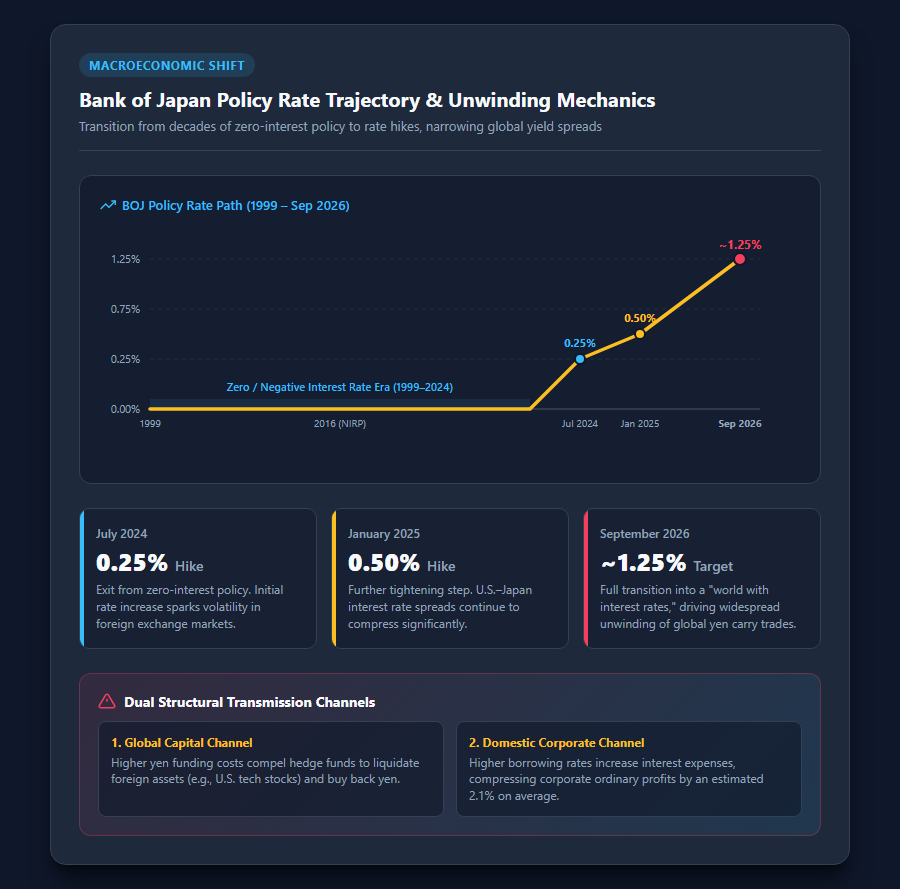
Rather than remaining a purely domestic monetary contraction, these rate increases serve as a direct catalyst disrupting years of accumulated global liquidity cycles.
How Low-Cost Yen Funding Powers Carry Trades and Their Cumulative Scale
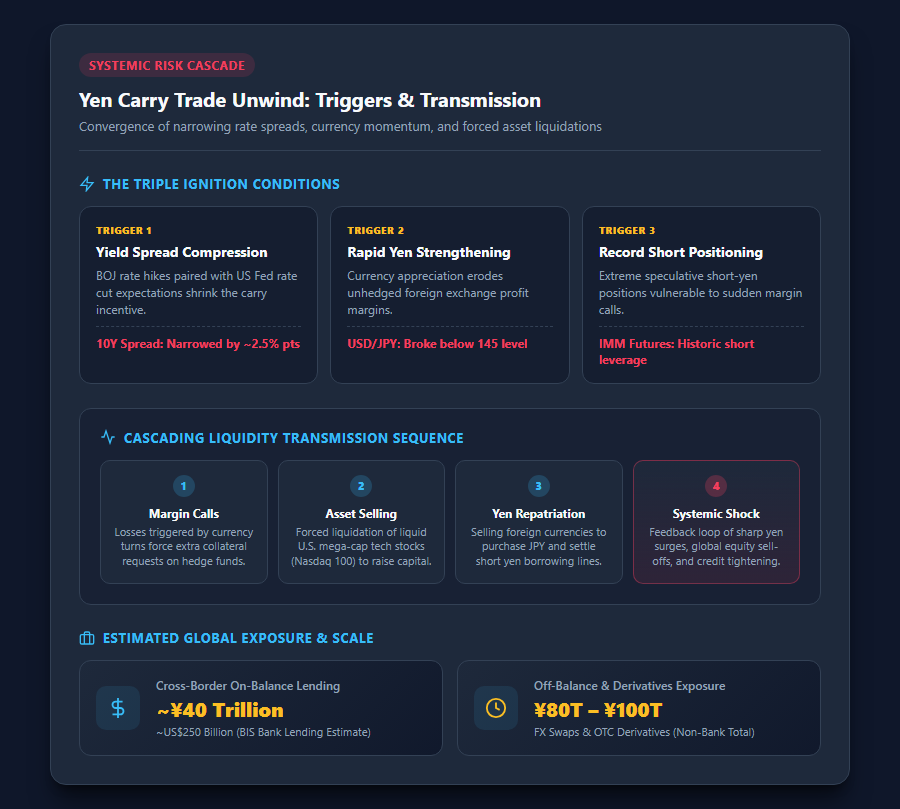
The yen carry trade is a financial strategy in which investors borrow low-interest Japanese yen, convert the proceeds into higher-yielding currencies such as the U.S. dollar, and deploy the capital into assets with higher returns, including U.S. Treasuries, American equities, and emerging market currencies. Global hedge funds and institutional investors have extensively leveraged this mechanism to capture both the interest rate spread (the carry) and foreign exchange gains driven by yen depreciation. According to Bank for International Settlements (BIS) estimates, cross-border on-balance-sheet yen-denominated bank lending alone stands at approximately 40 trillion yen (around US\$250 billion). When factoring in off-balance-sheet transactions such as foreign exchange swaps and over-the-counter derivatives extended to non-bank financial institutions, the total notional value is estimated between 80 trillion and 100 trillion yen. For years, this vast pool of yen capital generated surplus global liquidity, serving as a massive financial pillar supporting asset price appreciation in international equity and bond markets.
Global Market Spillovers and Violent Position Unwinding
Rapid Narrowing of Interest Rate Spreads and Triggers for the “Unwind”
The rapid liquidation and contraction of accumulated yen carry positions is known as an “unwind” or “reverse flow.” Rather than stemming from a single catalyst, an unwind occurs when three key conditions converge simultaneously: a rapid narrowing of the U.S.–Japan interest rate differential driven by BOJ hikes alongside Federal Reserve rate cut expectations, a sharp appreciation of the yen, and historically elevated short-yen speculative positioning. In August 2024, for instance, the 10-year yield spread between U.S. and Japanese government bonds compressed by nearly 2.5 percentage points, while the USD/JPY rate broke below 145. This movement triggered widespread margin calls, forcing distressed investors to liquidate risk assets simultaneously and buy back yen to settle their debts. Within days, this chain reaction unleashed severe yen strengthening and a sharp pullback in global equities. The diagram below illustrates the cascading impact of narrowing rate differentials on market liquidity.
Systemic Risks Spreading to U.S. Tech Stocks and Global Financial Infrastructure
A notable feature of recent yen carry trade unwindings is that the market fallout extended far beyond emerging market currencies, concentrating heavily in U.S. momentum stocks—most notably mega-cap technology equities within the Nasdaq 100. Cheap yen funding had evolved beyond simple interest rate arbitrage; it was deeply embedded as leverage capital financing investments in the U.S. technology sector. Consequently, when hedge funds faced surging borrowing costs and heightened exchange rate volatility, they rapidly dumped their most liquid and profitable holdings—U.S. tech stocks—to raise the yen required to cover their positions. Vector Autoregression (VAR) analysis conducted by Professor Kentaro Iwatsubo of Kobe University quantitatively confirms that international capital flows since 2004 have exerted a profound impact not only on foreign exchange markets but also on U.S. asset pricing. This reverse flow of yen is far more than a routine currency adjustment; international institutions view it as a major systemic risk capable of triggering global credit contractions and broader financial instability.
Impacts on the Japanese Economy, Corporate Performance, and Future Outlook
Rising Corporate Interest Expenses and Downward Pressure on Ordinary Profits
The BOJ’s interest rate hikes exert direct pressure on domestic corporate balance sheets. A survey conducted by Teikoku Databank covering approximately 96,000 domestic companies with interest-bearing debt reveals that a 0.25% increase in borrowing rates adds an average of 680,000 yen in annual interest expenses per firm. This rate hike depresses average corporate ordinary profits by 2.1% and is projected to push roughly 1,700 companies (1.8% of the total) into net loss territory. Should cumulative rate hikes reach 1.00%, the average annual interest burden per company would swell by 1.35 million yen, expanding the proportion of unprofitable firms to 3.6% (approximately 3,500 companies). The impact is sharply bifurcated across industries: in the real estate sector, which relies heavily on debt financing, a 0.25% rate increase reduces ordinary profits by 5.5%, leaving 3.8% of firms vulnerable to net losses.
Central Bank Policy Trajectories and Key Market Indicators to Watch
Looking ahead, financial market participants remain focused on the trajectory of U.S.–Japan interest rate differentials and the extent of remaining yen carry trade risks. The Bank of Japan faces a structural dilemma: achieving its stable 2% inflation target while mitigating the risks of rapid rate hikes, which inflate government debt service costs and strain funding for small and medium-sized enterprises. Concurrently, the pace of Fed rate cuts and U.S. macroeconomic data—such as nonfarm payrolls and CPI releases—remain decisive variables influencing the interest rate spread. Market participants should closely monitor five core indicators: Japan’s 10-year government bond yield (around 2.7%), the U.S.–Japan 10-year yield spread, the USD/JPY exchange rate, the VIX volatility index, and speculative net positions on Chicago IMM futures. For investors, maintaining disciplined risk management, avoiding panic selling, and executing strategic rotations toward domestic defensive sectors that benefit from a stronger yen will be paramount.
References
-
[Academic Paper] Yen Carry Trade and the Global Financial Crisis (Kobe University Academic Repository Kernel) https://hdl.handle.net/20.500.14094/81005231
-
[Research Report] Impact Survey of the Bank of Japan’s Additional Interest Rate Hike on Domestic Companies (Teikoku Databank) https://www.tdb.co.jp/report/watching/press/pdf/p250109.pdf
[#YenCarryTrade #BankOfJapan #MonetaryPolicy #JapaneseEquities #ForeignExchange #USStocks #InterestRates #EconomicNews]


コメント