
Mitsubishi UFJ Bank has signed a strategic partnership with three companies, including IBM Japan, to apply AI-driven development across the entire financial system. Through this partnership, AI will be integrated throughout the entire system lifecycle, from design to operation and maintenance, aiming for a fundamental overhaul of financial infrastructure.
- Announced July 6, 2026: Challenge to Revamp Financial Infrastructure
- Dramatic improvement in development productivity, reducing two months to 1.5 days
- AI-based system lifecycle covering operation and maintenance
- Autonomous Development Enabled by Agent-Based AI “IBM Bob”
- Balancing Security and Flexibility with a Hybrid Cloud Platform
- Breaking away from legacy languages and analyzing Excel graph paper
- Mitsubishi UFJ triples its staff, and other banks have three different strategies.
- Rereallocating Human Resources and Transforming Organizational Culture
- The 80-point principle and the importance of human-in-the-loop
- Measures against copyright risks and black-box operations
- Cross-Industry Expansion of Mitsubishi UFJ Models
- Training Next-Generation Financial Engineers and the ‘Year One of AI Agents’
Announced July 6, 2026: Challenge to Revamp Financial Infrastructure
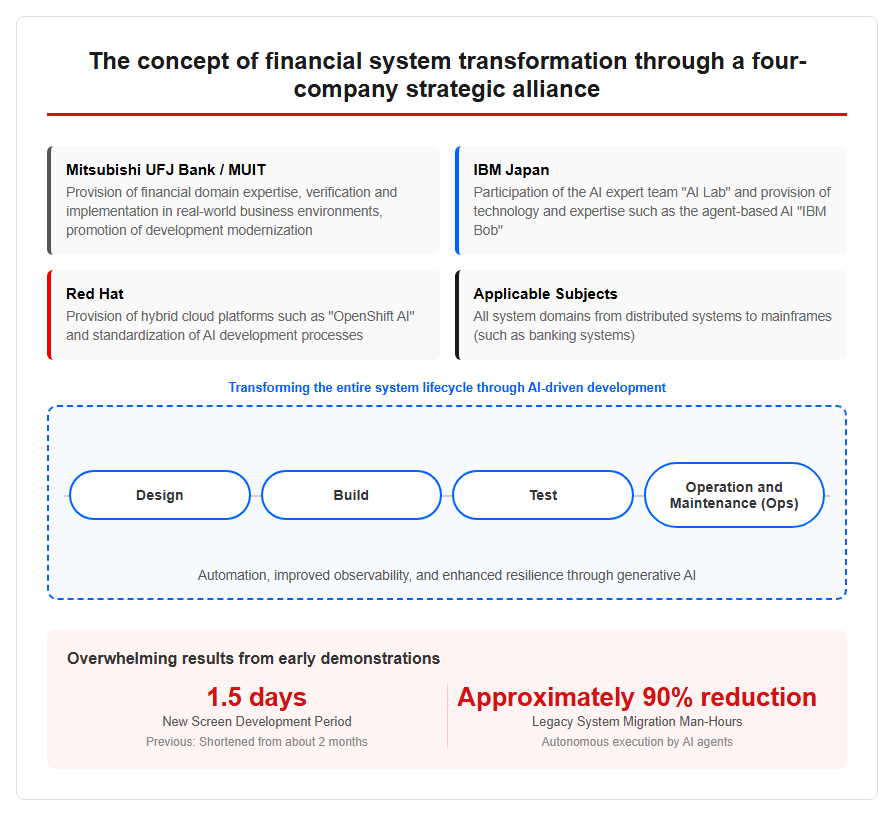
On July 6, 2026, four companies—The Bank of Mitsubishi UFJ, Inc., Mitsubishi UFJ Information Technology Co., Ltd. (hereinafter MUIT), Red Hat Corporation, and IBM Japan Co., Ltd. (hereafter IBM Japan)—announced the signing of a strategic partnership aimed at fully applying AI-driven development across the entire financial system. At the heart of this partnership lies not only in automatically generating program code but also integrating AI technology throughout the entire system lifecycle—from design, implementation, and testing to post-operational operation and maintenance. In the financial industry, as customer needs become more sophisticated, improving the speed of service delivery has become a top priority. However, the financial system, which has been operated for many years, is becoming increasingly complex, and the structure that requires significant human labor for maintenance and management has become a major management challenge. The four companies will integrate multiple ongoing projects into this partnership to accelerate demonstration and implementation. The following diagram illustrates the concept of transformation brought about by this partnership.
Dramatic improvement in development productivity, reducing two months to 1.5 days
Prior demonstrations conducted prior to this partnership have numerically demonstrated the overwhelming productivity improvements brought by AI-driven development. In the internal system development within Mitsubishi UFJ Bank, the development period for new screens, which previously took about two months, has been shortened to just 1.5 days thanks to the use of AI. Additionally, when migrating legacy systems built with older development languages to modern environments, it has been confirmed that about 90 percent of man-hours can be reduced. Mitsubishi UFJ Bank has been engaged in “development modernization” through its IT subsidiary MUIT, and this partnership will evolve that effort into a model based on a higher level of AI technology. By highly supporting and automating the traditional quality assurance process, which previously required an extremely high human burden, it becomes possible to achieve both agility and bank-level quality simultaneously.
AI-based system lifecycle covering operation and maintenance
One of the major features of this strategic partnership is the full-scale application of AI not only in the development process but also in the areas of “operation and maintenance.” Once a financial system begins to operate, enormous resources are spent to maintain its stability. The four companies aim to improve observability by closely linking their surveillance systems with AI agents. Specifically, when system performance degrades or unexpected failures occur, AI immediately identifies the cause and quickly executes everything from analyzing the impact area to deploying recovery actions. This aims to significantly strengthen the resilience of financial infrastructure against unexpected incidents. The expert team at IBM Japan, the “AI Lab,” is also participating in Mitsubishi UFJ Bank’s core banking system modernization projects and is jointly advancing the study of next-generation operational architectures.
Technical Background Beyond the Mainframe Wall
Autonomous Development Enabled by Agent-Based AI “IBM Bob”
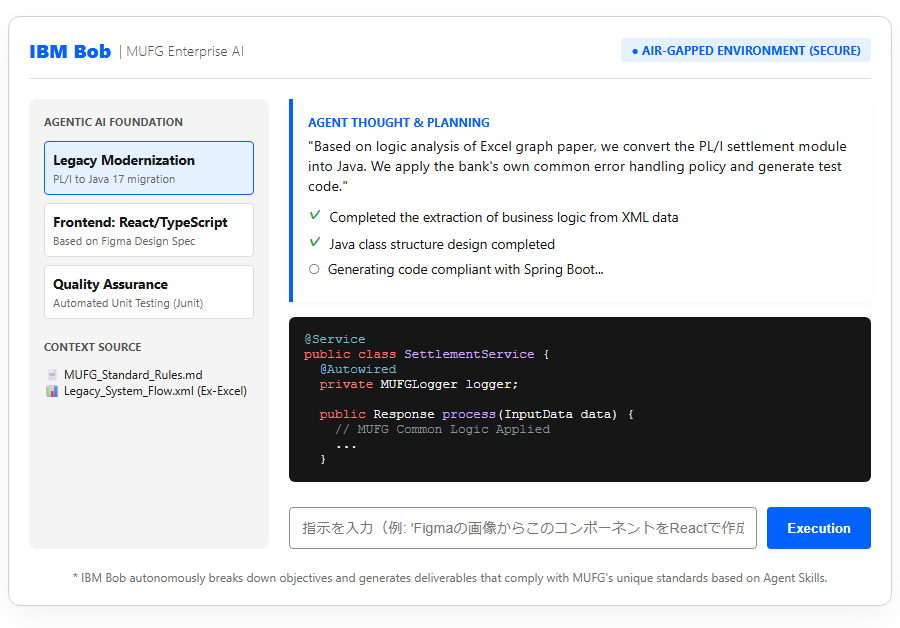
On the technical side, the project is strongly driven by the agent-based AI platform “IBM Bob” provided by IBM Japan. IBM Bob is not just a code completion tool, but an advanced AI system capable of autonomously carrying out the entire software development process. In traditional development, humans had to break down requirements and give instructions to AI, but agent-based AI understands goals and can plan and execute tasks independently. At MUIT, this AI is fed with text data trained on specific methodologies and standard rules called “Agent Skills,” generating deliverables that comply with the Mitsubishi UFJ Group’s unique development standards. On December 18, 2025, these skills will be formally recognized as the “Agentic AI Foundation.” The diagram below shows an interface image of IBM Bob.
Balancing Security and Flexibility with a Hybrid Cloud Platform
When financial institutions implement AI, the biggest concerns are data security and governance. To address this challenge, Red Hat provides container-based application platforms such as “Red Hat OpenShift AI” and “Red Hat Enterprise Linux AI,” responsible for standardizing AI development processes in hybrid cloud environments. In banking operations, there are many highly confidential tasks that cannot be accessed via external public clouds, but Red Hat’s technology makes it possible to operate AI agents even in “air-gapped environments” isolated from the internet. This allows banks to protect their proprietary confidential logic and customer data, while benefiting from AI-driven development efficiency. A flexible foundation that allows flexible use between on-premises and cloud environments supports the implementation of AI-driven development.
Breaking away from legacy languages and analyzing Excel graph paper
In Japanese financial institutions, major barriers to system renewal are the mainframe domain built with old COBOL code and the personalized, personalized document management. MUIT’s strategy emphasizes the revival of these “dead data assets.” For example, there are attempts to have AI analyze old specifications created in Japan’s unique “Excel graph paper” format and automatically convert them into program code. By having LLMs process Excel files as XML-based data structures, it became possible to directly understand complex flowcharts and business logic. Additionally, a method has been established to generate React and Angular code from PNG images from the UI design tool Figma. As the aging and shortage of engineers become increasingly serious, AI is becoming a powerful tool to overcome the walls of tacit knowledge that has become dependent on individuals.
Intensifying AI Competition Among the Three Mega Banks
Mitsubishi UFJ triples its staff, and other banks have three different strategies.
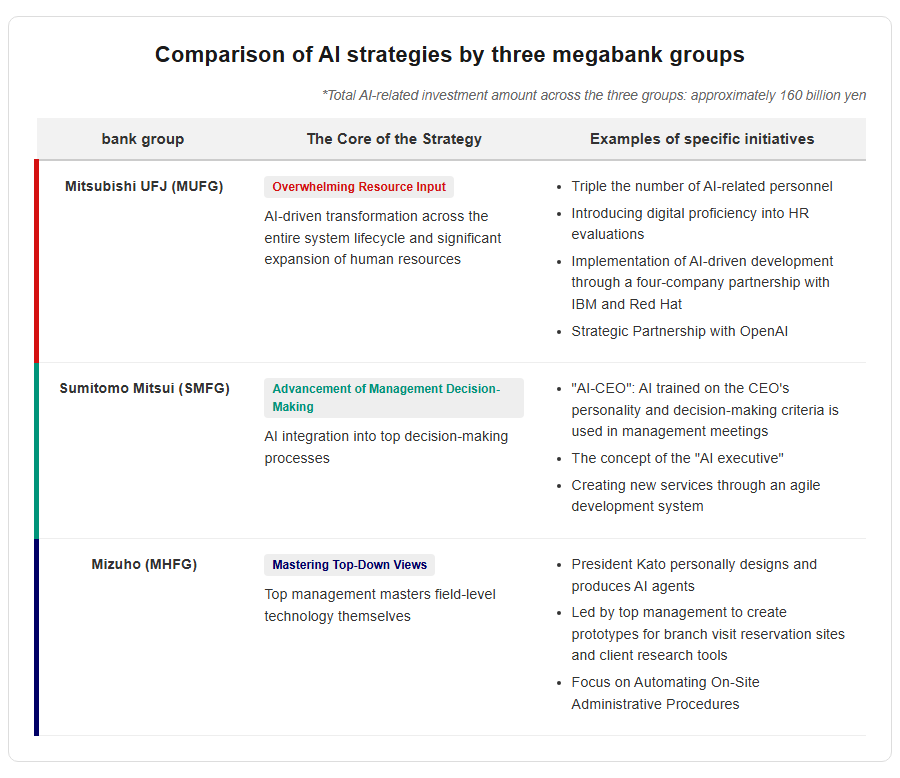
AI investment by major banks is extremely active, with the combined AI-related investment of the three major groups reportedly reaching approximately 160 billion yen. Among them, Mitsubishi UFJ overwhelmingly outperforms others in resource allocation, such as tripling its AI-related staff. Meanwhile, competitors are also presenting their own unique style. Katsuhiko Kato, President of Mizuho Bank, personally designed an AI agent and created a prototype for the branch’s visit reservation site, demonstrating his technical mastery through the top leadership. Additionally, Sumitomo Mitsui Financial Group is attempting to utilize AI in management meetings, such as utilizing “AI-CEO,” which incorporates the CEO’s personality and decision-making criteria, to enhance management decision-making. Even in the banking industry, where AI has been largely alike, differences in how AI is utilized are beginning to become increasingly distinct. The chart below compares the characteristics of AI strategies across different banks.
Rereallocating Human Resources and Transforming Organizational Culture
The introduction of AI-driven development is not just about cost reduction. Mitsubishi UFJ Bank and MUIT see this technological transformation as an opportunity to increase the mobility of development talent and shift engineers toward higher-value tasks. Traditional financial system development was a “labor-intensive” model that involved translating vast requirements definitions into code through manpower tactics. However, as AI takes over most of the implementation and testing tasks, engineers are expected to take on the role of the system’s “strategic architect.” Within the Mitsubishi UFJ Group, we are also supporting organizational culture transformation from the perspective of evaluation systems, such as introducing digital technology proficiency into personnel evaluations. They position AI not as a ‘stealer’ but as an ‘amplifying force,’ aiming to define a new way of working for bankers.
Ensuring Safety in AI-Driven Development
The 80-point principle and the importance of human-in-the-loop
AI-driven development always carries the risk of hallucination—the phenomenon of generating responses that are not based on actual data. Mitsubishi UFJ Bank adopts a realistic approach to this risk called the “80-point principle.” Expecting 100 percent accuracy from AI is inefficient, so we thoroughly implement a “Human-in-the-loop” model where humans carefully review and correct the remaining 20 percent of the “80 outputs” quickly generated by AI. This is also a lesson to be learned from the three major domestic failures that occurred in 2021. Many past system failures were caused by insufficient testing processes or misjudgments by experts with expertise. By establishing a system where humans bear the ultimate responsibility for quality assurance rather than leaving everything to AI, they guarantee the extremely high level of reliability required of financial systems.
Measures against copyright risks and black-box operations
In AI-generated code, risks such as unintentionally reusing copyrighted existing code and issues such as “black boxing” that obscures the program generation process have also been pointed out. MUIT has incorporated automated security scans for AI-generated code and OSS (open source software) license checks as standard into the development pipeline. Additionally, the “Step-Up Model” was introduced for training young engineers. It starts with a “read-only mode” where AI acts as code commentator, and only allows AI to generate code once intuition and judgment are developed. This aims to prevent the hollowing out of skills by “not being able to explain why the code became so good,” and to maintain future fault response capabilities.
Future Outlook and Establishment of Industry Standards
Cross-Industry Expansion of Mitsubishi UFJ Models
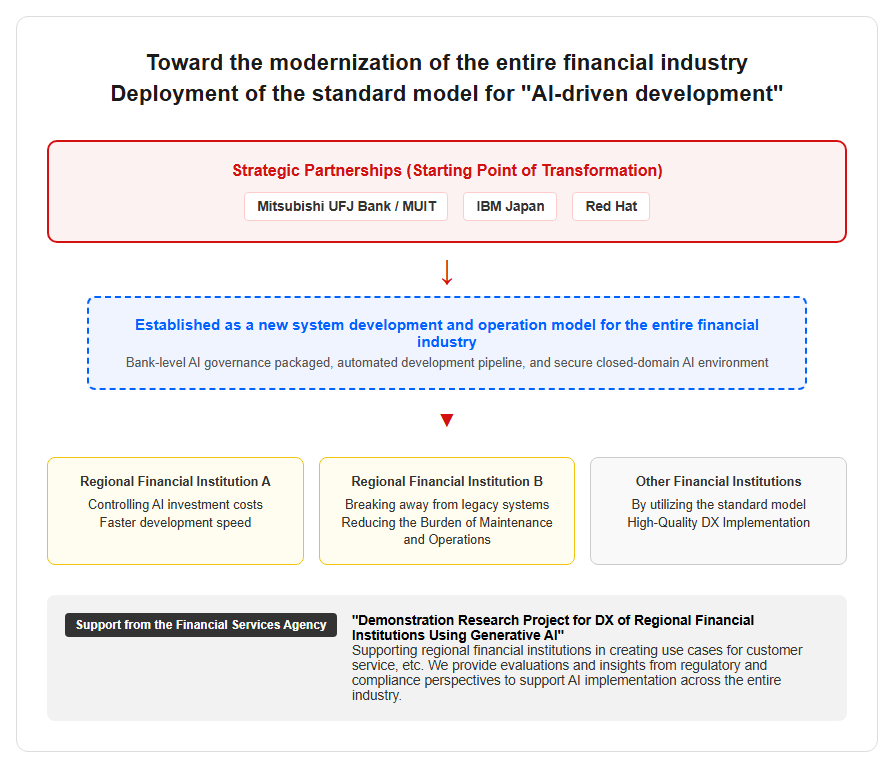
This strategic partnership among these four companies is not limited to internal transformation within Mitsubishi UFJ Bank. The four companies aim to continuously develop the knowledge and achievements gained through this project, aiming to establish it as a “new system development and operation model for the entire financial industry” in the future. Specifically, the plan is to provide this platform and development methodology to regional financial institutions that find it difficult to make large-scale AI investments on their own. The Financial Services Agency is also planning an “Empirical Research Project for DX of Regional Financial Institutions Using Generative AI,” supporting the industry-wide expansion of AI implementation. By leading the standardization of “bank-level AI governance” led by Mitsubishi UFJ, it is expected that the modernization of Japan’s overall financial infrastructure will accelerate. The following diagram illustrates the deployment to regional financial institutions.
Training Next-Generation Financial Engineers and the ‘Year One of AI Agents’
2025 is called the “Year of AI Agents,” marking the evolution of AI into a stage where it acts autonomously. The “AI-driven development” aimed at by four companies, including Mitsubishi UFJ Bank, is at the forefront of the paradigm shift brought about by this agent-based AI. The future focus will be on how to train the next generation of engineers who collaborate with AI. Engineers must evolve from “writers” of programming to “orchestrators” who wield the powerful computing resources of AI. While AI automates routine tasks, humans will focus on decision-making based on deep understanding of the financial domain and ensuring resilience against unexpected events. If this new division of labor system succeeds, Japanese financial institutions will overcome the “2025 cliff” and regain strong competitiveness in the global digital market.


コメント