
On July 10, 2026, MetaPlanet Inc., JPYC Corporation, and Progmat began joint discussions in the “digital credit” sector, which combines Bitcoin, stablecoins, and security tokens. This initiative aims to solve the financing challenges faced by mid-sized and growth companies and to build next-generation financial infrastructure that offers new yield products to individual investors in Japan.
- Aim of creating new markets through a four-company alliance
- Division of roles and expertise among participating companies
- Project NOVA and the Financial Assetization of Bitcoin
- Achieving 24/7 settlement and prorated distribution
- The digital securities market rapidly growing to the 1 trillion yen scale
- Regulatory Barriers and the Future of Separate Taxation for Practical Use
Aim of creating new markets through a four-company alliance
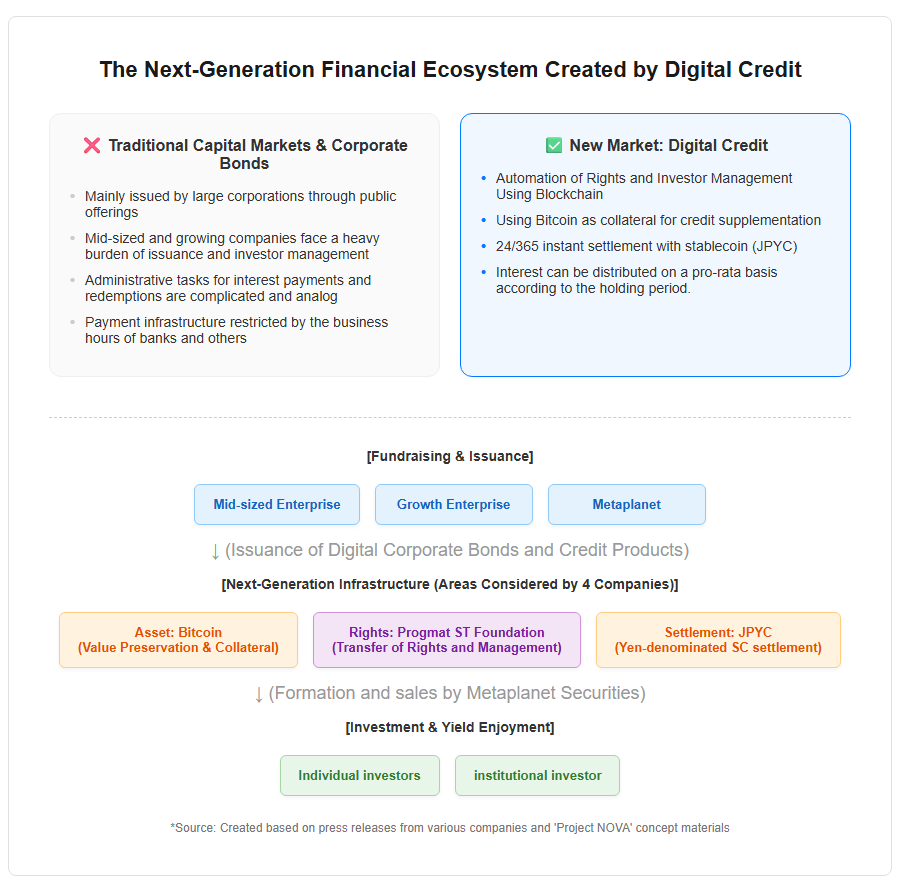
On July 10, 2026, Bitcoin treasury company MetaPlanet Inc. announced that, through its wholly owned subsidiary Metaplanet Ventures, it had begun joint discussions in the digital credit sector with JPYC Inc., Progmat, Inc., and Metaplanet Securities (now Siiibo Securities), which is scheduled to change its name on July 13, 2026. In this concept, “digital credit” refers to a mechanism that issues and manages financial products on the blockchain with predefined cash flows such as interest, redemption, and collateral. A major feature is that it targets a broader range of credit financial products, rather than limiting itself to specific digital corporate bonds.
Behind this consideration lies the structural challenges faced by Japan’s funding market. Currently, Japan’s corporate bond market is skewed toward public offerings by large corporations, and for mid-sized and growing companies, the administrative and technical burdens associated with issuance operations, investor management, interest payments, and redemptions are extremely heavy. By leveraging digital technologies, the four companies are significantly reducing these operational costs and aiming to open direct financial pathways for companies that have been left behind in the market. This initiative goes beyond simply digitizing payment methods; it is an ambitious project that redefines the very infrastructure of capital markets themselves. The diagram below illustrates the market image that digital credit aims to envision.
Division of roles and expertise among participating companies
In this joint review, a system has been established to combine the unique strengths each company possesses. First, Metaplanet, which places Bitcoin as its core financial asset, and Metaplanet Securities, its group company, will lead product design and composition. Metaplanet is one of the world’s leading Bitcoin holders as of July 2026, holding 43,000 BTC, leveraging its operational expertise and credibility as a publicly listed company to handle screening, sales, and investor communication. Metaplanet Securities (formerly Siiibo Securities) has a track record of handling over 100 issues across 40 companies on its online private bond platform, and its practical expertise is key to commercialization.
Meanwhile, in terms of payments and infrastructure, JPYC and Progamat play important roles. JPYC Corporation is responsible for issuing and redempting the Japanese yen-denominated stablecoin “JPYC,” providing payment methods that enable on-chain interest payments and redemptions. Furthermore, Progmat, which became independent from Mitsubishi UFJ Financial Group, provides “Progmat SaaS,” a platform for issuing and managing security tokens (ST). Progmat is a national infrastructure with approximately an 80% share of the digital securities market (based on new issuance in 2025), ensuring legal robustness for rights transfers and holder management. In this way, by combining the four layers of issuers, securities firms, stablecoins, and ST foundations, vertical integration is possible.
Strategic Background and Technological Innovation
Project NOVA and the Financial Assetization of Bitcoin
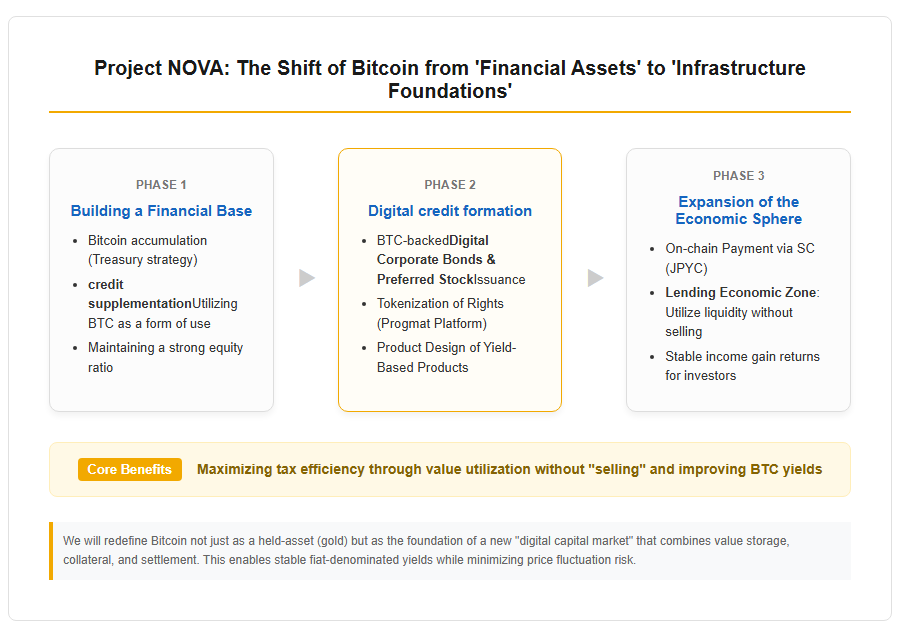
This review is positioned at the core of Metaplanet’s financial business initiative, “Project NOVA.” Project NOVA is a strategy that positions Bitcoin not merely as a held-asset but as a foundational asset that provides credit enhancement, value preservation, and collateral functions. Until now, Bitcoin investments have mainly aimed to capitalize on price appreciation, but by leveraging digital credit mechanisms, it becomes possible to generate stable income gains (yields) backed by Bitcoin.
Specifically, a “digital credit” strategy is envisioned, where preferred shares or digital bonds are issued using Bitcoin as collateral, and the funds are used to further build assets and expand businesses. Simon Gerovic, CEO of Metaplanet, has shown strong interest in launching products in Japan that offer stable prices and fixed dividends, such as Bitcoin-backed preferred shares (such as STRC) already available in the U.S. While Bitcoin’s value continues to rise, stablecoin-denominated debt remains fixed, making a model that allows you to utilize funds without compromising asset value can be a highly attractive option for individual investors in Japan. The acceleration of Bitcoin and financial integration can be summarized as shown in the diagram below.
Achieving 24/7 settlement and prorated distribution
Its greatest technical feature is the realization of “24/7 trading and settlement” and “pro-rated interest and distribution,” which were difficult with conventional securities infrastructure. Under Japan’s current legal system and practical practices, restrictions such as dividend systems under the Companies Act, record date systems, and shareholder registry management create significant barriers to flexible distributions according to the holding period. However, by managing rights on the blockchain as security tokens (ST) and making payments with stablecoins, it becomes possible to automate rights management and payment calculations at the holder level.
This allows investors to receive fair interest and distributions for daily or even very short holding periods. This is an attempt to maximize capital efficiency and aims to build a Japanese version of market infrastructure based on the premise of “daily revenue recognition” seen in leading markets such as the United States. The ST platform provided by Progmat leverages trust bank licenses that enable legally valid rights transfers and asset management, and has mechanisms to overcome regulatory barriers that cannot be overcome by technical capabilities alone. Once this on-chain, fully integrated digital securities infrastructure is established, the transparency and efficiency of Japan’s financial market are expected to improve dramatically.
Market Outlook and Future Challenges
The digital securities market rapidly growing to the 1 trillion yen scale
A driving force behind this round of digital credit considerations is the rapid expansion of the digital securities (ST) market within Japan. According to Progmat’s “Digital Securities Market Outlook 2026,” the domestic balance of ST deals is expected to double from about 583.1 billion yen at the end of 2025 to 1.0531 trillion yen by the end of 2026. The total number of projects is also expected to reach 110, and the market is entering a full-scale adoption phase beyond chasm.
In particular, the increasing proportion of bond-type STs (digital corporate bonds) is a positive factor for this digital credit initiative. Until now, STs backed by real estate have been mainstream, but it is expected that their use as a financing tool for operating companies will expand in the future. Also, from 2026, the phase will shift to full-scale introduction of tokenization of mutual funds and on-chain settlements linked with stablecoins. This joint review by these four companies can be seen as a strategic move aligned precisely with this market turning point. With Progmat holding a dominant position of about 80% of the market, there is potential that the results of these studies could directly become the industry standard (OS).
Regulatory Barriers and the Future of Separate Taxation for Practical Use
While it is highly anticipated, there are still many challenges to overcome before practical application. First, on the regulatory side, the focus is on easing the transfer limit of “1 million yen per day” imposed on the issuance and redemption of stablecoins (electronic payment methods). Noritaka Okabe, CEO of JPYC, pointed out that this has become a barrier to global expansion and large-scale financial innovation, and is advancing efforts to support large-scale payments through preparations for obtaining a Type 1 money transfer business license. Additionally, for trust-type stablecoins, utilizing a specific trust beneficiary rights scheme may allow the 1 million yen limit to be avoided, making it urgent to clarify legal interpretations.
On the tax side, attention will be drawn to the trends of the amendment to the Financial Instruments and Exchange Act approved by the Cabinet in April 2026. If this amendment is smoothly implemented, a 20% separate tax on crypto assets is expected to be applied starting in 2028, significantly lowering barriers for individual investors to enter. This digital credit product requires long-term product design that anticipates these tax reforms. The four companies plan to deepen discussions with relevant authorities while advancing legal and regulatory procedures and technical verification. Although the exact issuance timing and yield have not yet been finalized, the results of this year’s review will likely determine the future of Japan’s digital asset market.
[#メタプラネット #JPYC #Progmat #ビットコイン #デジタルクレジット #フィンテック #ステーブルコイン #セキュリティトークン]


コメント