OpenAI has officially released its autonomous business agent, ChatGPT Work. The background is fierce competition for market share with competitors and a strategic shift that evolves AI from mere tools into execution agents.
- Release on July 10, 2026 and the three-tier structure of GPT-5.6
- The fiercely competitive environment of the enterprise AI market
- Building Autonomous Workflow Through Multi-App Integration
- Advanced coding support through integration with Codex agents
- A trillion-dollar IPO and soaring computational costs
- Shift to orchestration over decision-making rights between humans and AI
Release on July 10, 2026 and the three-tier structure of GPT-5.6
On July 10, 2026, OpenAI, a pioneer in AI development, officially announced ChatGPT Work, a next-generation AI agent specialized for enterprise business automation, alongside the public launch of GPT-5.6, the latest AI model family. This announcement marks the first formal application of the AI Cybersecurity Executive Order signed by the Trump administration in early June 2026, realized after a roughly two-week public delay due to national security concerns. The GPT-5.6 model installed is composed of three grades: Sol, Terra, and Luna, which mimic the sun, Earth, and Moon. ChatGPT Work employs Sol, which boasts the highest reasoning ability, as its main brain. Sol recorded 91.9% for Sol Ultra and 88.8% for standard Sol in Terminal-Bench 2.1, a benchmark for agent-based coding, providing a solid foundation for efficiently handling advanced tasks.
The fiercely competitive environment of the enterprise AI market
The launch of ChatGPT Work came amid fiercer competition for market share with competitors in the enterprise market than ever before. As of July 2026, the AI industry landscape has changed dramatically, with Elon Musk publicly recognizing rival Anthropic as “clearly the current AI leader” and praising the company’s models as unparalleled. In fact, Anthropic’s valuation in the private equity market has reached about $1.2 trillion (approximately 194.8 trillion yen), surpassing OpenAI’s $908 billion (about 147.4 trillion yen). Furthermore, SpaceXAI, led by Musk, announced Grok 4.5 and implemented an aggressive low-price strategy that significantly outperformed competitors, putting OpenAI under a strong siege. ChatGPT Work is positioned as a direct competitor to Anthropic’s Claude Cowork, which is ahead in enterprise automation needs, serving as a strategic cornerstone for OpenAI to reestablish its dominance in the business market.
Innovative Features of ChatGPT Work
Building Autonomous Workflow Through Multi-App Integration
The biggest feature of ChatGPT Work is that it goes beyond its role as a simple chatbot and is an autonomous system that performs complex tasks on behalf of users. This agent can seamlessly connect with a wide range of essential tools for modern businesses, such as Slack, Gmail, Google Drive, Google Calendar, and major CRM systems. Unlike traditional AI that only generated answers to user questions, ChatGPT Work automatically completes a multi-step workflow by obtaining sources from financial data, matching numbers to create presentation materials, and reviewing the outputs yourself. For example, finance teams have already started using it to accelerate month-end report creation and future forecasting, making it easy to generate complex spreadsheets and web applications. Please refer to the diagram below.
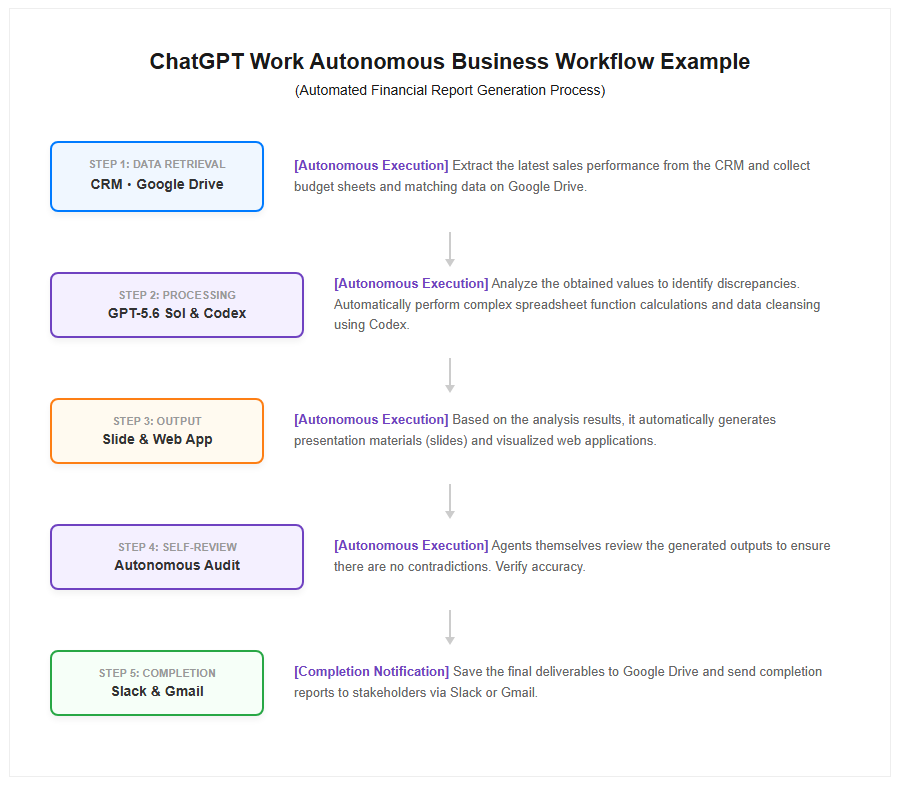
In this way, the ability to act autonomously across different apps has the potential to fundamentally overturn conventional ideas about business efficiency.
Advanced coding support through integration with Codex agents
What strongly supports ChatGPT Work’s autonomy is its advanced integration with Codex, OpenAI’s coding agent. According to OpenAI, Codex’s weekly user base has already exceeded 5 million as of July 2026, with more than 1 million of them utilizing this feature for tasks outside of traditional programming. ChatGPT Work is built on this Codex technology, and token efficiency in agent-based coding tasks has improved by 54% compared to previous models. This efficiency has enabled more accurate and advanced system construction and automated data processing while optimizing inference costs. Additionally, through a partnership with semiconductor startup Cerebras, GPT-5.6 Sol is expected to achieve ultra-fast operation of 750 tokens per second on dedicated hardware by July 2026. This enables smooth execution of operations without time lag even in high-load operations where multiple subagents run in parallel.
Future Developments and Highlights
A trillion-dollar IPO and soaring computational costs
OpenAI aims for a historic $1 trillion IPO through the adoption of ChatGPT Work, but the path remains uncertain. CEO Sam Altman acknowledges that the company is currently spending funds at a record pace, and that rising computing power and memory costs are major headwinds for continued expansion. OpenAI is now faced with a choice between waiting until 2027 to secure a $1 trillion valuation or going public with a smaller valuation within 2026. In terms of operational costs, the new prompt caching specifications introduced with GPT-5.6 also have a significant impact on enterprise API usage. Writing to cache is 1.25 times the unit price of non-cached input, but reading is 90% off, so to operate agents like ChatGPT Work that operate for long periods economically, efficient system design that understands this pricing structure is essential.
Shift to orchestration over decision-making rights between humans and AI
The biggest focus in future business settings will be the discussion of “orchestration,” which is how decision-making authority is distributed between humans and AI. According to a survey conducted in early 2026, there are ironic reports that intensive AI use correlates with increased workloads and burnout, highlighting that simply introducing tools does not lead to true productivity improvements. What organizations need to do in the future is not to ask what AI can do, but to build a strategic framework (Agency Continuum) that shapes decision-making authority between humans and AI. As highly autonomous agents like ChatGPT Work become widespread, humans need to shift from field workers to orchestrators who define AI’s behavioral boundaries and take responsibility for the entire system. As AI proposes goals and takes on execution, the fundamental question for future technology utilization is which process to leave human will.
[#ChatGPTWork #OpenAI #GPT56 #AIエージェント #業務自動化 #科学技術 #生産性向上]

コメント