Tris of the Aisan Kogyo Group has established a manufacturing technology for high-purity tungsten suitable for semiconductor applications. Behind this move lies the urgent challenge of a tungsten supply crisis caused by China’s export restrictions, and the resilience of domestic supply chains to counter it.
- Establishment of manufacturing technology and mass production plans by Tris
- The significance of automotive parts manufacturers entering the semiconductor materials market
- Prices soar 557% and China’s overwhelming market share
- The crisis of ‘zero domestic production’ brought about by the suspension of exports to Japan
- The Essential Role of Tungsten in Next-Generation Semiconductors
- The transition to alternative materials like molybdenum and its limitations
- Mitsubishi Materials’ ‘Urban Mines’ and the North American Circulation System
- Sumitomo Electric Increases Domestic Production Capacity by 1.5 Times
- Roadmap to Begin Mass Production in 2028
- Establishing ‘Clean Resilience’ to Protect Japan’s Manufacturing Industry
Establishment of manufacturing technology and mass production plans by Tris
Tris (Matsusaka City, Mie Prefecture), a group company of Aisan Kogyo, announced that it has established manufacturing technology for high-purity tungsten, which is essential for semiconductor manufacturing processes. Specifically, it produces tungsten powder of extremely high purity, which is required as a raw material for tungsten hexafluoride (WF6) used in the miniaturization process of next-generation semiconductors. This development has already passed evaluation tests for mass production and is at the stage of overcoming major hurdles toward practical application.
This technological establishment marks the first full-scale entry into the “upstream field” of material generation for the Aisan Kogyo Group, which has mainly focused on automotive parts manufacturing. By advancing the high-purity material production technology that Tris has cultivated so far, they have succeeded in establishing a new manufacturing process. Mass production is scheduled to begin in January 2028, with the Triis Koyo plant in Mie Prefecture expected to serve as the base. This is a symbolic example embodying the group’s VISION2030 of “expanding possibilities into the non-mobility sector.”
The significance of automotive parts manufacturers entering the semiconductor materials market
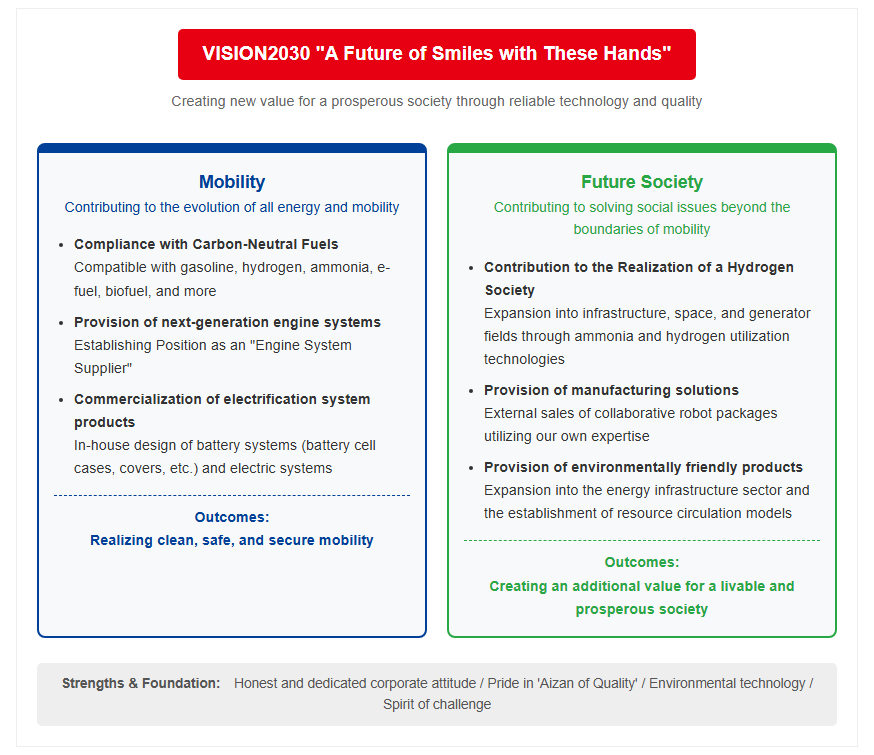
The background behind Aisan Kogyo’s entry into the semiconductor materials field this time is based on two aspects: structural changes in the automotive industry and economic security requirements. The company has traditionally held a high global market share in engine components such as fuel pump modules and throttle bodies, but with the progress of electrification, it is now compelled to build new revenue pillars independent of internal combustion engines. Applying the “manufacturing strengths” cultivated through precise fluid control technology, foreign matter management, and process management to the rapidly growing semiconductor supply chain is an extremely rational strategy.
Please refer to the diagram below. This is the structure of Aisan Industry’s dual-axis strategy of mobility and future society.
Furthermore, semiconductors are core components responsible for “running, turning, and stopping” in modern automobiles, and the stable availability of these materials directly impacts the overall resilience of the automotive industry. In particular, tungsten is indispensable as a contact material for connecting semiconductor substrate wiring, and its importance increases as miniaturization advances. For component manufacturers to have domestic production capabilities for materials, it is expected to reduce the risk of supply chain disruption and contribute to strengthening the overall competitiveness of Japan’s semiconductor industry.
The shock of the tungsten shock and the reality of China’s dependence
Prices soar 557% and China’s overwhelming market share
The global tungsten market is currently in the midst of a historic supply crisis, known as the “tungsten shock.” From 2025 to 2026, the benchmark price of APT (ammonium paratanguate), an intermediate ingredient for tungsten, recorded an astonishing surge of up to 557% compared to before the regulation was implemented. This rate of increase far exceeds that of major commodities like gold and copper, pushing a severe wave of cost increases across the manufacturing sector.
At the root of this abnormal situation lies China’s overwhelming monopoly on resources. As of 2024, China accounts for about 82% of global tungsten mine production, making it a material with an extremely high degree of “geopolitical unevenness” than its scarcity. In February 2025, the Chinese government used this dependence as a weapon to announce export restrictions on several key minerals, including tungsten. Furthermore, entering 2026, export controls to Japan will be further strengthened, with exports of items deemed to contribute to military use being banned without exception, effectively advancing the “weaponization of resources.”
The crisis of ‘zero domestic production’ brought about by the suspension of exports to Japan
China’s tightening of export controls has hit Japan’s high-tech industry hard. Entering 2026, a historic situation has occurred where China’s exports of high-purity tungsten powder to Japan will temporarily drop to zero. As a result, domestic production of tungsten hexafluoride (WF6), a specialty gas essential for semiconductor manufacturing, has been halted, and demand is being supported by inventory alone, leading to a precarious situation. Major Japanese chemical manufacturers such as Kanto Denka Kogyo and Central Glass supply WF6 to global semiconductor companies like TSMC, Samsung Electronics, and SK Hynix, but they are facing severe shortages due to difficulties in sourcing raw materials.
If this supply shortage is not resolved, production of essential devices for AI servers, such as 3D NAND flash memory and high-bandwidth memory (HBM), may be halted. The supply chain, which had been built on the premise that “being able to buy is a given,” has collapsed, and although Japanese companies have maintained production for several months by utilizing existing inventory, securing alternative sources has become an extremely difficult challenge. In such extreme conditions, the fact that domestic companies like Aisan Industrial Group independently established manufacturing technologies is an important step in overcoming the national crisis.
The Lifeline of the Semiconductor Industry: The Supply Crisis of Tungsten Hexafluoride
The Essential Role of Tungsten in Next-Generation Semiconductors
Due to its physical properties, tungsten plays an irreplaceable role in semiconductor manufacturing. Its melting point is 3,422°C, the highest among all metals, and it combines high electrical conductivity with chemical stability. In particular, when used in the form of a gas called tungsten hexafluoride (WF6), it is employed to fill extremely fine wiring and vias (interlayer connections) inside semiconductor chips through the chemical vapor deposition (CVD) process. This is a central technology for ensuring electrical conductivity in structures such as 3D NAND memory, where transistor layers are stacked vertically.
In recent years, with the growing demand for AI-driven semiconductors, the importance of tungsten in advanced processes below 7 nanometers (nm) has further increased. For example, Intel’s 18A process consumes about 15g of tungsten gas per wafer, and TSMC is also accelerating to expand supply capacity toward mass production of the 2nm process. About 60–70% of WF6 production costs are made from high-purity tungsten powder, and since the purity of raw materials affects the yield (yield rate) of the final product, extremely advanced manufacturing techniques are required.
The transition to alternative materials like molybdenum and its limitations
Due to supply concerns about tungsten, global semiconductor manufacturers have begun exploring the introduction of alternative materials. South Korea’s SK Hynix has revealed plans to adopt molybdenum instead of tungsten in the development of next-generation 375-layer NAND flash memory. Samsung Electronics is also said to have already introduced molybdenum materials in some of its NAND products for SSDs. Molybdenum is a high-melting-point metal similar to tungsten, and it holds potential as an alternative in certain processes.
However, there are still high hurdles to fully replace tungsten. Tungsten’s unique density, wear resistance, and high-temperature stability are often insufficient for molybdenum in extreme environments such as defense applications where kinetic energy is important, rocket nozzles, and hypersonic propulsion components. Additionally, existing semiconductor manufacturing lines are optimized for tungsten-based processes, requiring enormous development costs and time reinvestment to switch materials. Therefore, for the time being, ensuring the stability of high-purity tungsten remains undoubtedly the top priority for semiconductor manufacturers.
Industry Restructuring: Mitsubishi Materials and Sumitomo Electric’s Resource Strategies
Mitsubishi Materials’ ‘Urban Mines’ and the North American Circulation System
While Aisan Kogyo is working to establish domestic manufacturing technology, Mitsubishi Materials, a major non-ferrous company, is accelerating bold global investments centered on “resource circulation.” At the end of 2024, the company completed the acquisition of H.C. Starck, a leading German tungsten manufacturer, for approximately 58.9 billion yen. With this acquisition, Mitsubishi Materials secured production bases in Europe, North America, and Asia, and in particular, incorporated advanced technology with an 80% recycling rate at its German site within the group.
The core of the company’s strategy is not new mine development, but rather a ‘urban mine’ model that collects and recycles used carbide tools and electronic device scrap. In April 2026, it established a “Resource Circulation Division” in Chicago and began building a closed-loop supply chain in the United States. In the United States, domestic commercial mining has been halted since 2015, and from 2027, the Department of Defense will significantly strengthen restrictions on sourcing Chinese resources. Mitsubishi Materials is looking ahead to this “2027 deadline” and is prepared to fully meet Western demand by establishing a recycling and refining system within its allies that starts faster and has lower environmental impact than land-bound mining development.
Sumitomo Electric Increases Domestic Production Capacity by 1.5 Times
Sumitomo Electric Industries has also decided to make massive domestic investments to break free from dependence on China. Allied Materials, part of the company’s group, announced it will invest approximately 15.9 billion yen to build a new factory for tungsten powder and tungsten carbide powder in Toyama Prefecture. Operations are targeted for the first half of fiscal 2028, with plans to increase manufacturing capacity to about 1.5 times the current level. This initiative has been certified as part of the “Critical Minerals Supply Securing Plan” led by the Ministry of Economy, Trade and Industry, and is eligible for government subsidies.
Sumitomo Electric’s decision is backed by a very strong declaration of intent to “completely halt procurement from China” in May 2026. The company has set a clear goal to reduce dependence on China by 30% by 2028 and is accelerating the establishment of a self-sustaining domestic supply chain. With the entry of Aisan Industry and the strengthening of these established giants’ capabilities, Japan’s tungsten industry has reached a structural turning point from an era of “buying from China” to an era of “circulating domestically and producing in-house.” Each company leverages its strengths to tackle the common challenge of economic security with different approaches.
Looking Ahead: Industrial Resilience Brought by Mass Production Start in 2028
Roadmap to Begin Mass Production in 2028
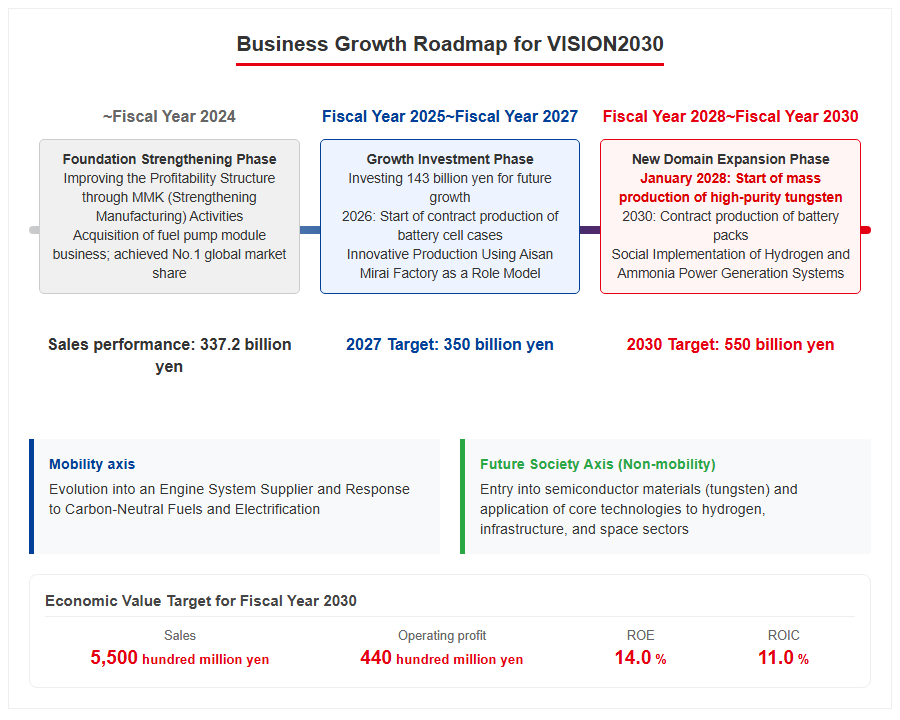
January 2028, when Aisan Kogyo Group is scheduled to begin mass production of high-purity tungsten, marks a crucial milestone in Japan’s semiconductor strategy. Based on the currently established manufacturing technologies, it is expected that in the coming years, detailed design of manufacturing equipment and fine-tuning of process compatibility with semiconductor manufacturers will be advanced. At the same time, Sumitomo Electric’s new Toyama plant is also scheduled to begin operations, and 2028 is expected to be a year in which Japan’s tungsten supply capacity will improve dramatically in both quality and quantity.
Achieving this roadmap requires knowledge of “innovative manufacturing,” such as digitizing and automating manufacturing processes. The use of collaborative robots and AI-driven process management technology at Aisan Kogyo’s “Aisan Mirai Factory” are expected to be major assets for stable production of high-purity tungsten. Please refer to the diagram below. This is the company’s business growth roadmap toward 2030.
In addition to technical challenges, building a stable collection network for scrap raw materials is also a key focus going forward. How Aisan Industry develops the “resource circulation model” in the Americas, similar to Mitsubishi Materials’ in the Americas, will likely influence the spread of this business model in domestic and Asian markets, and the profitability after mass production.
Establishing ‘Clean Resilience’ to Protect Japan’s Manufacturing Industry
The establishment of this technology by Aisan Kogyo Group is not just a business diversification by a single company, but can be seen as a symbol of “clean resilience” (clean and resilient resilience) across Japan’s manufacturing industry. The approach of overcoming the risks of relying on other countries for resources and being swayed by geopolitical intentions through domestic technology and wisdom is the right path for the future of the materials industry. There is a growing recognition that building a circular economy that turns waste into value and continuously circulates resources between one’s own country and allies is the only way to survive.
Going forward, applications are expected not only in the semiconductor field but also in other high-growth tungsten demand sectors such as additives for lithium-ion batteries (LiB), aerospace, and medical devices. For example, research is progressing on adding tungsten to LiB cathode materials to triple cycle life, making market expansion in the energy storage sector certain. The biggest focus going forward is for the Aisan Kogyo Group to bring the “pride in quality” cultivated as an automotive parts manufacturer to the materials sector, thereby enhancing the credibility of Japan’s entire high-tech industry and establishing a new sovereignty as a resource-poor country.
[#愛三工業 #タングステン #半導体材料 #経済安全保障 #資源循環 #サプライチェーン #製造業 #ビジネスニュース]

コメント