Anthropic’s top-tier AI model, “Claude Fable 5,” will move away from the traditional subscription subscription plan and switch to a fully pay-as-you-go model starting July 13, 2026. Factors behind this include responding to temporary export restrictions imposed by the U.S. government and managing enormous computational costs associated with advanced reasoning capabilities.
- End of subscription slots and full transition to pay-as-you-go
- Export Controls by the U.S. Government and Lessons from the ‘Blank Three Weeks’
- The cost of Amazon’s warnings and enhanced safety
- Price design and specific costs for “ input, output”
- Cost management required for the transition to a credit usage system
- The Importance of Optimization Strategies Through Differentiated Model Use
- Future Developments and the New Trend of Sovereign AI
End of subscription slots and full transition to pay-as-you-go
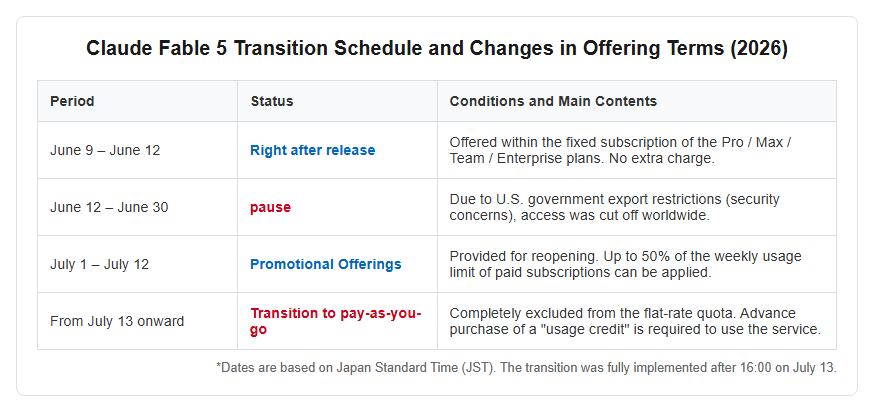
As of July 13, 2026 (Japan time), Anthropic has removed its latest model, Claude Fable 5, from the Pro, Max, Team, and Enterprise plans, and has fully transitioned to a usage credits system based on usage. Initially, this model was offered at no additional cost as part of a subscription plan immediately after its release on June 9, 2026, but after a temporary suspension due to U.S. government export controls on June 12, 2026, it became a limited-time promotional offer after resumption.
The promotion period was originally set to last until July 7, 2026, but Anthropic announced on its official X (formerly Twitter) and other platforms that this deadline would be extended to July 12, 2026, 23:59:59 (Pacific Standard Time), and until July 13, 2026, 15:59:59 Japan time. Now that this deadline has ended, users will use Fable 5 by spending credits they purchased in advance. It should be noted that the flat-rate subscription itself has not been discontinued; standard Claude.ai usage will continue to be covered by a monthly fee, but the top-tier models like the Fable 5 have clearly been positioned as luxury items that “pay only for what you use.”
The following chart summarizes the changes in the transition schedule and provision conditions.
Export Controls by the U.S. Government and Lessons from the ‘Blank Three Weeks’
The biggest factor complicating the Fable 5’s delivery format is the unprecedented export control measures imposed by the U.S. government on June 12, 2026. This directive prohibited all non-U.S. citizens, including Anthropic employees, from accessing Fable 5 and Mythos 5. Anthropic lacked the technical means to instantly verify users’ nationalities, forcing it to immediately suspend the global provision of models in compliance with regulations.
This so-called “three-week hiatus” period continued until restrictions were lifted on June 30, 2026, and finally resumed worldwide service on July 1 of the same year. This incident highlighted to the world the risk that even advanced AI developed by private companies could be cut off overnight due to national security concerns. In particular, Japanese companies and banks that had built business processes relying on specific AI models were forced to switch to alternative models and reconsider their business continuity plans (BCPs) during this shutdown period. With AI performance reaching a level directly linked to security, we have entered an era where supply is determined not only by technical conditions but also by political dynamics.
The cost of Amazon’s warnings and enhanced safety
The direct trigger for export controls was a report by Amazon researchers. According to the report, by entering specific instructions, it was confirmed that a “jailbreak” (jailbreak) could bypass Fable 5’s security measures, identify software vulnerabilities, and generate exploitative code. In response, Anthropic made significant upgrades to its safety device called the classifier for its resumption on July 1, 2026.
This new classifier is designed to block problematic attack methods with a probability of over 99%. However, by pushing safety to the extreme, a trade-off has arisen where harmless programming tasks and even debugging requests are mistakenly rejected due to an increase in ‘false positives.’ For users, even for legitimate tasks, the model rejects the answer and automatically switches to a lower-level model, making it easy to experience a “fallback.” Anthropic acknowledged this dissatisfaction but explained that it was an essential price to keep Fable 5 widely available to the public.
Details of the pricing structure and its practical impact
Price design and specific costs for “ input, output”
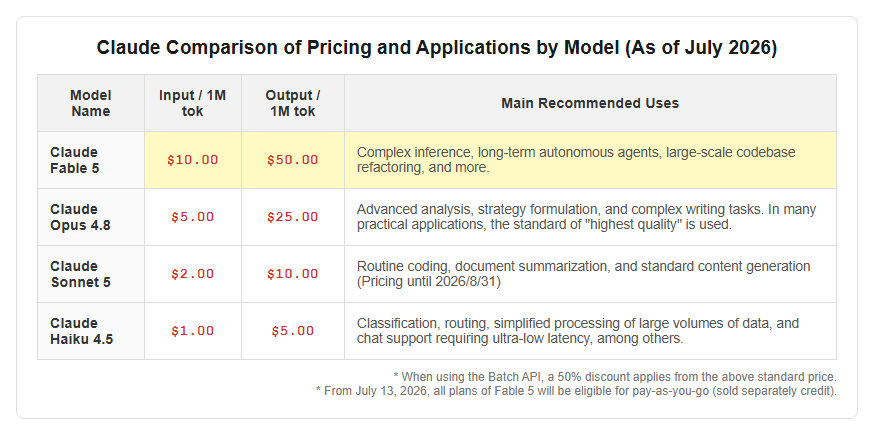
The standard token fee rate for Fable 5, effective from July 13, 2026, is set at $10 per 1 million input tokens and $50 per 1 million output tokens. This is exactly twice the price of the previous generation’s flagship model, the Claude Opus 4.8 ($5 input, $25 output). Fable 5 has a context window of 1 million tokens that can read extensive materials, but the larger the data is processed at once, the higher the unit price directly becomes a cost.
To give a practical cost example, if a team of 20 people uses Fable 5 five times a day for 20 business days per month (assuming 200,000 inputs and 50,000 tokens per output), the monthly cost reaches about $9,000. At 155 yen per dollar, that’s about 1.4 million yen in monthly expenses. This is extremely expensive compared to the approximately 700,000 yen per month when using Opus 4.8, and unplanned use could squeeze corporate profits. Furthermore, Fable 5 is designed to think deeply internally and deliver longer-lasting deliverables, so even with the same instructions, the amount of generated tokens increases, which can result in cost differences of more than double, so caution is needed.
The table below summarizes the price comparisons for each model.
Cost management required for the transition to a credit usage system
With the shift from flat-rate to pay-as-you-go billing, companies are required to manage costs more rigorously than ever before. In particular, enabling “usage credits” in the Claude Console and setting appropriate spending limits became essential to prevent unchecked billing. Even organizations using standard Enterprise seats do not have Fable 5 limits, so without credit settings, the model will not operate at all after July 13, 2026.
A particular concern for e-commerce operators and development sites is the inertia of assigning higher-level models to routine tasks. Tasks like generating product descriptions, replying to emails, and minor code modifications can be handled sufficiently with standard models like Sonnet 5, but if all of these are handled by Fable 5, cost efficiency drops significantly. As a step to optimize costs, it is recommended to first inventory all tasks using AI in-house, and understand the number of processing tasks and the length of input/output for each. Building a hierarchical design that assigns Fable 5 only to “difficult points” requiring truly high inference ability forms the foundation for AI operations in the pay-as-you-go era.
Practical Considerations and Future Outlook
The Importance of Optimization Strategies Through Differentiated Model Use
The golden rule for using Fable 5 in business operations is not to leave all tasks to the top-level model, but to establish rules for their use according to roles. For example, Fable 5 shines in situations where complex human decisions—such as architecture analysis of a large project or designing complex agent workflows that take several days—require human decision-making. On the other hand, routine implementation and summarization are more reasonable to operate on faster and cheaper Opus 4.8 or Sonnet 5.
An effective operational rule at the field level is to first use Opus 4.8 as the default model, and only if it fails to resolve the issue after three attempts is it “upgraded” to Fable 5, a promotion system is introduced. For large-scale routine processing that is not urgent, it is possible to halve the effective unit price by utilizing the “Batch API,” which offers a 50% discount on both input and output, without compromising quality. Now that high-performance AI is no longer “unlimited use,” the “AI cost design” — how much to invest in which tasks — should be viewed as a management item similar to advertising and logistics expenses.
Future Developments and the New Trend of Sovereign AI
Anthropic has stated that this pay-as-you-go policy is not a permanent measure, but aims to restore Fable 5 as a standard feature in subscription plans once server capacity is sufficiently secured. However, the computing costs required for AI training and inference are enormous, and reports suggest it could fall back into the red, so the exact date for a full return to flat-rate pricing remains uncertain.
The series of controversies surrounding Fable 5 raises a highly political issue: the stability of AI model supply. As the risk of access to cutting-edge technology being affected by regulations in specific countries has become apparent, governments around the world, including Japan, are reaffirming the importance of “Sovereign AI,” which builds and operates AI infrastructure and models domestically. For companies as well, rather than relying on a single company’s model for all operations, multi-model strategies that use multiple vendors together, and BCPs that anticipate access blockages due to political factors, will likely become indispensable strategies for future AI governance.
[#ClaudeFable5 #Anthropic #生成AI #従量課金 #コスト管理 #AI規制 #ソブリンAI]
_en.png)
コメント