Okayama University was selected for a total of 20 research projects under the Ministry of Education, Culture, Sports, Science and Technology’s (MEXT) “Supporting Pioneering Research through AI for 1,000 Discovery Challenges” (SPReAD) program. This achievement is driven by the university’s proactive push to leverage generative AI and other advanced technologies to elevate and accelerate research capabilities university-wide.
- Overview of the SPReAD Program Announced in September 2026 and Key Selection Results
- Nationwide High-Competition Selection and Strong Research Drive at Okayama University
- Institutional Reforms and Infrastructure Building as a “Regional Core and Distinctive Research University”
- Specific AI Applications in Medicine, Healthcare, and Drug Discovery Research
- Expanding Academic Horizons Through Interdisciplinary Fusion with Agriculture, Science, and Humanities
- Key Points for Future Development: AI Management and Research Ethics
Overview of the SPReAD Program Announced in September 2026 and Key Selection Results
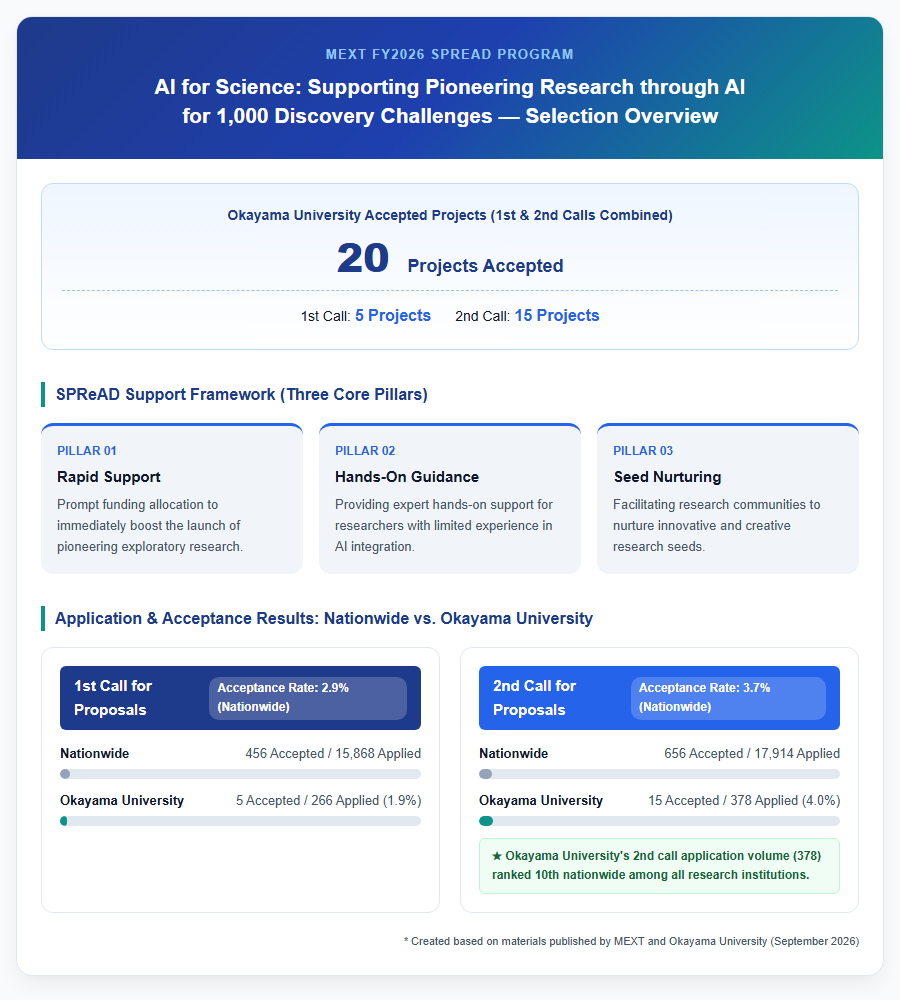
On September 8, 2026, National University Corporation Okayama University announced that a total of 20 research projects were selected under MEXT’s FY2026 program, “AI for Science Innovation Program: Supporting Pioneering Research through AI for 1,000 Discovery Challenges (SPReAD).” The SPReAD initiative aims to foster unique competitive advantages for Japan by encouraging researchers across all academic disciplines—from the humanities and social sciences to the natural sciences—to utilize AI to elevate and accelerate scientific research. Okayama University secured 5 accepted projects in the first call for proposals and 15 in the second call, demonstrating the creative drive of its diverse research community. To encourage bold initiatives even among researchers with limited AI experience, the program is built on three core support pillars: rapid funding support, hands-on guidance for AI integration, and nurturing innovative research seeds. As shown in the conceptual diagram below, this framework comprehensively accelerates the integration of AI directly into research fields.
Nationwide High-Competition Selection and Strong Research Drive at Okayama University
The SPReAD program attracted an overwhelming number of applications from across Japan, resulting in a highly competitive selection process. According to official data released by MEXT, the nationwide application and acceptance figures were as follows:
- First Call for Proposals: 456 projects accepted out of 15,868 applications nationwide (acceptance rate: 2.9%)
- Second Call for Proposals: 656 projects accepted out of 17,914 applications nationwide (acceptance rate: 3.7%)
Amid these rigorous selection odds, Okayama University secured 5 accepted projects out of 266 applications in the first call and 15 accepted projects out of 378 applications in the second call. Notably, the 378 applications submitted by Okayama University in the second call ranked 10th highest among all universities and research institutions nationwide. These figures clearly reflect the strong momentum within Okayama University to actively integrate AI into research and open up new academic frontiers.
Institutional Reforms and Infrastructure Building as a “Regional Core and Distinctive Research University”
Behind Okayama University’s strong performance in the SPReAD selection is its long-term institutional vision and robust research support framework. Under its “Okayama University Long-Term Vision 2050,” the university aims to be “A research university that co-creates the future of the region and the earth, contributing to global innovation.” To achieve this vision, the university has actively leveraged major government initiative grants, including MEXT’s “Regional Innovation and Unique Research University Strengthening Promotion Project (J-PEAKS)” and the “Advanced Research Infrastructure Renovation Project (EPOCH),” to modernize its research infrastructure and enhance its innovative capacity. The institution has established a framework that prioritizes not only the development of advanced scientific technologies, but also social implementation and public engagement. Building on the support from the SPReAD program, Okayama University is rapidly expanding an environment where students, faculty, and staff can actively apply AI to tackle unprecedented research challenges.
Examples of AI Integration Across Diverse Research Fields and Future Outlook
Specific AI Applications in Medicine, Healthcare, and Drug Discovery Research
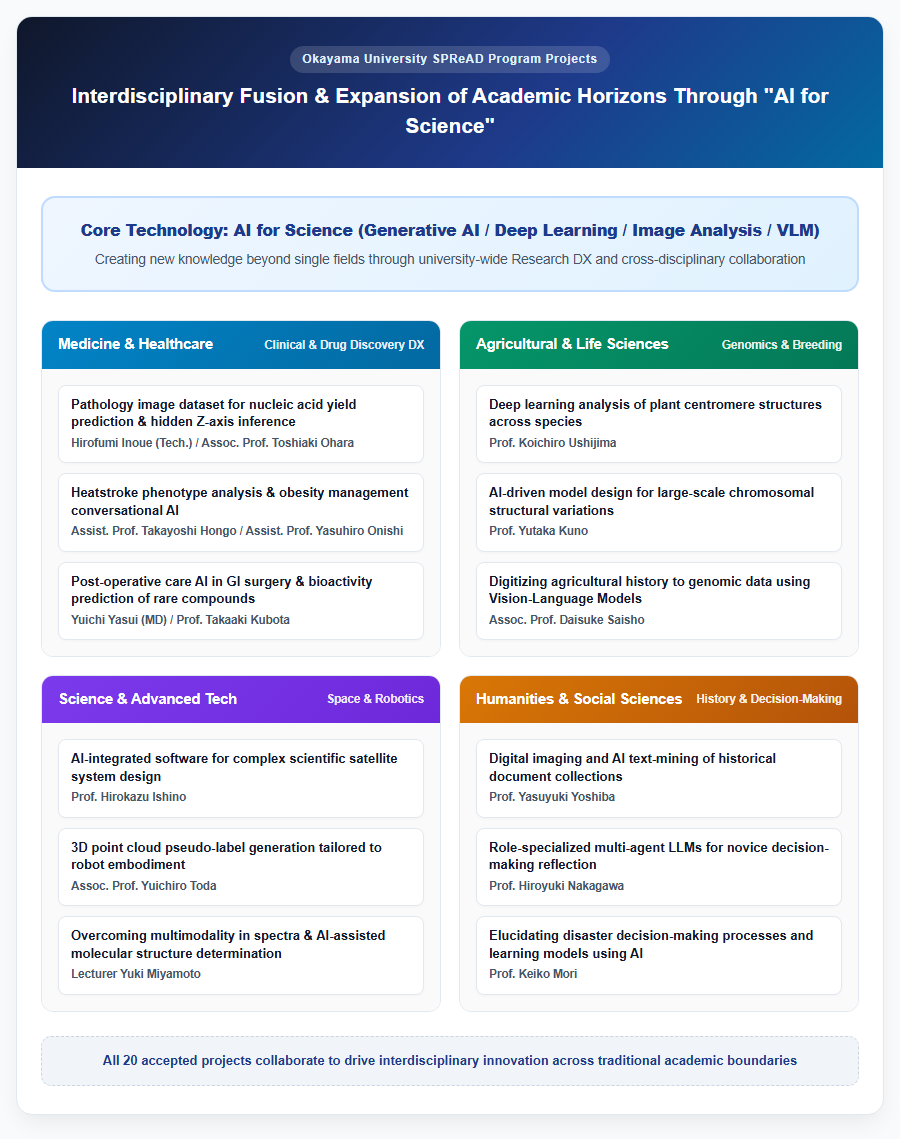
A significant portion of Okayama University’s accepted SPReAD projects focuses on cutting-edge AI applications in medicine, healthcare, and drug discovery. Specific research initiatives include:
- Building a dataset platform for nucleic acid yield prediction using lung cancer pathology images (Hirofumi Inoue, Clinical Laboratory Technologist)
- Phenotype analysis and prognosis evaluation of heatstroke using national registries and machine learning (Takayoshi Hongo, Assistant Professor)
- Overcoming domain shifts in digital pathology: Inferring the “hidden Z-axis” with AI (Toshiaki Ohara, Research Associate Professor)
- Implementation of physical activity support during weight loss in obesity management using conversational generative AI (Yasuhiro Onishi, Assistant Professor)
- Development of a post-operative care assistance system using multimodal generative AI in gastroenterological surgery (Yuichi Yasui, Physician)
- AI-based prediction of calcification potential from early-stage osteoblast phase-contrast images (Hirohiko Okamura, Professor)
- Target-independent bioactivity prediction of rare natural compounds using AI (Takaaki Kubota, Professor)
These initiatives are expected to directly yield meaningful outcomes in clinical settings by enhancing diagnostic precision and reducing the workload of healthcare professionals.
Expanding Academic Horizons Through Interdisciplinary Fusion with Agriculture, Science, and Humanities
The impact of AI for Science extends beyond medicine into agriculture, science, engineering, and even the humanities and social sciences. In agricultural sciences, deep learning is being applied to comparative interspecies analysis of plant centromere structures (Professor Koichiro Ushijima), alongside AI-driven design of large-scale chromosomal structural variations for breeding (Professor Yutaka Kuno). In science and engineering, projects include developing AI-integrated software for complex satellite systems (Professor Hirokazu Ishino) and generating 3D point cloud pseudo-labels tailored to robot embodiment (Associate Professor Yuichiro Toda). Furthermore, data-driven humanities research is gaining momentum, such as digital imaging and AI text-mining of historical document collections (Professor Yasuyuki Yoshiba), as well as bridging historical agricultural development records to genomic information using vision-language models (Associate Professor Daisuke Saisho). As illustrated below, the cross-disciplinary fusion of knowledge is rapidly advancing.
Key Points for Future Development: AI Management and Research Ethics
With the rapid evolution and adoption of AI technologies in research environments, ensuring scientific validity and establishing robust “AI Management” have become critical priorities for future progress. President Yasutomo Nasu noted in his statement that while combining human expertise with AI has become the standard approach for advancing science, addressing challenges related to psychological safety and data reliability remains essential. He emphasized that as a core research institution, Okayama University must not only drive research innovation forward, but also focus heavily on proper AI governance and management frameworks. Going forward, key points to watch will include the progress of individual SPReAD research projects, alongside the university’s efforts to expand AI usage guidelines and advance its overall research environment.
References
- [MEXT] Supporting Pioneering Research through AI for 1,000 Discovery Challenges (SPReAD)
https://www.mext.go.jp/aifors_spread/ - [Okayama University] 20 Projects Selected for MEXT’s “SPReAD” Initiative – Further Accelerating Research Capabilities Through AI for Science
https://www.okayama-u.ac.jp/tp/news/news_id15643.html
【#OkayamaUniversity #AIforScience #SPReAD #MEXT #ResearchCapability #ArtificialIntelligence #ResearchDX】


コメント