The Kanto Regional Development Bureau of the Ministry of Land, Infrastructure, Transport and Tourism announced that it will begin full-scale caisson sinking for the floating island shaft to launch shield machines during the construction of the Tama River Tunnel on National Route 357. This construction marks a crucial phase in the development of the Tokyo Bay Coast Road, aiming to alleviate chronic traffic congestion and strengthen logistics functions in the coastal area.
- Full-scale caisson sinking at the floating island shaft
- Project Scale and Structure of National Route 357 Tamagawa Tunnel
- Discovery of a Massive Underground Obstacle That Became a Difficult Problem
- Overcoming the longest pre-replacement method in history
- Access Revolution and Traffic Congestion Relief Between Haneda and Kawasaki
- Steps toward completion in 2029 and the path to full access
Full-scale caisson sinking at the floating island shaft
On July 8, 2026, the Kanto Regional Development Bureau announced the progress of the Tamagawa Tunnel construction on National Route 357, revealing that caisson sinking work on the Ukishima shaft on the Kawasaki City side, which is being constructed by Wuyo Construction, is expected to begin in earnest within the month. This shaft serves as a base facility for deploying a massive shield machine for digging into the seabed, boasting one of the largest scales in Japan, measuring 31.9 meters wide, 37.0 meters long, and 48.4 meters high. The construction employs the ‘pneumatic caisson method,’ employing advanced techniques in which a massive concrete casket (caisson) is sunk underground by its own weight. This full-scale commencement marks an important step in tackling the biggest hurdle in constructing the tunnel body after years of preparatory work.
Project Scale and Structure of National Route 357 Tamagawa Tunnel
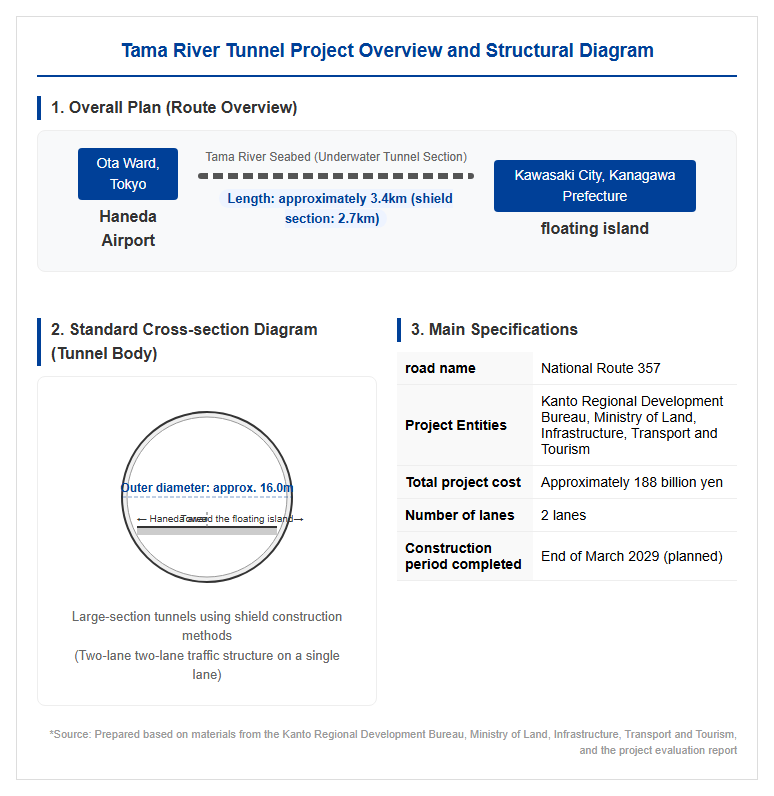
The Tamagawa Tunnel on National Route 357 is planned to stretch 3.4 kilometers from Haneda Airport in Ota Ward, Tokyo to Ukishima in Kawasaki Ward, Kawasaki City, Kanagawa Prefecture, with 2.7 kilometers of the seabed excavated by shield machines. The tunnel is extremely large with an outer diameter of about 16 meters, and is planned to be a two-way traffic structure with one lane on each side. According to the project evaluation in December 2020, the total project cost for the tunnel itself reached approximately 188 billion yen, with the overall project aimed for completion by the end of March 2029. This project aims to eliminate the unopened section of the approximately 80-kilometer-long “Tokyo Bayshore Road” connecting the coastal areas of Chiba, Tokyo, and Kanagawa, dramatically improving access between major logistics hubs such as airports and ports. The following diagram shows the overall view of the Tama River Tunnel and its standard crossing configuration.
Battling Underground Obstacles and the World’s First Large-Scale Construction
Discovery of a Massive Underground Obstacle That Became a Difficult Problem
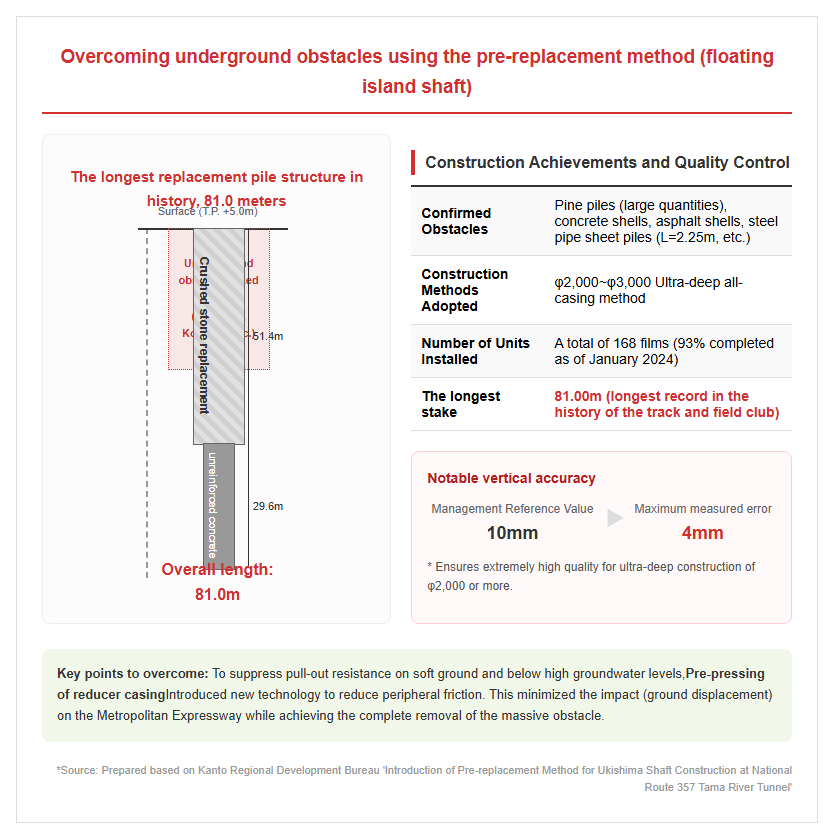
During the start of construction, a major challenge was the discovery of unexpectedly underground obstacles deep beneath the planned route. Before the main structure began, boring surveys and explorations revealed traces of past reclamation and bank protection work in the soft ground near T.P. -33 meters, including concrete shells, asphalt shells, steel pipe sheet piles, and a large number of pine piles. These obstacles not only hindered the sinking of the caisson but, if forced to sink, caused looseness in the ground and posed a significant risk of severely impacting the structures of the adjacent Metropolitan Expressway Bayshore Route. In fact, the distance between the construction site and the Metropolitan Expressway structure was only about 4.0 meters, making extremely precise construction management and obstacle removal measures essential.
Overcoming the longest pre-replacement method in history
To safely remove the discovered underground obstacles, the construction team introduced a large-scale pre-replacement method using the “all-casing method.” This method involves surrounding obstacles with huge casings (steel pipes) to remove them, replacing the site with sand, crushed stone, or unreinforced concrete. The maximum length of the replacement piles constructed in this project reached 81.00 meters, marking a significant new record for the longest construction record on land in history. During construction, a new technology was employed that preemptively pressed in a reducer casing to reduce peripheral friction, overcoming enormous resistance and successfully pulling it out. In terms of vertical accuracy, it maintains high quality, with a maximum tolerance of 4 mm compared to an allowable error of 10 mm, and for the first time on land, succeeded in ultra-deep displacement of φ2,000 or more.
Transformation and Future Outlook of the Coastal Network
Access Revolution and Traffic Congestion Relief Between Haneda and Kawasaki
The opening of the Tama River Tunnel has the power to fundamentally transform the traffic flow between Tokyo and Kanagawa. Currently, to travel between Haneda Airport and Ukishima by regular road, passengers must make a significant detour to inland industrial roads (Prefectural Route 6) and National Route 15, which cause chronic congestion with daily traffic volumes exceeding 100,000 vehicles. With the completion of the tunnel, the access time via the industrial road, which used to take about 23 minutes, is expected to be significantly reduced to about 8 minutes. This will create a route that allows free vertical crossing of the coastal area without the need for forced use of the Metropolitan Expressway, and is expected to bring significant economic and social benefits, such as reducing logistics costs, easing congestion on local roads, and strengthening cooperation among wide-area disaster prevention hubs during large-scale disasters.
Steps toward completion in 2029 and the path to full access
With the full-scale commencement of caisson sinking at the floating island shaft, the project has made significant progress toward completion by the end of March 2029. After completing the shaft construction, the plan is to finally move on to seabed drilling using shield machines. At the Haneda shaft on the Tokyo side, a new contract was signed in April 2025 (Reiwa 7) to continue removing underground obstacles while proceeding with sinking work, indicating steady preparations. Moreover, the completion of this tunnel also serves as a stepping stone toward the unopened section toward Yokohama, namely the full opening from Kawasaki Ukishima to Daikoku Pier. If a bridge from Higashi-Ogishima to Ogishima is realized in the future, a true network running through the Tokyo Bay will be completed, further enhancing the urban functions of the entire metropolitan area.
[#多摩川トンネル #国道357号 #ケーソン沈設 #五洋建設 #東京湾岸道路 #羽田空港 #川崎浮島 #交通インフラ]


コメント