
In Shizukuishi Town, Iwate Prefecture, four cases of winning bid rescissions and contract cancellations resulting from administrative processing errors in bidding for public works and outsourced services have successively come to light in fiscal year 2026. Driven by errors in calculating estimated design costs and inconsistencies in bidding-related documents, there are strong demands for a fundamental review of the municipality’s procurement checking systems and measures to ensure fairness.
- Chronology of Four Bid Cancellations and Contract Terminations in Fiscal Year 2026
- Specific factors behind estimation errors and discrepancies in bidding documents for each case
- Scrutiny in the Shizukuishi Town Assembly and Preventive Measures Announced by the Town
- Human Errors in Cost Estimation and Structural Issues Lurking in Local Government Operations
- Responses to Estimation Errors and Damage Risks Seen in Mie Prefecture and Iwaki City
- Ensuring the effectiveness and transparency of recurrence prevention measures as the key focus moving forward.
Chronology of Four Bid Cancellations and Contract Terminations in Fiscal Year 2026
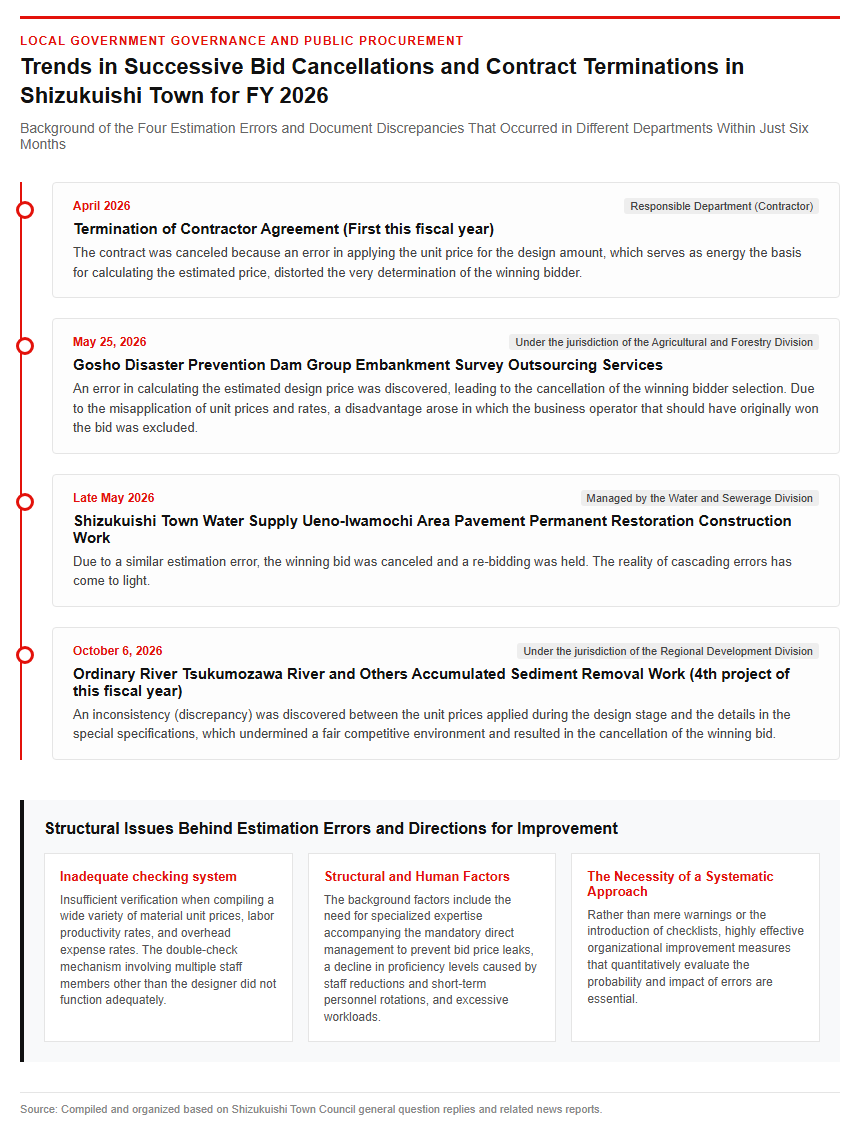
In Shizukuishi Town, Iwate Prefecture, a series of administrative processing errors in bidding for public works and outsourced services have occurred in fiscal 2026, resulting in four cases of revoked winning bids or canceled contracts.
The first incident occurred in April 2026 regarding the “Shizukuishi Elementary School District Zone 30 Plus Improvement Construction (Work Section 1),” commissioned by the Regional Development Division. In this case, an error in setting the unit price for the construction design amount was discovered after the contract was concluded. Recalculation using the correct unit prices revealed that the contract had been awarded to a party different from the one that should have won the bid, leading to the cancellation of the contract on April 27, 2026.
Subsequently, in May, an error in calculating the design amount was discovered in the “Gosho Disaster Prevention Dam Group Embankment Survey Outsourced Service,” managed by the Agriculture and Forestry Division, and the decision on the winning bidder was revoked on May 25, 2026. Furthermore, in the “Shizukuishi Town Waterworks Ueno Iwamochi Inside and Outside Pavement Permanent Restoration Construction,” managed by the Water and Sewerage Division and executed in late May, the winning bid was similarly revoked due to a calculation error, leading to a re-bidding process.
Then, in October, an inconsistency between the unit price adopted during the design phase and the special specification document was discovered in the “Ordinary River Tsukuzawagawa and Other Accumulated Sediment Removal Construction,” managed by the Regional Development Division, resulting in the fiscal year’s fourth revoked winning bid on October 6, 2026. This has brought to light a chain of errors occurring across different departments in the span of just half a year.
Specific factors behind estimation errors and discrepancies in bidding documents for each case
The main factors behind the series of issues lie in unit price setting errors made by staff during estimations and insufficient verification of related documents. In the construction project whose contract was terminated in April, an error occurred in applying the unit price to the design amount—which serves as the basis for calculating the estimated price—ultimately distorting the winning bidder selection process itself. For the surveying services and pavement restoration work whose winning bids were canceled in May, the cause was an error in applying the unit prices and rates used in the estimations, resulting in the unfair exclusion of contractors who should have rightfully won the bids. In the accumulated sediment removal work in October, a discrepancy arose between the unit price adopted during the design phase and the details specified in the special specifications, undermining a fair competitive environment based on common and appropriate conditions. Public works estimation tasks require the accurate compilation of a wide range of material unit prices, labor outputs, and overhead rates; however, it has become starkly evident that double-checking mechanisms designed to prevent insufficient verification and human errors during the workflow failed to function adequately.
Scrutiny in the Shizukuishi Town Assembly and Preventive Measures Announced by the Town
Due to the frequent occurrence of bidding errors, distrust among local residents and related businesses is growing, and they are facing severe scrutiny in the town assembly as well. During the general questions at the September 2026 regular session of the Shizukuishi Town Assembly, when the third estimation error within the town had occurred, the town’s response regarding recurrence prevention measures, such as creating checklists when placing orders, was questioned. In response to the series of events, the town administration expressed deep apologies to those involved upon announcing each case, while outlining policies to strengthen information sharing among relevant departments, ensure the thorough application of the latest unit prices and rates, and enhance a mutual checking system by multiple staff members other than the designer. However, because a fourth error occurred in October—just as countermeasures were being formulated—there are strong demands to establish more effective organizational improvement measures that go beyond mere reminders or the introduction of checklists.
Structural Issues in Public Works Cost Estimation and Precedent Cases in Other Municipalities
Human Errors in Cost Estimation and Structural Issues Lurking in Local Government Operations
Behind the frequent errors in public works estimation processes lie structural problems within municipal operations. According to an analysis conducted by the Osaka Municipal Waterworks Bureau, estimation work must be performed in-house to prevent the leakage of bid prices. While it requires specialized knowledge and practical experience, the nature of the work makes it inherently prone to human error. In particular, the compounding of underlying factors—such as declining proficiency due to staff reductions and short-term personnel rotations, heavy workloads, oversights, and misinterpretations—easily leads to severe miscalculations. As a rule, estimation errors trigger bid withdrawals, failed auctions, or contract terminations, significantly hindering the steady execution of public works. To maintain fairness and transparency in bidding and contracting procedures, rather than relying solely on the individual attentiveness of staff members, an organizational approach is essential to quantitatively evaluate the probability and impact of errors and improve the workflow itself. The following figure illustrates the risk assessment and improvement approach for estimation operations.
Responses to Estimation Errors and Damage Risks Seen in Mie Prefecture and Iwaki City
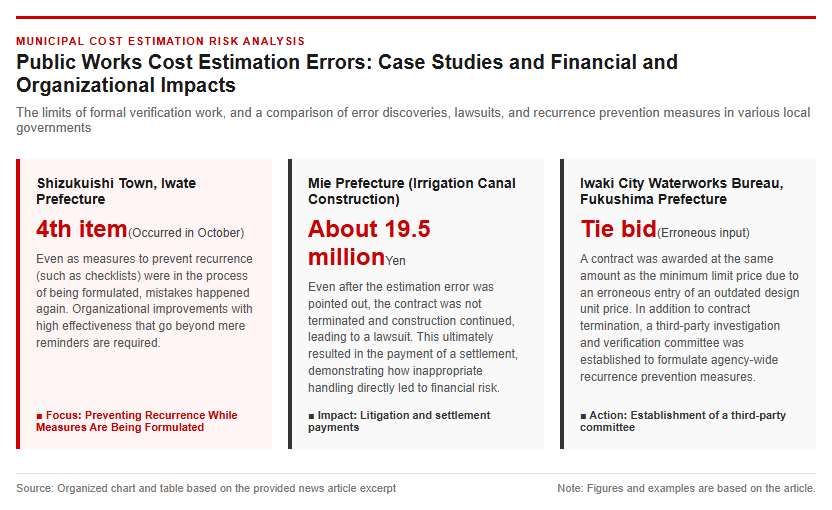
The impact of estimation and ordering errors goes beyond mere re-bidding, posing significant legal and financial risks to local governments. In a case involving irrigation channel construction commissioned by Mie Prefecture, the project was continued without cancelling the contract despite warnings about an estimation error. As a result, a lawsuit was filed by the business operator that should have originally won the bid, ultimately leading to a settlement payment of approximately 19.5 million yen. Furthermore, at the Iwaki City Waterworks Bureau in Fukushima Prefecture, an erroneous input of outdated design unit prices resulted in a contract being awarded at the exact minimum restricted price. This led to the cancellation of the contract, the establishment of a third-party investigation and review committee, and the formulation of organization-wide measures to prevent recurrence. Because inappropriate responses or leaving mistakes unaddressed after they are discovered directly lead to the improper expenditure of tax money and serious compensation issues, prompt and fair decision-making at the stage when an error is identified, as well as the establishment of an objective verification system incorporating external perspectives, are critically important.
Ensuring the effectiveness and transparency of recurrence prevention measures as the key focus moving forward.
For local governments, including Shizukuishi Town, to regain public trust, the continuous implementation of recurrence prevention measures that are both effective and transparent is indispensable. On the hardware front, it is necessary to build an environment that prevents information leaks and fraud by restricting access to estimation systems, managing design documents under lock and key, and tightening rules for meetings with contractors. On the software front, regular compliance training for all employees, appropriate responses to unjust demands, and operational transparency through periodic personnel rotations are required. Furthermore, on the institutional front, it is considered effective to inspect and review the bidding system itself, including the calculation methods for minimum limit prices, the introduction of random coefficients, and making the submission of estimation breakdowns mandatory. To uphold citizens’ trust in municipal administration, local governments are expected to adopt an approach that goes beyond mere formal verification, continuously improving the overall procurement system by cycling through the PDCA framework. The figure below represents the process of sustainable operational improvement.
Reference Page
- [Cancellation of Successful Bidder Determination Due to Inconsistencies in Bidding Documents and Re-bidding | Shizukuishi Town Hall, Iwate Prefecture] https://www.town.shizukuishi.iwate.jp/docs/2026100500040/
- 【Cancellation of Successful Bidder Determination Due to an Error in the Estimated Price and Re-bidding (Water and Sewerage Division) | Shizukuishi Town Hall, Iwate Prefecture】https://www.town.shizukuishi.iwate.jp/docs/2026060200011/
- [Regarding the Cancellation of the Successful Bidder Determination Due to an Error in the Estimated Amount and Re-bidding | Shizukuishi Town Hall, Iwate Prefecture] https://www.town.shizukuishi.iwate.jp/docs/2026052600041/
- 【Cancellation of Town-managed Construction Work Contract | Shizukuishi Town Hall, Iwate Prefecture】https://www.town.shizukuishi.iwate.jp/docs/2026042700034/
【#IwatePrefectureShizukuishiTown #PublicWorks #BiddingError #WinningBidCancellation #AdministrativeScandal #RecurrencePreventionMeasures】

コメント