A bill to include regulations on crypto assets, currently under discussion in the House of Councillors, is expected to be voted on at the House of Councillors Committee on Financial Policy and Monetary Policy on July 14, 2026. This legal amendment aims to fundamentally strengthen user protection and market transparency, in line with the realities of the market, where crypto assets have shifted from traditional payment methods to investment targets.
- House of Councillors Committee Vote on July 14, 2026 and Path to Enactment
- The reality of the cryptocurrency market as an investment target
- Transfer of Legal Status from the Payment Services Act to the Financial Instruments Act
- Insider Trading Regulations and Mandatory Information Disclosure
- Preparation for Fraudulent Outflows and Accumulation of a ‘Liability Reserve’
- The long-awaited separate taxation of 20.315% and loss carryforward deductions
- Signs of Domestic Crypto Asset ETF Restrictions and Industry Restructuring
House of Councillors Committee Vote on July 14, 2026 and Path to Enactment
Significant developments have emerged regarding the proposed amendment to the Financial Instruments and Exchange Act (Financial Instruments and Exchange Act), which focuses on regulating crypto assets, currently under discussion in the House of Councillors. On July 10, 2026, through interviews with government officials, it was revealed that a vote is expected at the House of Councillors Financial Affairs Committee on July 14 next week. This amendment was already passed by a majority vote in favor of the LDP, Nippon Ishin no Kai, and the Democratic Party for the People at the House of Representatives Committee on June 10 of the same year, and at the House of Representatives plenary session on June 11 of the same year. With coordination progressing within the House of Councillors, a concrete voting schedule was finalized, and the likelihood of passage during the regular Diet session by the original end of the session on July 17, 2026, has greatly increased.
With the decision on the voting schedule, the postponement to the extraordinary Diet session in autumn will be avoided. The government’s hastening to promptly review and pass the bill in this session stems from a sense of crisis over the rapid expansion of the crypto asset market and the resulting delays in user protection. During deliberations in the House of Representatives, issues such as the inappropriate cryptocurrency “Sanae Token” named after Prime Minister Sanae Takaichi were brought up as a topic of discussion, emphasizing the necessity of ensuring cybersecurity for crypto assets as investment targets and the healthy development of the digital economy. If the bill passes after a vote in the House of Councillors, Japan’s crypto asset policy will truly shift from the “era of settlements” to the “age of investment.”
The reality of the cryptocurrency market as an investment target
One reason for the urgent need for legal reform is the dramatic changes in the actual use of crypto assets within Japan. According to data published by the Financial Services Agency, as of October 2025, the total number of accounts at domestic crypto asset exchange operators exceeds 13 million, and users’ deposit balances have reached approximately 5 trillion yen. This level surpasses the holding rates of foreign exchange margin trading (FX) and corporate bonds, showing that crypto assets are no longer a special asset handled only by a select group but have become a familiar investment target for general investors.
Notably, user motivation is a key factor. According to a domestic survey, 86.6% of users aim for “investments with the expectation of long-term price appreciation,” and its use as a “payment method” as originally defined is limited. About 70% of holders earn less than 7 million yen annually, and over 80% of assets held in personal accounts are less than 100,000 yen, making it an established small-scale investment method, especially among the working generation. On the other hand, the Financial Services Agency’s consultation desk receives an average of over 350 complaints and consultations per month, many of which relate to fraudulent investment solicitations and inappropriate information provision. Thus, while the actual investment situation took precedence, a “regulatory gap” emerged where existing payments laws did not sufficiently protect investors.
[Fundamental Regulatory Changes] New Rules Brought by the Transition to the Financial Instruments and Exchange Act
Transfer of Legal Status from the Payment Services Act to the Financial Instruments Act
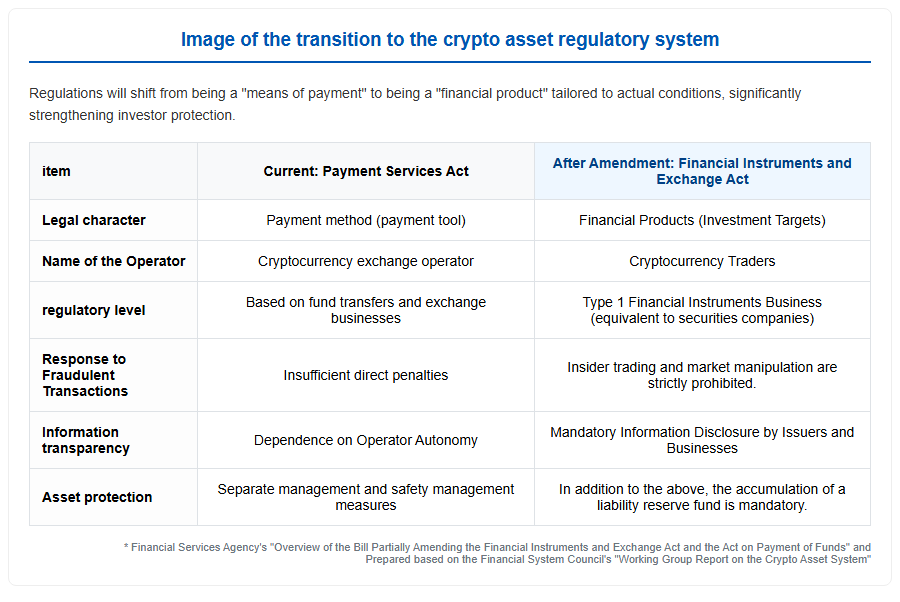
The main point of this legal amendment is to shift the regulatory basis for crypto assets from the previous Payment Services Act to the more stringent Financial Instruments and Exchange Act (Financial Instruments and Exchange Act). Until now, the Payments for Payments Act has regarded cryptocurrencies such as Bitcoin as “payment tools” used for purchasing goods and sending money. However, since trading for capital gains has become mainstream in practice, it was deemed appropriate to incorporate these into the framework of the Financial Instruments and Exchange Act, which regulates products with strong investment characteristics across sectors, similar to stocks and derivatives trading.
With the transition to the Financial Instruments and Commerce Act, crypto assets are legally and clearly positioned as “financial products.” However, since crypto assets do not carry legal rights to dividends or interest distribution, they are organized as a new category of financial products distinct from existing “securities.” Additionally, the name of the business operator will be changed from the traditional “crypto asset exchange operator” to “crypto asset trading operator,” requiring a strict business management system similar to the “Type 1 Financial Instruments Business Business” applied to securities companies and others. This raises the standards for managing customer assets, internal controls, and compliance to a higher level. The following diagram illustrates the transition of the regulatory system.
Insider Trading Regulations and Mandatory Information Disclosure
To ensure market fairness, a new “Unfair Trading Regulation” targeting crypto assets will be introduced. Until now, there were no direct insider trading regulations for crypto assets, but going forward, it will be strictly prohibited for crypto asset traders or insiders of issuers to trade while knowing undisclosed “material facts” such as new listings, delistings, or serious hacking incidents. Violators are investigated by the Securities and Exchange Surveillance Commission and subject to fines or criminal penalties.
Additionally, ‘regulations on information disclosure’ will be established to eliminate information asymmetry. Stocks with issuers are now defined as “specified crypto assets,” and issuers are required to disclose in advance the nature, functions, core technology, and financial status of the assets when offering or listing. For coins like Bitcoin, which have no issuer, the handling exchange is responsible for information disclosure. If false statements or material information are not disclosed, strict enforcement equivalent to a securities disclosure violation is applied. Specifically, the maximum penalty will be significantly raised from previous limits (such as 3 years of imprisonment), imposing up to 10 years in prison, fines of up to 10 million yen, or both.
Preparation for Fraudulent Outflows and Accumulation of a ‘Liability Reserve’
Based on lessons from past large-scale domestic fraud leaks and the collapse of the global exchange FTX in 2022, regulations on governance and security measures for operators will also be strengthened. Under this amendment, crypto asset traders are legally required to accumulate a “liability reserve” as compensation for customers in the event of unauthorized outflows caused by cyberattacks or other factors. Previously, a certain amount of holding was required only for assets managed in hot wallets, but going forward, it will be necessary to secure appropriate capital according to the risk of outflow, including assets managed in cold wallets.
Furthermore, to ensure the security of the entire supply chain, regulations will be introduced for key system vendors providing wallet software to exchanges, including prior notifications, system security obligations, and regulatory oversight. Additionally, the “lending (lending crypto assets)” business, where users borrow crypto assets for management, will be incorporated from a regulatory gap into a regulated area under the Financial Instruments and Exchange Act. Businesses are obligated to establish risk management systems for re-lending destinations and provide highly transparent risk explanations to users. These multi-layered protective measures create an environment where users’ assets are easily protected even in the event of an emergency.
[Future Developments & Points of Interest] Tax Reform and the Future of Digital Finance
The long-awaited separate taxation of 20.315% and loss carryforward deductions
For investors, the biggest concern in this amendment to the Financial Instruments and Commerce Law is the review of the tax system. Currently, gains from crypto asset sales are classified as “miscellaneous income” and subject to comprehensive taxation, with a maximum tax rate of 55% (45% income tax + 10% resident tax) combined with other income. However, assuming the enactment of this amendment to the Financial Instruments and Exchange Act, the “FY2026 Tax Reform Outline” approved by the Cabinet in December 2025 clearly states a policy to subject profits from crypto asset trading to “separate declaration taxation,” similar to stocks and FX.
When separate taxation is applied, the tax rate is a flat 20.315% (income tax 15.315% + resident tax 5%), regardless of income. Furthermore, the introduction of a “loss carryforward deduction” allows losses from crypto asset trading to be carried forward for up to three years and offset against profits from the following year onward. This tax revision is scheduled to take effect from January 1 of the year following the year in which the amended Gold Merchandisity Act comes into effect. If the bill is enacted in fiscal year 2027, it could become a roadmap to apply the new tax system as early as January 2028. Significant tax cuts and the realization of profit and loss offsetting are expected to serve as strong incentives for individual investors aiming for long-term asset building, as well as those who have previously avoided entering the market due to disliked high tax rates.
Signs of Domestic Crypto Asset ETF Restrictions and Industry Restructuring
The completion of legal reforms will greatly attract the birth of “crypto asset ETFs (exchange-traded funds)” in Japan. In May 2026, Hiroki Yamamichi, CEO of Japan Exchange Group (JPX), announced plans to list a cryptocurrency ETF domestically. The Financial Services Agency has also revised the Enforcement Order of the Investment Trusts Act to include crypto assets as ‘specified assets’ that investment trusts can manage. Defining crypto assets as legally reliable “financial products” under the amendment of the Financial Instruments and Commerce Law is an essential prerequisite for securities companies to construct ETF products. Once realized, individual investors will be able to diversify into major stocks like Bitcoin through their securities accounts, just like with stocks.
On the other hand, the increased compliance costs due to legal changes are likely to accelerate elimination and restructuring within the industry. Responding to the Type 1 Financial Instruments Business under the Financial Instruments and Exchange Act would require enormous costs such as system investment and staff expansion, so small and medium-sized exchanges with limited resources will likely be forced to integrate into major groups. In fact, in May 2026, SBI Holdings began discussions to make Bitbank a subsidiary, and restructuring efforts have already begun. While strengthening regulations will help stabilize the market, it will also increase the burden on operators. Looking ahead, more dynamic partnerships and integrations between traditional financial institutions and Web3 companies are expected to take the lead in digital finance.
[#暗号資産 #金商法 #分離課税 #インサイダー規制 #投資家保護 #ETF #金融庁]


コメント