」_en.png)
On April 15, 2026, the latest open-source large language model, “Qwen 3.6 35B-A3B,” an AI assistant running fully local environments, was announced. This news has attracted attention as a major turning point away from cloud AI among user communities seeking to balance privacy protection with high-performance inference.
- The Emergence of the New Generation Local Assistant Belochka
- Technical Features of the Base Model Qwen 3.6 35B
- Concrete use cases in actual business operations
- Migration Trends from Cloud AI to On-Premises
- Inference acceleration technology and hardware environment
- Performance Improvements Through Quantization and Scaffolding
- Paradigm Shift Brought by Local LLMs
The Emergence of the New Generation Local Assistant Belochka
In April 2026, the announcement of the AI assistant “Belochka (Bella),” centered around the latest model, the Qwen 3.6 35B-A3B, shocked the AI community. The biggest feature of this assistant is that it operates in a “fully local environment” that does not require any internet connection. According to the latest report dated April 20, 2026, the use of local LLMs (large language models) is rapidly shifting from a mere experimental phase to a “practical practical use” stage.
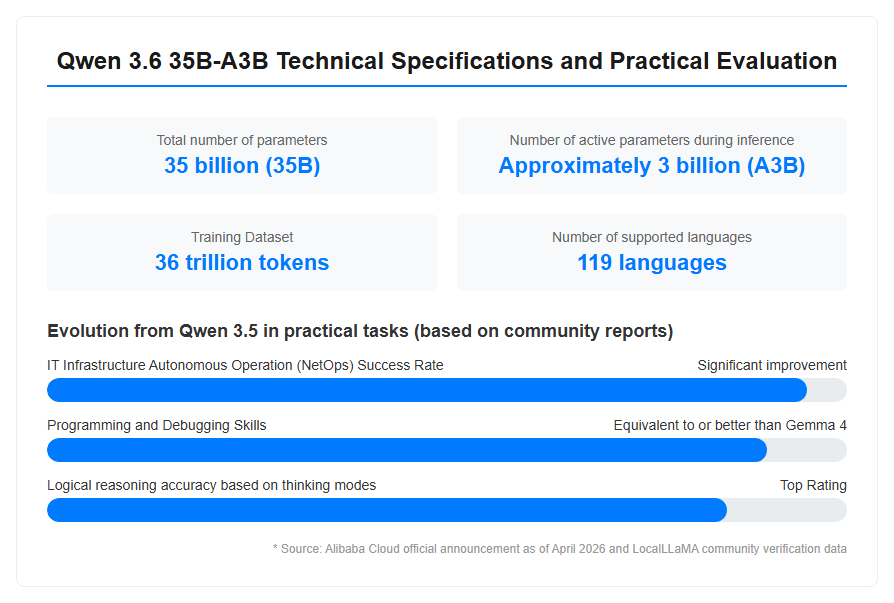
The Qwen 3.6 35B-A3B that Belochka is based on is a model just released by Alibaba Cloud on April 15, 2026, and is distributed under the open-source license Apache 2.0. It enables complex task processing that was difficult with traditional local models, and has received very high praise especially for multilingual support including Japanese, coding capabilities, and system operation accuracy. Please refer to the diagram below.
With the arrival of this new generation of assistants, businesses and individual users can now enjoy advanced AI capabilities on their PCs without sending sensitive information to external cloud servers.
Technical Features of the Base Model Qwen 3.6 35B
Supporting Belochka’s outstanding performance is the advanced technologies adopted in the Qwen 3.6 series. Qwen 3.6 35B-A3B adopts a Mixture of Experts (MoE) architecture, with a total parameter count of 35 billion (35B), while the actual number of parameters activated during inference is limited to about 3 billion (A3B). This design achieved lightweight performance that allows for realistic speeds to operate on home and office hardware while maintaining the model’s vast knowledge base.
For training data, an astonishing 36 trillion tokens covering 119 languages and words is used. This has dramatically improved contextual understanding, and as of 2026, it boasts world-class performance as an open-source model. Additionally, the Qwen 3.6 series includes a function to switch between “thinking mode” and “non-thinking mode,” and Belochka can flexibly handle tasks ranging from simple dialogues to those requiring deep logical reasoning. Such technological advances have greatly enhanced the feasibility of AI assistants in local environments.
Practicality and Evaluation: Explosive Response in the Community
Concrete use cases in actual business operations
The Qwen 3.6 35B-A3B equipped by Belochka has been praised immediately after its announcement by communities like Reddit’s r/LocalLLaMA as “the best local model I’ve ever used.” Specifically, it has been reported for its use in IT infrastructure automation (NetOps), and in cases where Cisco switches were operated as SSH operation agents, it was confirmed that the failure rate of tool calls significantly improved compared to the previous Qwen 3.5 era.
Additionally, in implementing the “Browser OS,” which handles complex frontend development tasks, Qwen 3.6 demonstrated excellent agent capabilities. The fact that AI agents are not only generating text but also invoking specific external tools to control network devices or refactoring code is a significant advancement in the history of AI agents. Despite being a local model, there are reports that it achieved results equal to or better than Google’s Gemma 4 in complex debugging tasks, demonstrating its technical reliability.
Migration Trends from Cloud AI to On-Premises
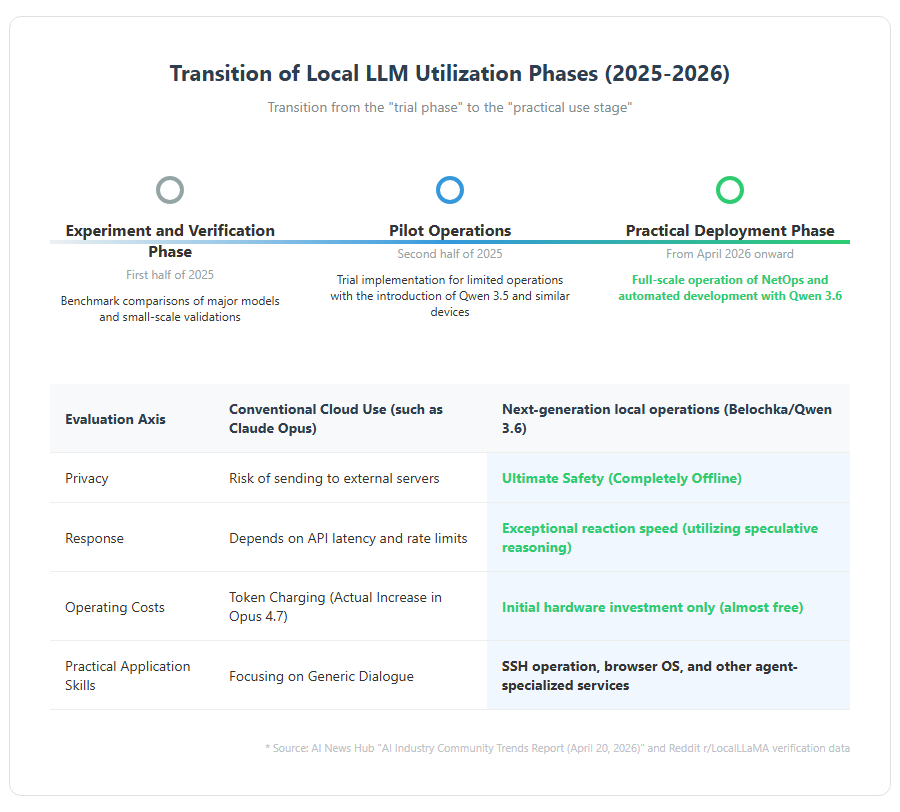
A prominent trend in the AI industry in the first half of 2026 is the rapid increase in users considering switching from high-end cloud APIs like Anthropic’s Claude Opus 4.7 to high-performance local models like Qwen 3.6 35B. While the cloud’s top models still have the upper hand in complex reasoning capabilities, local assistants like Belochka offer invaluable advantages in cost, fast response, and above all, ultimate privacy protection.
In fact, when running on high-performance personal hardware like the MacBook Pro M5 Max with 128GB of integrated memory, there is debate about whether it can operate at a sufficiently practical speed as a routine coding agent. Users who returned to the local model after four months praised the response as “exceptional,” indicating that the user experience in Qwen 3.6 has improved. As a result, companies that had previously conducted small-scale pilot operations before full implementation of cloud AI are now accelerating their transition to full-scale operations in local environments. The following chart shows changes in the utilization rate of local LLMs.
Optimization and Future Outlook: The Future of Autonomy and Privacy
Inference acceleration technology and hardware environment
To achieve comfortable operation in local environments, applying inference acceleration technology is essential. In Belochka’s operations, technologies such as ‘speculative checkpointing,’ merged into the llama.cpp, have also attracted attention. In certain settings for coding purposes, this has been confirmed to achieve speeds ranging from 0 to 50%, making the adjustment of parameters according to the type of task a practical key.
For operating environments, gaming laptops equipped with NVIDIA’s latest GPU, the RTX 5090, and professional RTX PRO 5000 (Blackwell architecture, 48GB VRAM) are considered strong options. Especially when fine tuning is prioritized, NVIDIA GPUs with large VRAM capacity are advantageous, while for balancing portability and inference speed, Apple’s M5 Max chip is recommended. Furthermore, a guide for efficient environment building on Linux using Podman containers has been published, deepening discussions on optimization at the infrastructure layer.
Performance Improvements Through Quantization and Scaffolding
Belochka’s operational expertise is shared not only in the base performance of the model but also in the design of the quantization form and the “scaffold” that determine the final output. For example, in the quantization level of Qwen 3.6 35B-A3B, there are reports that the Q4_K_XL format outperforms the Q5_K_S format in terms of inference accuracy for specific applications such as web research and document analysis. This suggests that the relationship between quantization and accuracy is not simply a matter of size.
Additionally, experiments have shown that simply changing the scaffold design to control the model dramatically improves benchmark scores. There have been cases where simply changing the scaffold from Aider to “little-coder” using the same Qwen weight more than doubled the Polyglot benchmark score from 19.1% to 45.6%. This shows that to maximize a model’s performance, it is as important as the evolution of the model itself that the implementation side must devise ways to use it effectively.
Paradigm Shift Brought by Local LLMs
The future envisioned by Belochka and Qwen 3.6 is one where AI functions not as something “inside a massive server owned by someone,” but as intelligence “at the user’s own hands.” This means that the knowledge management paradigm is fundamentally transforming. As seen in the case where Keio University introduced Notion to all faculty and staff and launched a project to train AI on 168 years of intellectual assets, organization-wide AI integration is moving beyond simply borrowing tools from the cloud.
Going forward, autonomous agents like Belochka will accelerate “headlessness,” where they not only wait for user instructions but also send and receive emails, manage calendars, and handle complex file operations in the background. Having addressed privacy and security concerns, local AI becomes an indispensable partner for reducing individual cognitive costs and maximizing human creativity. The widespread adoption of Qwen 3.6 35B is sure to be a major step toward truly advancing AI democratization.
[#Qwen #ローカルLLM #AIエージェント #AIアシスタント #ディープラーニング #科学技術 #オープンソース]

コメント