In September 2026, Microsoft resolved a series of critical vulnerabilities across more than 10 cloud services, including Azure Database for PostgreSQL and Azure Billing. Driving this surge are shared architectural flaws in authentication and authorization logic, alongside a rapid rise in elevation of privilege risks as cloud infrastructure becomes increasingly multi-layered.
- Overview of Vulnerability Fixes Spanning Over 10 Azure Services
- An Attack Surface Expanding from Identity Infrastructure to AI, Data, and Billing Tiers
- The Reality Behind the Spike in Critical Vulnerabilities
- Threat Mechanics of Elevation of Privilege (EoP) and Remote Code Execution (RCE)
- SFI Mobilization of 35,000 Engineers and the Autonomous AI Model “MAI-Cyber-1-Flash”
- Managing Cloud Dependency Risks and Key Focus Areas
Overview of Vulnerability Fixes Spanning Over 10 Azure Services
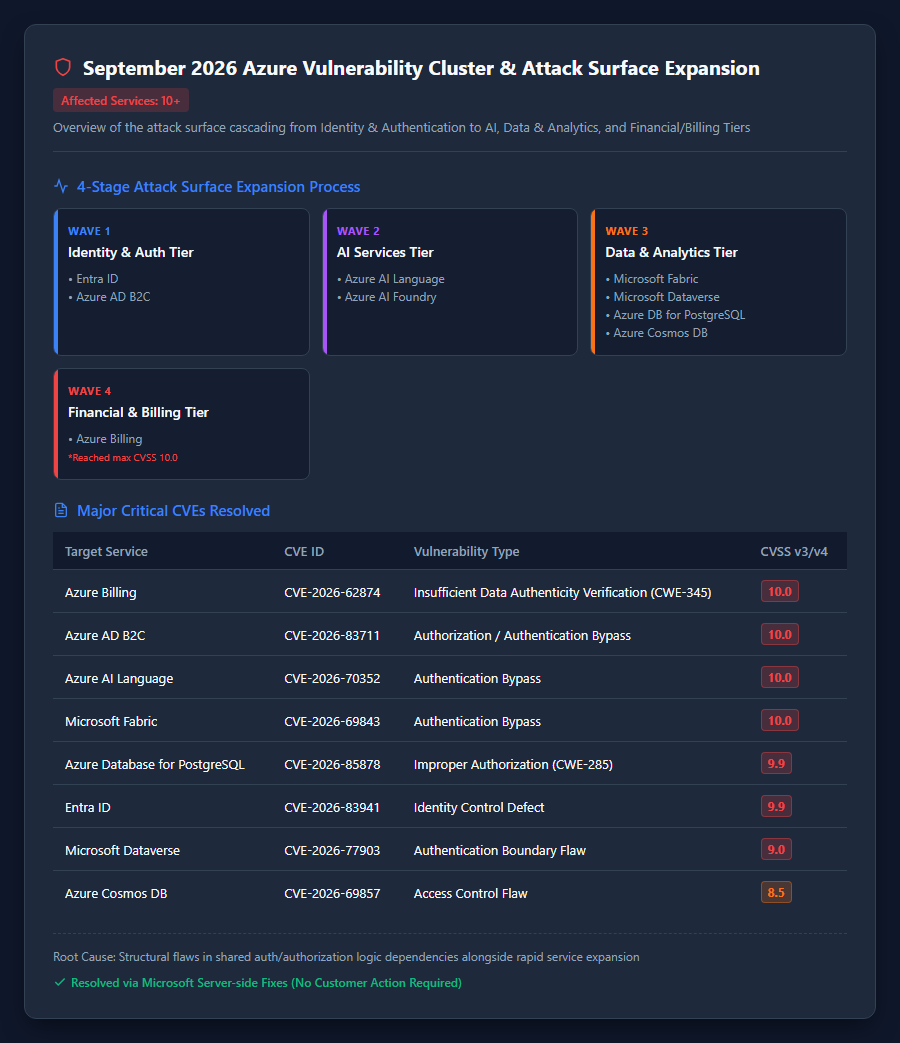
In September 2026, Microsoft released fixes for a series of critical Common Vulnerabilities and Exposures (CVEs) across various Azure cloud services. This patch rollout was of an extraordinary scale, extending beyond isolated services to impact more than 10 distinct Azure offerings.
Key highlights of this event include:
- Data Tier Vulnerabilities: An improper authorization flaw in Azure Database for PostgreSQL (CVE-2026-85878, CVSS score 9.9) was identified and resolved.
- Financial Tier Vulnerabilities: An insufficient data authenticity verification flaw in Azure Billing (CVE-2026-62874, CVSS score up to 10.0) was publicly disclosed.
- Identity Control Tier Vulnerabilities: Maximum-severity flaws in core authentication systems, such as Entra ID (CVE-2026-83941, CVSS 9.9) and Azure AD B2C (CVE-2026-83711, CVSS 10.0), were remediated.
Many of these vulnerabilities shared a structural pattern allowing attackers to bypass security boundaries without holding valid credentials. Microsoft addressed these flaws through server-side updates, successfully resolving the issues without requiring manual intervention from customers. Please refer to the figure below.
An Attack Surface Expanding from Identity Infrastructure to AI, Data, and Billing Tiers
A critical perspective regarding the September 2026 vulnerability remediations is the rapid expansion and multi-layering of the cloud infrastructure attack surface. Traditional cloud attacks primarily focused on the identity control plane—determining who could log in. However, tracking the progression of this CVE cluster reveals that the impact has systematically deepened across multiple functional layers.
Following an initial wave that impacted core authentication infrastructure such as Entra ID and Azure AD B2C, a second wave spread to AI services, including Azure AI Language (CVE-2026-70352, CVSS 10.0) and Azure AI Foundry (CVE-2026-85889, CVSS 10.0). A third wave subsequently reached the data and analytics tier, affecting Microsoft Dataverse (CVE-2026-77903, CVSS 9.0), Microsoft Fabric (CVE-2026-69843, CVSS 10.0), Azure Cosmos DB (CVE-2026-69857, CVSS 8.5), and PostgreSQL. Finally, a fourth wave hit the financial and billing tier via Azure Billing.
The escalation of defects from authentication controls to AI endpoint trust, data storage, and ultimately financial control layers highlights the systemic vulnerabilities inherent in shared architectural and authentication dependencies across cloud ecosystems.
Data-Driven Analysis of Microsoft Vulnerability Trends (2025–2026)
The Reality Behind the Spike in Critical Vulnerabilities
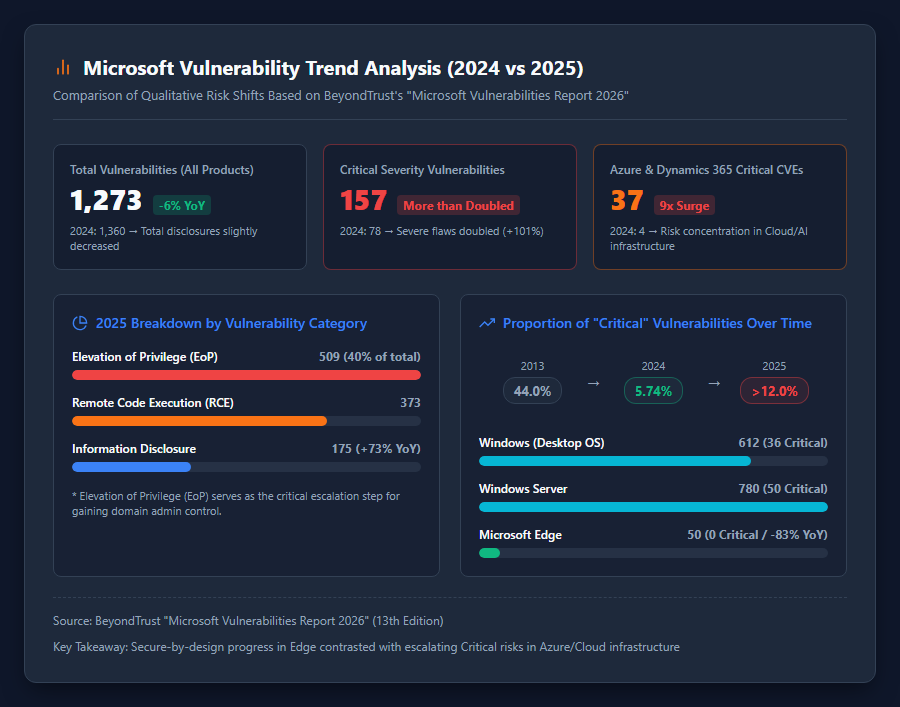
According to analytical data from BeyondTrust’s Microsoft Vulnerabilities Report 2026, the total number of disclosed vulnerabilities across all Microsoft products dropped by approximately 6% year-over-year, decreasing from 1,360 in 2024 to 1,273 in 2025. While this decline might initially suggest an improvement in security, underlying data reveals a concerning shift for enterprise defenders.
Most alarmingly, the number of “Critical” vulnerabilities—flaws capable of complete system compromise—more than doubled in a single year, surging from 78 in 2024 to 157 in 2025. Over the past decade, Critical flaws as a proportion of total disclosures had steadily fallen from 44% in 2013 to just 5.74% in 2024. However, 2025 marked a sharp reversal, with the Critical proportion rising back above 12%.
This surge was primarily driven by two product suites: Microsoft Azure and Dynamics 365. Critical vulnerabilities within this domain skyrocketed ninefold, jumping from 4 in 2024 to 37 in 2025. As Azure has become the foundational infrastructure for AI agents, Copilot integrations, and automated machine-identity workloads, risk concentration within the platform has intensified significantly. Please refer to the figure below.
Threat Mechanics of Elevation of Privilege (EoP) and Remote Code Execution (RCE)
Elevation of Privilege (EoP) flaws continue to represent the single largest category within Microsoft’s vulnerability landscape. In 2025, 509 EoP vulnerabilities were disclosed, accounting for nearly 40% of all reported CVEs across Microsoft’s portfolio.
In modern cyberattacks, threat actors rarely require sophisticated zero-day exploits for initial access. Instead, attackers leverage phishing or credential theft to gain a low-privilege foothold, then exploit EoP vulnerabilities in the Windows kernel or Azure control plane to escalate privileges to domain admin or full cloud-tenant control.
Remote Code Execution (RCE) vulnerabilities constituted the second-largest category with 373 disclosures, frequently serving as the initial execution component in these attack chains. Platform-wise, Windows logged 612 vulnerabilities (36 Critical), while Windows Server recorded 780 vulnerabilities (50 Critical). Conversely, Microsoft Edge showed dramatic improvement due to Chromium-based hardening, dropping 83% year-over-year to 50 vulnerabilities (0 Critical), illustrating the tangible benefits of Secure by Design principles.
Future Security Outlook: SFI and AI-Driven Defense
SFI Mobilization of 35,000 Engineers and the Autonomous AI Model “MAI-Cyber-1-Flash”
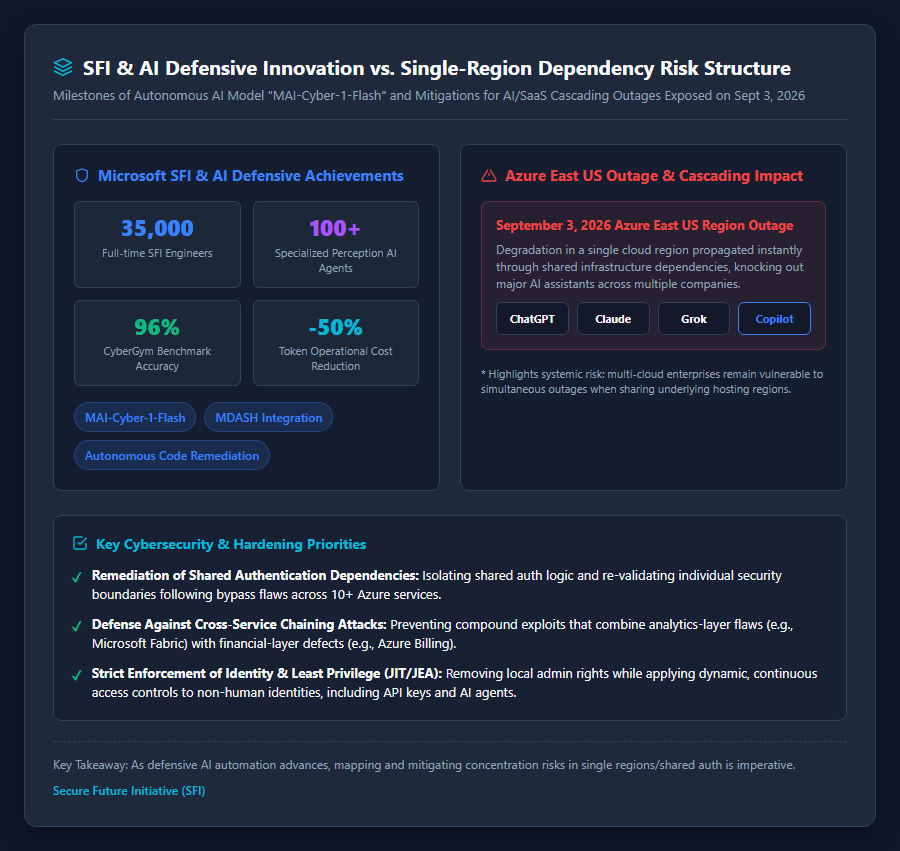
In response to cascading cloud vulnerabilities and sophisticated attack tactics, Microsoft is accelerating its company-wide “Secure Future Initiative” (SFI). With the equivalent of approximately 35,000 full-time engineers dedicated to security engineering, SFI represents the largest cybersecurity initiative in digital history.
To counter real-time threats, Microsoft introduced “MAI-Cyber-1-Flash,” a specialized security AI model for vulnerability scanning, detection, and automated remediation, alongside “Project Perception,” an agentic security system. Perception incorporates over 100 specialized AI agents that continuously track threat vectors and apply patches across enterprise environments.
In CyberGym benchmark evaluations assessing AI reasoning over large codebases, the combination of MDASH and MAI-Cyber-1-Flash achieved a 96% success rate, outperforming conventional models. Furthermore, this multi-agent architecture reduces computational and token overhead, achieving an estimated 50% operational cost reduction compared to previous configurations.
Managing Cloud Dependency Risks and Key Focus Areas
On September 3, 2026, a degradation in Azure’s East US region simultaneously disrupted ChatGPT, Claude, Grok, and Microsoft Copilot, underscoring the risks of over-reliance on a single cloud region. As enterprises rapidly integrate AI agents and cloud services into core operational workflows, building resilience into shared infrastructure has become a paramount priority.
Key security focus areas moving forward include:
- Remediation of Shared Authentication Dependencies: Ensuring the long-term stability of server-side fixes across 10+ Azure services following the September Patch Tuesday cycle.
- Prevention of Cross-Service Chaining Attacks: Mitigating risks where authentication bypasses in unified analytics platforms (such as Microsoft Fabric) could be chained with billing-layer vulnerabilities.
- Strict Enforcement of Least Privilege and Identity Governance: Eliminating standing local administrator rights and implementing dynamic privilege controls for non-human identities, including API keys, service principals, and AI agent permissions.
Organizations must map their end-to-end dependencies on SaaS products and AI agents back to underlying cloud regions to build true operational resilience against cascading outages. Please refer to the figure below.
References
- 【Microsoft Security Update Guide】https://msrc.microsoft.com/update-guide/
- 【Microsoft Secure Future Initiative】https://www.microsoft.com/en-us/trust-center/security/secure-future-initiative
【#Microsoft #Azure #Cybersecurity #Vulnerabilities #CloudSecurity #AISecurity】
コメント