French research firm Yole Group has announced the top 20 global power semiconductor manufacturers by sales for 2025. While the leading German company Infineon Technologies maintains an overwhelming market share, the rapid rise of Chinese companies and the restructuring efforts to survive the five Japanese companies are becoming clear.
- Overview of the 2025 rankings and Infineon’s overwhelming dominance in Germany
- Current Locations and Device-Based Competitiveness of Five Japanese Companies
- The Relentless Pursuit of Chinese Players and the Seismic Shifts in Power Electronics
- Transition to SiC and GaN and Expansion of the Electric Vehicle Market
- The Intellectual Property and Patent Disputes Reveal the Leadership Struggle for Next-Generation Semiconductors
- Future competition driven by packaging technology and thermal management
- Market Growth and Industry Restructuring Toward 2031
Overview of the 2025 rankings and Infineon’s overwhelming dominance in Germany
The power semiconductor market research report, “Status of the Power Electronics Industry 2026,” revealed the manufacturers’ sales rankings for 2025. The breakdown of the top 20 companies by country and region is as follows: 6 from the United States, 5 from Japan, 5 from China, and 4 from Europe, highlighting the global division of labor and intense competition. Germany’s Infineon Technologies reigns at the top of the list, leveraging a broad product portfolio covering silicon (Si), silicon carbide (SiC), and gallium nitride (GaN), establishing a strong lead that far surpasses the second and lower ranks. Infineon’s sales scale is so massive that even the combined sales of the five Japanese companies ranked on the list can be combined. In second place is US-based onsemi, followed by European company STMicroelectronics, and the dominance of the top three companies remains unshaken. After years of rapid expansion, the power semiconductor industry is now transitioning into a period of consolidation, where the ability to supply cutting-edge products, acquire customers, and execute sales has become the key to competition.
Current Locations and Device-Based Competitiveness of Five Japanese Companies
In the top 20 for 2025, five Japanese companies have made the list. The highest position is Mitsubishi Electric in 4th, followed by Fuji Electric in 5th, Toshiba in 6th, ROHM in 8th, and Renesas Electronics in 14th. Looking at sales breakdown by device, Mitsubishi Electric and Fuji Electric have overwhelmingly high ratios of silicon IGBT (Insulated Gate Bipolar Transistor), which excels in industrial equipment and railway applications. In terms of IGBT alone, Mitsubishi Electric holds the second largest position worldwide after Infineon, while Fuji Electric holds third place. On the other hand, Toshiba ranks third globally in Si-MOSFETs and also maintains a certain presence in IGBTs. Additionally, ROHM recorded the highest SiC sales among Japanese companies, backed by aggressive investment in next-generation SiC. However, while Japanese companies have strengths in their respective fields, they have not yet reached a scale that can compete with major Western companies on their own. For this reason, ROHM, Toshiba, and Mitsubishi Electric have begun discussions on business and management integration, aiming to become one of the world’s top 10 global semiconductor companies.
The Relentless Pursuit of Chinese Players and the Seismic Shifts in Power Electronics
One of the most notable trends in this ranking is that five Chinese companies have broken into the top 20, rapidly expanding their presence. Specifically, China Resources Microelectronics ranked 9th, Silan Microelectronics Hangzhou ranked 10th, Nexperia, a subsidiary of Wingtech Technology, 11th, BYD 13th, and CRRC 20th. Chinese companies are leveraging their massive domestic demand for electric vehicles (EVs) to increase their share across the entire value chain, from SiC wafers to devices and industrial power modules. Among these, many startups are entering high value-added areas that were once dominated by Western companies, and it is pointed out that they may further climb the rankings in the future. The rise of Chinese players is closely linked not only to improving mass production capacity but also to government-led measures to raise semiconductor self-sufficiency. In response to such seismic shifts, existing European, American, and Japanese manufacturers are compelled to enhance their resilience through technological differentiation and strategic alliances.
Dramatic changes in the market environment: Technology shift toward SiC and GaN and deepening competition
Transition to SiC and GaN and Expansion of the Electric Vehicle Market
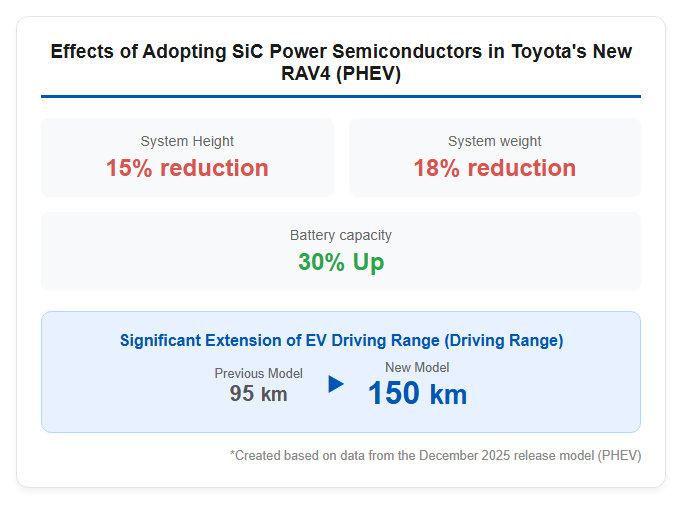
The global power electronics market is projected to grow at a compound annual growth rate (CAGR) of 7.1% from 2025 to 2031, reaching a scale of 41.3 billion USD by 2031. The biggest driver of this growth is the electrification of vehicles (xEV shift). The EV market share is expected to expand from 25% in 2025 to 32% by 2031. In particular, the adoption of SiC and GaN devices, next-generation materials to replace traditional silicon, is accelerating, and these next-generation products are projected to account for 31% of the total market by 2031. Regarding SiC power semiconductors, their adoption in Toyota’s new “RAV4” hybrid system is symbolic, and 2026 is expected to be a turning point for full-scale adoption. By using SiC, it becomes possible to miniaturize, lightweight, and save energy in power conversion devices such as inverters, directly extending EV driving range. Please refer to the diagram below.
Additionally, GaN excels in high-speed switching and miniaturization, and is increasingly being widely adopted mainly in data center power supplies and rapid chargers.
The Intellectual Property and Patent Disputes Reveal the Leadership Struggle for Next-Generation Semiconductors
The competition over next-generation power semiconductors has entered a phase of legal battles over not only manufacturing capacity and price but also intellectual property (IP). In July 2026, Infineon Germany announced that the U.S. International Trade Commission (US ITC) had finalized its decision to halt imports and sales related to patent infringement by Chinese GaN manufacturer Innoscience. Infineon holds approximately 450 GaN patent families and pursues a strategy to solidify market rules by leveraging its technology portfolio. Meanwhile, there have been reports of Innoscience winning lawsuits against Infineon within China, highlighting the risk of market fragmentation due to legal systems and geopolitics. Such patent disputes pose serious supply chain risks not only for semiconductor manufacturers but also for customer companies adopting components. For companies to survive in the global market, simply creating excellent products is not enough; product design and procurement strategies that consider patent risks in each country, as well as advanced intellectual property strategies aimed at early rights acquisition, are essential.
Looking Ahead: Industry Heading into a Phase of Integration and Key Points for 2030
Future competition driven by packaging technology and thermal management
The focus of innovation in power semiconductors is shifting from improving the performance of individual chips to thermal management and advanced packaging. Next-generation devices such as SiC and GaN can operate under high voltages and temperatures, but the challenge in module design is how to efficiently dissipate the resulting heat generation. Specific trends include top-surface and double-sided cooling, silver sintering technology, low-inductance module layouts, and embedded die packaging that embeds chips into circuit boards. Especially in AI data centers, where vast amounts of power are handled, even slight improvements in power conversion efficiency can lead to dramatic reductions in cooling loads and equipment costs. Going forward, a vertically integrated approach that considers the cooling method for the entire module from the chip development stage and aligns designs as it proceeds will become important. Additionally, advances in packaging have led to the development of multifunctional modules that combine silicon semiconductors and SiC/GaN into a single package, accelerating efforts to optimize the balance between cost and performance.
Market Growth and Industry Restructuring Toward 2031
After 2026, the power semiconductor market is forecasted to return to a strong growth trajectory, following inventory normalization in the latter half of 2025. There are forecasts that by 2035, the market size will reach 7.771 trillion yen, growing 2.3 times compared to 2024. To capitalize on this wave of growth, companies are rushing to expand their production capacity, introducing manufacturing lines compatible with 300mm wafers and acquiring factories from other companies one after another. However, alongside strong demand, geopolitical risks such as U.S. tariff policies and export controls are increasing uncertainty. In particular, the Trump administration’s protectionist policies have become major management challenges for semiconductor companies operating global supply chains, forcing them to pass on prices and relocate production bases. For Japanese companies, the success or failure of business integration among Mitsubishi Electric, Toshiba, and ROHM will serve as a touchstone for maintaining their presence in the global market. Fast-paced decision-making for survival and strengthening resilience that incorporates geopolitical risks will determine the winners of the 2030s.
Reference Page
- 【Power electronics at a turning point】https://www.yolegroup.com/press-release/power-electronics-at-a-turning-point/
[#パワー半導体 #半導体ランキング #EV #SiC #GaN #経済 #製造業 #地政学]

コメント