It was discovered that Japan Airlines (JAL) had improperly received labor costs in public projects related to drones and flying cars. This is because management instructed researchers to create work logs that differed from the actual situation, and the company has decided to return approximately 285.21 million yen to the government.
- Decision to refund over 280 million yen in NEDO business
- Diary creation that differed from the actual systematic practice
- Lack of escalation that silenced on-site doubts
- Deliberate instructions from managers aiming to secure the full budget
- Repeated scandals and a governance system under scrutiny
- The Weight of Next-Generation Mobility Strategy and NEDO Business Withdrawal
- Rebuilding Safety and Compliance and Future Highlights
Decision to refund over 280 million yen in NEDO business
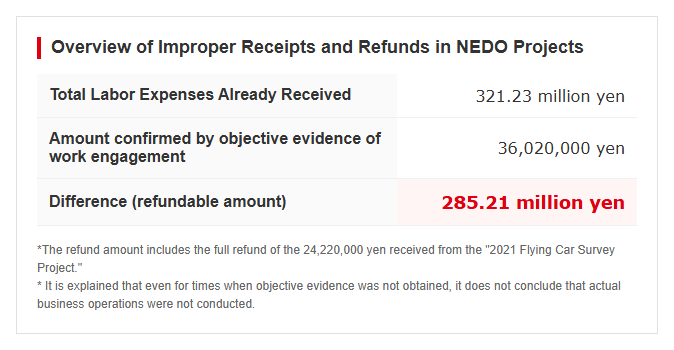
On June 30, 2026, Japan Airlines (JAL) reported the results of its investigation to the New Energy and Industrial Technology Development Organization (NEDO) regarding improper labor cost applications in public commissioned and subsidized projects. Due to this issue, JAL will have to return the difference of 285.21 million yen from the 321.23 million yen in labor costs already received, excluding 36.02 million yen for which objective evidence confirmed the work was done. The refund amount also includes the full amount of 24.22 million yen received from the flying car survey project conducted in fiscal 2021.
Details of this incident were clarified through a forensic investigation (digital forensics) conducted by JAL with outside lawyers. After scrutinizing emails and schedule data left on the server, it was found that many cases lacked evidence to prove the facts. JAL claims that not all items subject to return were actually conducted in business, but for cases where digital data is missing or for periods when sufficient investigations could not be conducted due to retirees or secondees, they also include them as refundable due to lack of reliable evidence.
The following image shows the head of JAL’s Innovation Headquarters apologizing upon reporting the investigation results.
Diary creation that differed from the actual systematic practice
The stage for the fraud was an organization of about 20 members, called the ‘Air Mobility Creation Department,’ which handles the flying car and drone businesses. According to the survey results, several managers instructed researchers to assign predetermined “scheduled work hours” and to write work logs according to those plans. Specifically, it became routine to have managers copy sample descriptions of their work content directly into the journal, ignoring the actual situation.
It has been explained that such improper operations had become routine from the very beginning in three projects implemented since fiscal 2021. Although no clear intent for organized collusion or fraudulent receipt was initially recognized, JAL judges that for the two new projects starting in fiscal year 2025, there was an intent to maximize NEDO’s budget by accumulating unnecessary labor costs. This highlighted the distorted attitude of organizations that focused solely on budget consumption and acquisition rather than efficient use of public funds.
Lack of escalation that silenced on-site doubts
What is serious about this issue is that, despite concerns raised by researchers on the ground, these questions were not properly reported to the upper management of the organization. In September 2025, when management gathered researchers to explain how to write logs, several researchers expressed concerns such as “Does my work really fall under NEDO projects?” However, the responsible managers maintained their traditional approach and remained vague, without reporting the issue to upper management.
Executive Officer Iiyama, Head of JAL Innovation Headquarters, explained that researchers were forced to be cautious of managers’ words and actions, and that the “escalation” mechanism for seeking appropriate instructions was not functioning. The company only officially recognized this issue after it was confirmed internally in January 2026 that objections had arisen during the company-wide review of the management status of public subsidies. When the on-site self-cleansing mechanism was about to take effect, the management closed the gap, which became a decisive factor in the expansion of the damage and loss of social credibility.
Deficiencies in management and underlying organizational culture challenges
Deliberate instructions from managers aiming to secure the full budget
Behind this improper receipt was a significant lack of regulatory awareness regarding the management of public funds. The fact that managers gave specific instructions to meet scheduled times in two drone-related businesses launched in fiscal 2025 is not merely a clerical mistake but is considered an intentional attempt to inflate labor costs. According to JAL’s explanation, internal investigations have confirmed that there was an intention to secure full funding for NEDO’s budget for these projects.
Such actions not only risk violating laws such as the Subsidy Appropriateness Act but also fundamentally question corporate ethics. JAL has already implemented personnel measures and organizational reforms for management, but regarding formal disciplinary actions, they will wait for the results and judgment of NEDO’s re-inspection and decision before being decided based on work regulations. NEDO plans to conduct a re-inspection over the next two months, finalizing the refund amount, imposing additional charges and late payment penalties, and imposing further restrictions on future participation in public projects.
Repeated scandals and a governance system under scrutiny
In recent years, Japan Airlines has faced a series of issues related to safety management and compliance. In December 2024, a captain was involved in a drinking incident in Australia, leading to a recommendation for operational improvement from the Ministry of Land, Infrastructure, Transport and Tourism. At that time, Chairman Akasaka, who was the overall safety manager, was dismissed, and a large-scale executive reshuffle and personnel reshuffle were carried out, including the appointment of Director Nakagawa of the Procurement Headquarters.
The issue of improper receipt of labor costs this time was uncovered while efforts were underway to rebuild the safety management system. In its management vision toward 2035, the company has set “safety and security” as the foundation of all its activities, but serious deficiencies have also been found in the handling of public funds, leading to serious scrutiny as to whether the company’s very structure has improved. The current management is once again being called to know how to restore the most important social trust for airlines.
Impact on Business Strategy and Future Outlook for Trust Restoration
The Weight of Next-Generation Mobility Strategy and NEDO Business Withdrawal
Due to this scandal, JAL has decided to withdraw from three ongoing NEDO commissioned and subsidized projects. Specifically, this includes the development of “suitability verification methods” and “development of airframe and system element technologies” to realize one-to-many drone operations, as well as research and development on flight management technologies for flying cars. All of these businesses have a fulfillment period until the end of fiscal 2026 and are expected to be key pillars of JAL’s next-generation mobility strategy in its “JAL Group Management Vision 2035.”
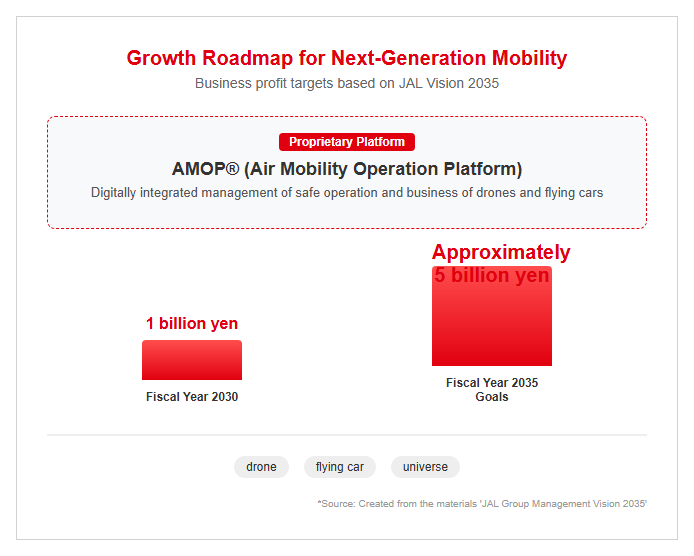
JAL aims to generate profits of around 5 billion yen in the next-generation mobility sector by fiscal year 2035, centered on its in-house developed platform “AMOP.” Withdrawing from public projects not only affects the speed of these growth strategies but also leads to lost opportunities for collaboration with other companies and social implementation. Going forward, the challenge will be how to increase the proportion of in-house investments that do not rely on government support while ensuring transparency in technology development.
The following image illustrates JAL’s vision for the future of next-generation mobility.
Rebuilding Safety and Compliance and Future Highlights
Japan Airlines is currently urgently restructuring its company-wide strategy to restore trust. Under Management Vision 2035, we plan to invest approximately 260 billion yen in technology over the next five years, which includes not only improving operational efficiency but also utilizing digital technologies to enhance safety management and operational transparency. In response to this fraudulent receipt issue, an internal investigation was conducted on the use of subsidies outside of public projects, but at this point, no similar improper accounting has been found.
The key point of interest going forward will be the final disciplinary action imposed by NEDO and the thoroughness of internal accountability for the response. Additionally, with the recovery in aviation demand, we have revised our consolidated earnings forecast for the fiscal year ending March 2026 upward, indicating that current business results remain solid. However, how we enhance the non-financial value of trust from investors and society will influence the medium- to long-term stock price and corporate valuation. Whether JAL can reestablish “safety” and “integrity” as the core of its management and balance creating social value with growth will serve as a true test for revitalization.
[#日本航空 #JAL #NEDO #不正受給 #ドローン #空飛ぶクルマ #ガバナンス #経営戦略]

コメント