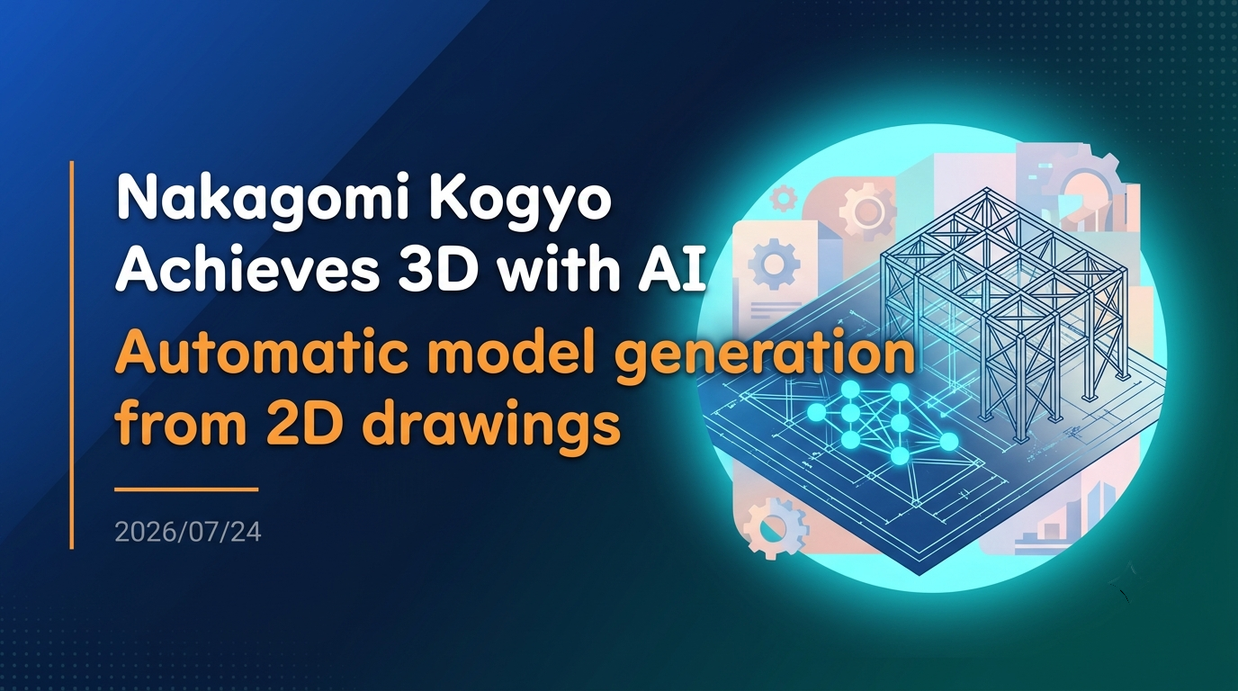
Nakagomi Kogyo, a steel fabric fabricator in Edogawa Ward, Tokyo, has established a method to automatically generate complex 3D models from 2D drawings by utilizing the generative AI agent “Claude Code.” In the construction industry, which faces severe labor shortages and the retirement of skilled technicians, this is a groundbreaking initiative that teaches AI advanced skills to enhance productivity through “human-machine integration,,。
- 1-1. Generating complex stair models from 2D drawings in about 2 hours
- 1-2. The Challenge of Nakagomi Industrial, an M-Grade Steel Fabricator
- 2-1. High-Precision DXF Data Analysis Using Python and ezdxf
- 2-2. Automatic Control of Tekla Using PowerShell and Open API
- 3-1. Turning Skilled Technicians’ “How to Make” and “Inspection Methods” into Prompts
- 3-2. The Human-Machine Integration Correction Process Beyond Full Automation
- 4-1. Construction Industry 2024 Issues and Increasing Burden of 3D Modeling
- 4-2. The Ministry of Land, Infrastructure, Transport and Tourism’s Principled Policy for ‘3D/2D Alignment Confirmation’
- 5-1. 3D Modeling BPO and Business Process Transformation
- 5-2. Realizing a ‘Human-Machine Integrated’ Workplace Through Skill Accumulation
1-1. Generating complex stair models from 2D drawings in about 2 hours
On July 23, 2026, Nakagomi Kogyo Co., Ltd., which handles steel frame construction for buildings and bridges, released a technology that combines the AI agent “Claude Code” with the steel frame 3D modeling software “Tekla Structures” to create 3D models from 2D CAD drawings. This initiative targets particularly complex shapes like stairs, which are considered labor-intensive. Staircase modeling required comparing multiple drawings such as floor plans, building diagrams, cross-sections, and detailed drawings to confirm the positions and heights of components, and traditionally relied on manual work by skilled workers.
In this demonstration, we used DXF drawings equivalent to four A3 pages as the source data, and completed the entire stair body modeling—from arranging the reference model to creating the 24 members and verifying the numbers—in about two hours. Please refer to the diagram below.
1-2. The Challenge of Nakagomi Industrial, an M-Grade Steel Fabricator
Nakagomi Kogyo Co., Ltd. is a steel fabric fabricator certified by the Minister of Land, Infrastructure, Transport and Tourism as an M-grade steel frame fabricator, headquartered in Edogawa-ku, Tokyo. The company mainly handles seismic reinforcement work for schools, metropolitan housing, and public facilities, handling everything from construction drawing creation to factory processing and on-site construction. Yoshiyuki Nakagome, an engineer at the company, has experience in rocket strength design at Mitsubishi Heavy Industries, and applies his cross-industry experience to solving challenges in the construction sector.
In recent years, the construction industry has faced serious challenges such as restrictions on working hours due to the 2024 issue and a decline in young hires. Against this backdrop, Nakagomi Kogyo aims to balance labor-saving and technology transfer by applying generative AI, the latest IT technology, into on-site “real-world operations.” The use of Claude Code this time is positioned not merely as an experiment but as a concrete solution to shorten construction periods and improve accuracy in the actual steel frame fabrication flow.
2. [Technical Details] A mechanism for ‘measuring’ drawings and operating software via API
2-1. High-Precision DXF Data Analysis Using Python and ezdxf
In this system, the open-source Python library “ezdxf” is utilized for reading 2D drawings. The important point is that the AI did not view drawings as images or read text using OCR. Claude Code directly analyzes entity data such as LINE, CIRCLE, ARC, and TEXT within DXF files.
The basic policy for drawing analysis is based on the construction site rule: ‘Lines are correct, characters are for comparison.’ For example, the system measures the dimensions of components from the coordinates of lines on the drawing, and then matches the results with the dimension text in the drawing to ensure accuracy. On the other hand, for example, when the text is drawn in double size, as shown in detailed drawings, exceptions such as treating the text as positive are also applied. In this way, the key to high reliability lies in AI not simply trusting drawings but automating the process of “checking and verifying” multiple data sources.
2-2. Automatic Control of Tekla Using PowerShell and Open API
To realize the results analyzed by AI as 3D models, automatic control is performed using “Tekla Structures,” a BIM software dedicated to steel structures. This operation used both “PowerShell” and the software’s “Tekla Open API.” Specifically, it directly loads the Tekla Open API DLL file from PowerShell and connects it to the currently running software to create components and place reference models.
Claude Code, the command center of the entire process, executes Python scripts as needed to analyze drawings, generates PowerShell commands based on the results, and operates Tekla, achieving a multi-layered orchestration. The division of roles can be summarized as: “DXF analysis = Python + ezdxf,” “Tekla operations = PowerShell + Tekla Open API,” and “overall command = Claude Code.” Please refer to the diagram below.
3. [Innovation in Skill Transfer] Instructing AI in the Procedures of Skilled Workers Through ‘Human-Machine Integration’
3-1. Turning Skilled Technicians’ “How to Make” and “Inspection Methods” into Prompts
What stands out in this project is that instead of simply telling AI to “build stairs,” it taught the skilled technicians the very “way of working” they usually do. Engineers at Nakagomi Works place the floor plan and pillar layout diagram as reference models on Tekla when modeling manually, and assemble the three-dimensional structure according to those lines. Furthermore, the completed model is checked by comparing it with drawings from multiple perspectives.
By teaching the know-how of “how to make” and “inspect” to Claude Code as skills, AI has been able to accurately reproduce the placement of complex stairs. This means that skilled techniques, which tend to depend on individuals, have been formalized as digital prompts. Rather than using AI as a mere tool, it is a new model case of skill inheritance in the construction industry, where AI is nurtured as ‘subordinates’ who pass on the knowledge of skilled workers.
3-2. The Human-Machine Integration Correction Process Beyond Full Automation
The method proposed by Nakagomi Kogyo does not aim for “full automation” that completely eliminates humans. Rather, it emphasizes a “human-machine integration” process where humans review AI deliverables and have AI re-execute necessary corrections. For example, if a human points out that the initial model created by AI is “lacking landing” or “the cross-sectional shape is not right,” the AI immediately re-measures the relevant area from the drawing and corrects the model.
Building a perfect system that handles all exceptions requires enormous development costs, but by combining human judgment with AI analytical capabilities, a wide variety of structures can be handled with minimal preparation. This approach frees skilled individuals from simple input tasks and allows them to focus on final confirmation of finished models and advanced decision-making tasks. As labor shortages accelerate, AI is a strategy to significantly expand the scope of work that a single skilled person can cover.
4. [System and Social Background] Worsening Labor Shortages and New Rules from the Ministry of Land, Infrastructure, Transport and Tourism
4-1. Construction Industry 2024 Issues and Increasing Burden of 3D Modeling
The construction industry is subject to the so-called “2024 problem” and overtime cap regulations, making productivity improvement an urgent priority. In particular, while the use of BIM/CIM is advancing, 3D modeling itself is becoming a new burden on the site. Traditionally, 2D drawings and 3D models were created separately, and humans had to manually verify their consistency, which contributed to delays and increased costs.
For specialized contractors like steel fabric fabricators, the accuracy of BIM models required by the main contractor is improving year by year, and modeling at the detailed drawing level requires an enormous amount of man-hours. Nakagomi Kogyo’s initiatives aim to alleviate the “modeling burden” on these sites through AI, and in Japan, where labor shortages are severe, it serves as a survival strategy for engineers to devote time to their original creative work.
4-2. The Ministry of Land, Infrastructure, Transport and Tourism’s Principled Policy for ‘3D/2D Alignment Confirmation’
As a social background, the Ministry of Land, Infrastructure, Transport and Tourism’s policy of ‘confirming consistency between 3D models and 2D drawings’ cannot be ignored. The Ministry of Land, Infrastructure, Transport and Tourism has indicated a policy to mandate this alignment confirmation in principle within the next two to three years, aiming to improve design and construction efficiency and prevent errors. This has made eliminating discrepancies between 3D models and 2D drawings the standard industry rule.
To comply with this new rule, technology that synchronizes drawings and models with high accuracy is essential. Nakagomi Industries’ method of “measuring drawings, creating models, and cross-checking them with text information” is precisely the goal of ensuring consistency that the Ministry of Land, Infrastructure, Transport and Tourism seeks through AI. As institutional changes loom, AI-powered automatic alignment technology is likely to become essential infrastructure for future construction companies to maintain competitiveness.
5. [Future Outlook] The Future of the Construction Industry Brought by Collaboration with AI
5-1. 3D Modeling BPO and Business Process Transformation
The approach developed by Nakagomi Kogyo has the potential to significantly transform the future landscape of BPO (Business Process Outsourcing) in 3D modeling. If AI handles the primary tasks of large-scale drawing analysis and modeling, and experienced professionals review the results and issue advanced instructions, a dramatic acceleration in modeling operations will be achieved.
Additionally, by combining it with the ‘BIM Model Approval’ mechanism being promoted by Takenaka Corporation, there is a possibility that model-based approval workflows will become widespread without relying on paper two-dimensional detail drawings. If AI can generate accurate 3D models from 2D drawings, it is expected to minimize friction in information exchange between design and construction, significantly shortening the overall lead time for construction projects.
5-2. Realizing a ‘Human-Machine Integrated’ Workplace Through Skill Accumulation
By accumulating skilled practitioners’ procedures as ‘skills’ in AI agents like Claude Code, the AI learns more as it completes projects, creating a cycle where the accuracy and speed of work improve. This means that corporate intellectual property accumulates not only in individuals’ minds but also as dynamic assets called AI.
In response to concerns about “AI taking over jobs,” the case of Nakagomi Industrial offers a positive response: “Teach AI how to work and make them a strong subordinate.” Skilled technicians will evolve into ‘orchestrators’ who master AI, enabling them to deliver high-quality results with AI support, regardless of age or experience. With the spread of this human-machine integrated work style, the construction industry, once considered harsh and labor-intensive, is opening the way for it to transform into an attractive intellectual industry that leverages advanced IT technologies.
Reference Page
-
[Nakagomi Kogyo Co., Ltd.] http://nakagome.c.ooco.jp/index.html
-
【ezdxf – GitHub】https://github.com/mozman/ezdxf
-
【Tekla Structures Open API】https://developer.tekla.com/tekla-structures/api
[#建設DX #AI活用 #中込工業所 #ClaudeCode #BIM #鉄骨建設 #2024年問題 #TeklaStructures]

コメント