It has been revealed that SoftBank Group is considering acquiring Gravis Robotics, a Swiss startup specializing in autonomous construction machinery. Behind this is the company’s ambitious strategy to dominate “physical AI” in the construction industry, which faces severe labor shortages.
- Full details of SoftBank Group’s acquisition plan
- Gravis’s ‘retrofit’ technology revolutionizing the construction industry
- Synergy with the acquisition of ABB Robotics
- Masayoshi Son’s ASI Vision and the New Company “Roze”
- Addressing Severe Labor Shortages and Improving Environmental Efficiency
- Competition with Existing Heavy Equipment Manufacturers and Business Model Transformation
- Entry into the North American market and acceleration of global expansion
- Strengthened Foreign Investment Regulations and Security Risks
Full details of SoftBank Group’s acquisition plan
On July 24, 2026, it was reported that SoftBank Group (SBG) was considering acquiring the Swiss startup Gravis Robotics. The acquisition amount could reach up to $500 million (about 82 billion yen), making it an exceptionally large-scale deal for a company in its fourth year. SBG has decided to hold the shares acquired through this acquisition under the umbrella of Roze, a new company specializing in artificial intelligence (AI) and robotics established in the United States. The acquisition process is expected to proceed in stages by acquiring shares from existing shareholders and accepting new shares. Negotiations are said to be in the final stages, but depending on final conditions, there is still a possibility of postponement or cancellation, drawing attention from market participants. This move can be seen as an event symbolizing the “next wave of AI,” where AI breaks out of the software world to control the physical world of reality.
Gravis’s ‘retrofit’ technology revolutionizing the construction industry
Gravis Robotics was established in 2022 as a spin-off company from ETH Zurich, one of the world’s leading research institutions. The company’s greatest technical feature is developing a “retrofit kit” that enables autonomous control of existing heavy machinery such as hydraulic excavators and bulldozers using AI. The kit includes a Lidar, stereo camera, hydraulic actuator, and a computer stack that runs advanced recognition and planning algorithms. Operators only need to instruct tasks such as excavation and land leveling through tablet terminals, and the machines execute them autonomously and accurately. In December 2025, the company successfully raised $23 million (about 3.4 billion yen), and its autonomous control system has already been deployed in infrastructure projects worldwide, including in Europe, the United States, and Asia.
Background of the management strategy: Massive investment in physical AI
Synergy with the acquisition of ABB Robotics
Prior to the Gravis acquisition, SBG had agreed to acquire the robotics business of Swiss heavy electrical giant ABB in October 2025 for approximately 5.375 billion USD (approximately 818.7 billion yen). While ABB’s business specializes in industrial robots used in factories such as the automotive industry, Gravis’s technology is specialized for the harsh and dynamic environments of ‘outdoor construction sites.’ By combining these two acquisitions, SBG aims to build an AI robot platform that covers every aspect of the physical world, from factory assembly lines to civil engineering work. This series of moves clearly shows a shift from traditional software-centered AI investments to AI that autonomously controls hardware with physical entities.
Masayoshi Son’s ASI Vision and the New Company “Roze”
Masayoshi Son, Chairman and President of SBG, has set the mission of realizing artificial superintelligence (ASI), which far surpasses human intelligence. He believes that achieving this requires AI chips, data centers, power supply, and AI robots as “physical AI.” The new company “Roze,” established in the United States, will consolidate the robotics assets within these groups and serve as a core strategic hub with an eye toward future listings. The acquisition of Gravis adds a major piece of construction automation to Roze’s portfolio, serving as a decisive step toward establishing global dominance. The company already has around 20 affiliated investors, including Berkshire Gray and Skilled AI, and aims to maximize technical synergies by leveraging Gravis’s advanced algorithms across the group.
Impact on the market and society, and changes in industry structure
Addressing Severe Labor Shortages and Improving Environmental Efficiency
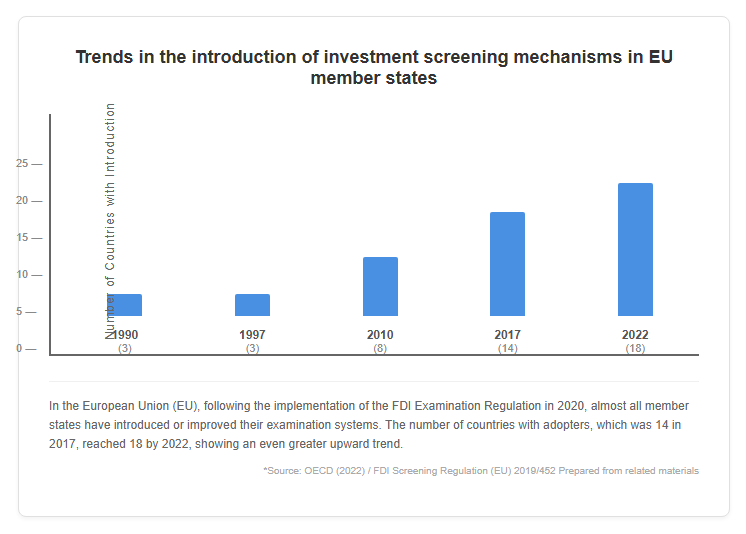
The global construction industry is a massive market worth 10 trillion dollars, but it faces structural challenges such as an aging of skilled operators and a shortage of young hires. Gravis’s autonomous driving technology not only boosts operator productivity by up to 30%, but also achieves dramatic efficiency improvements, reducing fuel consumption by about 18% and keeping rework rates below 3%, which is about 12% for manual work. Additionally, since construction sites are private land unlike public roads, legal and regulatory hurdles are lower, allowing for rapid practical and commercial application of advanced autonomous driving technologies. The chart below shows trends in strengthened investment screening in countries such as Europe, suggesting growing attention to these strategic technologies.
Competition with Existing Heavy Equipment Manufacturers and Business Model Transformation
Gravis’s business model consists of kits priced between $85,000 and $140,000 per unit, plus software subscriptions costing $800 to $1,200 per month. This “retrofit model” proposal serves as a strong countermeasure against the new vehicle integration automation technologies developed by existing major heavy machinery manufacturers such as Caterpillar and Komatsu Manufacturing. For construction companies, the flexibility to upgrade existing fleets without replacing expensive new cars is extremely attractive. If SBG succeeds, this disruptive startup business model will be reinforced by overwhelming capital and will force existing heavy equipment manufacturers to accelerate their roadmaps for automation and autonomy.
Future Developments, Key Points, and Potential Challenges
Entry into the North American market and acceleration of global expansion
Gravis currently operates mainly in European countries, but joining SBG is expected to accelerate rapid expansion into the North American market. The U.S. construction equipment market is valued at about $54 billion annually, and due to a severe labor shortage, demand for automation technology is extremely high. If ample funding is poured in through Roze, the construction of sales and support networks in North America will accelerate rapidly. Furthermore, integration not only with autonomous control but also with teleoperation technology, where operators remotely perform operations based on site conditions, is expected to continue evolving as a practical solution toward fully unmanned construction sites.
Strengthened Foreign Investment Regulations and Security Risks
Meanwhile, investment screenings for advanced technologies in various countries are becoming increasingly stringent year by year. Switzerland is also set to implement the Investment Review Act (ISA) in 2027, which will subject more stringent scrutiny to foreign capital related to critical security infrastructure and sensitive technologies. Since AI robots cannot be ruled out for military use, whether regulators will approve this acquisition could be the biggest uncertainty. Additionally, as seen in the European Union’s (EU) concerns over infrastructure investments by Chinese companies, the wave of international regulations aimed at protecting strategic autonomy may affect SBG’s cross-border M&A within its “Physical AI” strategy.
Reference Page
-
[Notice Regarding the Acquisition of ABB Ltd’s Robotics Business | SoftBank Group Corp.]https://group.softbank/news/press/20251008
-
【D-MAVT spin-off Gravis Robotics secures \$23 million – ETH Zurich】https://mavt.ethz.ch/news-and-events/d-mavt-news/2025/12/gravis-robotics-secures-23-million.html
[#ソフトバンクグループ #ロボティクス #フィジカルAI #自動運転 #スマート建機 #スタートアップ #M&A #経済ニュース]
コメント