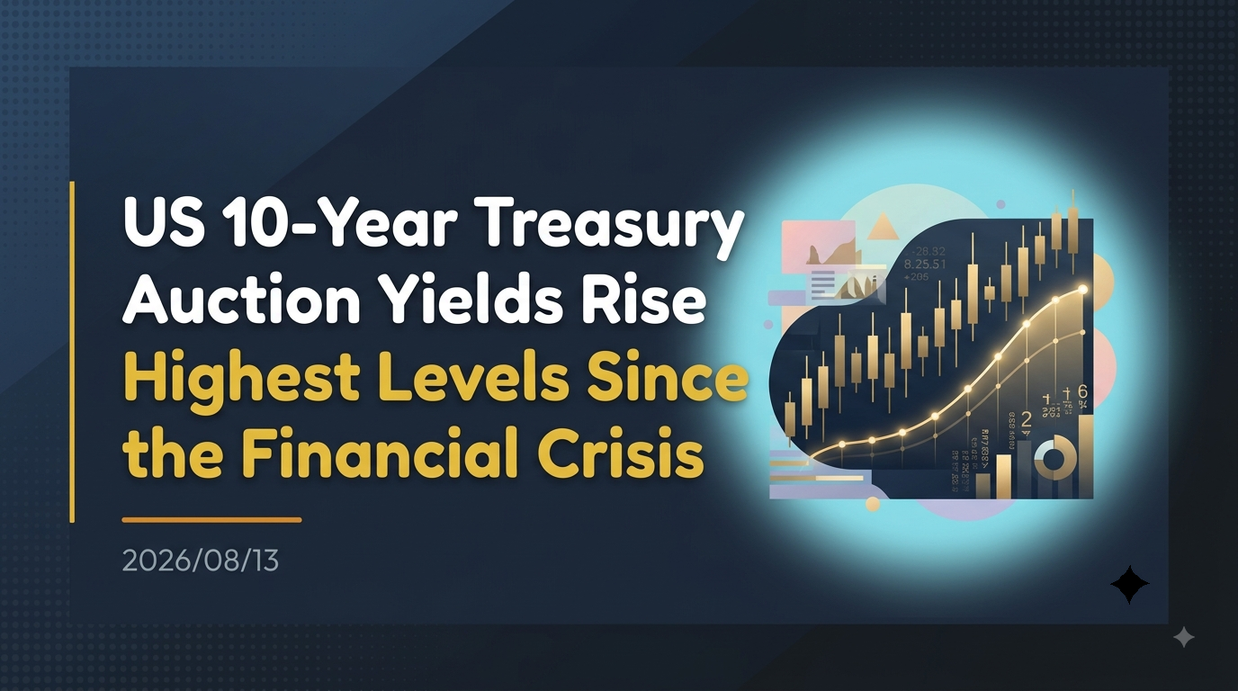
In a recent 10-year US Treasury note auction, the high yield hit 4.683%, the highest level since the 2007 period preceding the Global Financial Crisis,. This rise is driven by a ballooning US fiscal deficit and persistent inflation, which are significantly increasing global borrowing costs,.
- Record-High 4.683% Yield in 10-Year Note Auction and Demand Analysis
- Sticky Inflation and Fiscal Deficits Driving Up Long-Term Yields
- Impact of the “Asset Price Anchor” Rise on the Real Economy and Stock Markets
- Breakdown of the Dollar-Yield Correlation and the Limits of Market Intervention
- Future Policy Outlook and Key Points for Market Participants
Record-High 4.683% Yield in 10-Year Note Auction and Demand Analysis
The US Department of the Treasury conducted a 42-billion-dollar auction for 10-year notes on August 12, 2026, where the highest落札利回り (high yield) was confirmed at 4.683%,. This figure represents the highest level since 2007, a time when the signs of the Global Financial Crisis were first beginning to emerge,. Compared to the 4.580% yield from the previous month’s auction, yields have climbed by more than 10 basis points (0.1%) in just one month, reflecting a significant shift in how the market prices the US government’s borrowing costs,. Despite the high yield, demand remained relatively steady with a bid-to-cover ratio of 2.53x, slightly exceeding the six-month average of 2.47x,. A notable highlight was the participation of indirect bidders—a category that includes international central banks and foreign investors—who took up 76.7% of the auction, the highest since last year. This suggests that while yields are rising, the high nominal returns continue to attract international capital,. Following the announcement, the market for existing US Treasuries maintained its upward trend, indicating that investors are beginning to accept these elevated interest rate levels as the new baseline,. Please refer to the figure below.
Sticky Inflation and Fiscal Deficits Driving Up Long-Term Yields
The sustained high levels of US long-term interest rates are rooted in two structural problems: persistent inflation concerns and a widening national fiscal deficit,. Inflation in the United States continues to hover above the target set by the Federal Reserve (FRB), keeping market participants on high alert. Simultaneously, massive government spending has led to a surge in the supply of government bonds to fund the deficit, naturally putting upward pressure on yields,. In fact, US interest payments on national debt have now surpassed defense spending, becoming one of the largest single items in the federal budget,. Furthermore, geopolitical tensions, such as the conflict involving Iran, have raised fears of a resurgence in energy-driven inflation due to potential spikes in crude oil prices,. Under these conditions, where both supply and demand factors keep rates high, investors are demanding a higher premium for holding long-term US debt,. This environment has made it difficult for yields to return to lower levels, even as certain economic data shows signs of moderation.
Impact of the “Asset Price Anchor” Rise on the Real Economy and Stock Markets
As the 10-year US Treasury yield serves as the “anchor” for global asset prices, its rise to nearly 20-year highs exerts broad pressure on the global economy,. This increase directly translates into higher borrowing costs for corporations and consumers, affecting everything from equipment investment to residential mortgages and auto loans,. In the stock market, particularly for high-growth technology shares, higher yields lead to a compression of valuations as the present value of future cash flows is discounted at a higher rate,. Historical data suggests that when the US 10-year yield deviates significantly (more than 1% point) from its one-year moving average, equity markets often face major corrections,. Similarly, the US housing market is highly sensitive to these shifts; a rapid spike in rates can lead to a sharp decline in housing investment and prices, potentially triggering a “negative wealth effect” that dampens individual consumption,. Investors must remain cautious, as the rising risk-free rate is fundamentally altering the attractiveness of riskier assets across the globe,.
Breakdown of the Dollar-Yield Correlation and the Limits of Market Intervention
In the foreign exchange markets, the traditional positive correlation where “rising US rates lead to a stronger Dollar” has recently shown signs of breaking down,. Despite high US yields, the US Dollar has faced downward pressure against major currencies, a phenomenon some analysts attribute to a “Sell America” sentiment fueled by concerns over the sustainability of US fiscal policy,. This creates a complex situation for international policy coordination. For instance, Japanese authorities have been under pressure to intervene in currency markets to stop the depreciation of the Yen. However, if Japan were to sell its vast holdings of US Treasuries to fund such interventions, it could further drive up US yields, creating a vicious cycle. While US Treasury Secretary Janet Yellen (and potential successors like Scott Bessent) have occasionally signaled support for currency stability, the underlying fiscal imbalances make long-term intervention difficult,. Many market participants believe that as long as the US fiscal trajectory remains unsustainable, the effectiveness of any government intervention will be short-lived,. Please refer to the figure below.
Future Policy Outlook and Key Points for Market Participants
The immediate focus for the market is whether the Federal Reserve will maintain its restrictive monetary policy through the end of the year. While recent US Consumer Price Index (CPI) data met expectations, lowering the immediate probability of an additional rate hike, investors remain wary of a potential rebound in inflation,. The upcoming Jackson Hole Economic Symposium in late August is expected to be a pivotal event, where Fed officials may provide clearer guidance on the future path of interest rates. Any hawkish signals from this meeting could solidify the 10-year yield above the 4.5% threshold,. Looking further ahead, there are growing warnings regarding the sustainability of US federal debt. If the US credit rating were eventually downgraded to the “A+” level, it could significantly increase holding costs for global banks due to international financial regulations (Basel III), potentially destabilizing the global financial system,. Some experts even suggest that the current “debt bubble” might lead to a significant “Financial Reset,” a possibility that continues to weigh on market sentiment and limit the upside for risky assets.
Reference
- 【U.S. Department of the Treasury】https://home.treasury.gov/
【#USTreasuries #InterestRates #Inflation #FiscalDeficit #FederalReserve #FinancialMarkets #EconomicNews #InvestmentStrategy】

コメント