In response to a series of scandals involving massive fraudulent money collection and scams by a former sales employee at Sony Life Insurance, the Financial Services Agency (FSA) has begun considering conducting an on-site inspection of the company under the Insurance Business Act. In the background lie serious challenges within the business model itself, such as the isolation of customer relationships in face-to-face sales and the dysfunction of corporate governance associated with a merit-based system.
- Background leading to the consideration of an on-site inspection and scandals uncovered so far
- Occurrence of Fraud Directly Leading to Cancellations and Reductions, and Strengthening of Administrative Supervision by the Financial Services Agency
- Full-commission compensation and the atrophy of management functions for star players
- The Closed-Door Nature of Customer Relationships and the Light and Shadow of the Life Planner System
- Loss of Credibility and Stock Price Drop Immediately After Partial Spin-Off Relisting
- Prior disciplinary precedents against Prudential Life Insurance and medium- to long-term countermeasures
Background leading to the consideration of an on-site inspection and scandals uncovered so far
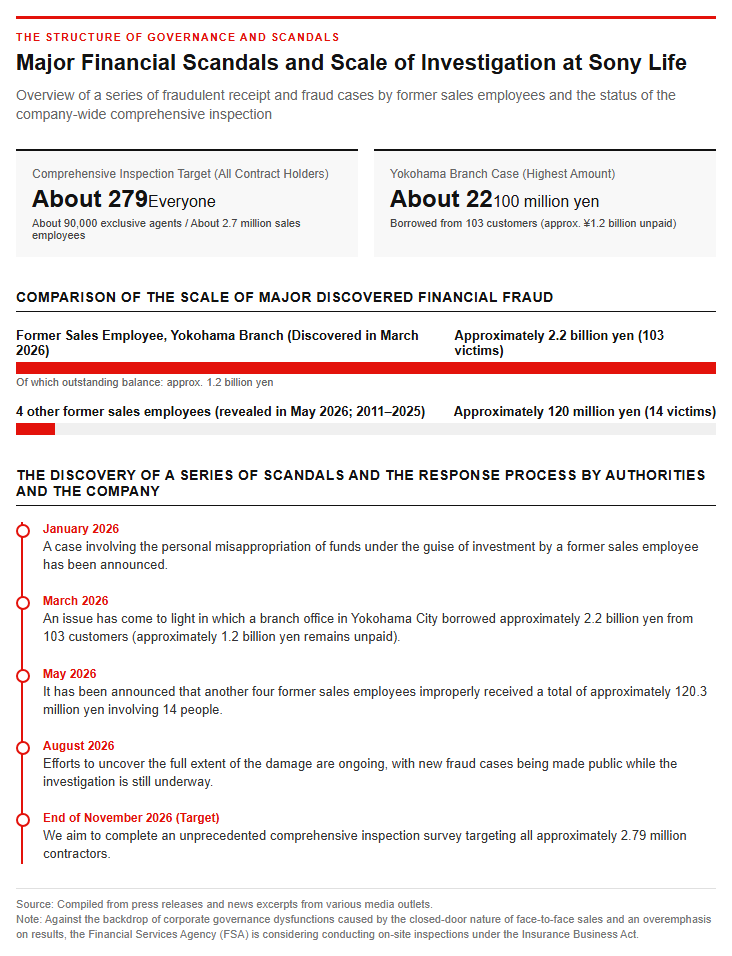
Behind the Financial Services Agency’s consideration of an on-site inspection of Sony Life Insurance are a series of financial misconduct cases that have successively come to light at the company. Beginning with the public disclosure in January 2026 of a case in which a former sales employee misappropriated money received from customers under the guise of investments, serious troubles have been revealed one after another at the company. In March of the same year, a problem came to light in which a former sales employee belonging to a branch office in Yokohama City personally borrowed a total of approximately 2.2 billion yen from 103 customers and others, of which approximately 1.2 billion yen remains unrepaid. Furthermore, in May of the same year, it was also announced that four other former sales employees had inappropriately received a total of approximately 120.3 million yen from 14 customers under the guise of investments between 2011 and 2025. In response to these situations, Sony Life is proceeding with an unprecedented comprehensive inspection survey targeting all approximately 2.79 million policyholders—comprising about 90,000 handled by exclusive agencies and about 2.7 million handled by sales employees. Although this survey aims for completion by the end of November 2026, new fraudulent acquisition cases were announced even in August during the survey, and the full clarification of the damage remains ongoing. The timeline of the major financial misconduct uncovered so far is as shown in the figure below.
Occurrence of Fraud Directly Leading to Cancellations and Reductions, and Strengthening of Administrative Supervision by the Financial Services Agency
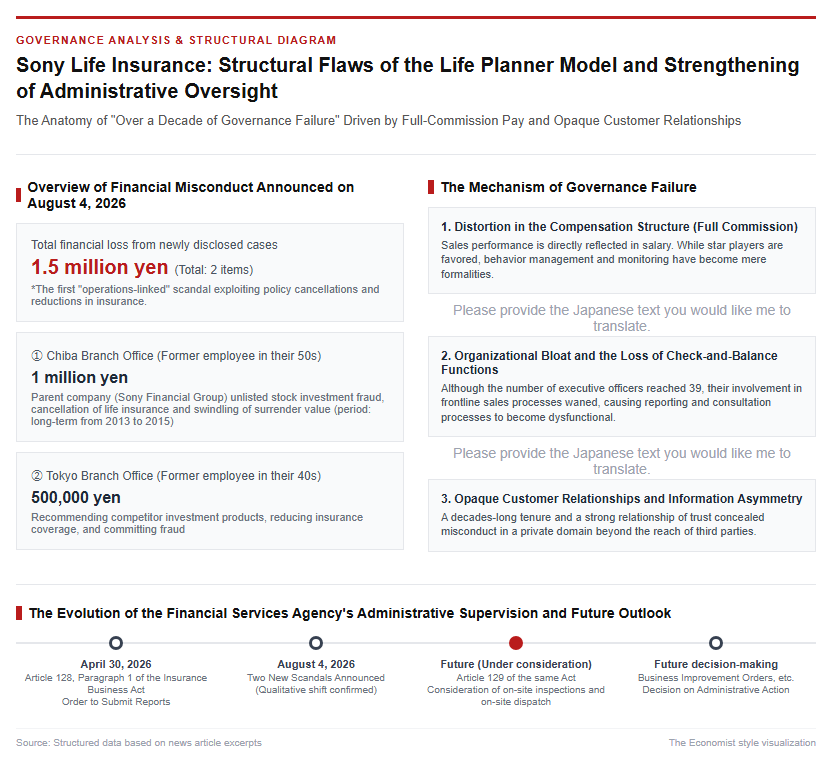
The two new financial scandals announced by Sony Life Insurance on August 4, 2026, while small in scale at a total of 1.5 million yen, indicate a critical situation qualitatively different from previous cases. A former employee in their 50s belonging to a branch in Chiba Prefecture falsely claimed that customers could invest in unlisted shares of the parent company, Sony Financial Group, and defrauded a customer of 1 million yen from the cash surrender value by having them cancel their life insurance policy. Additionally, a former employee in their 40s belonging to a branch in Tokyo recommended an investment product from another company, reduced the insurance coverage, and swindled 50 million [Wait, 50万 is 500,000 yen, let me fix: 50万 is 500,000 yen] 500,000 yen. These were recognized by the company for the first time as scandals directly tied to business operations, exploiting legitimate business processes such as the cancellation or reduction of insurance contracts. The Financial Services Agency had already issued an order for reports based on Article 128, Paragraph 1 of the Insurance Business Act as of April 30, 2026, requesting the clarification of causes and measures to prevent recurrence. However, judging that a written investigation alone was insufficient to uncover the actual situation, the agency has begun considering an on-site inspection based on Article 129, which carries stronger enforcement powers. The policy is to have inspectors stationed permanently at the headquarters to thoroughly investigate the degree of disciplinary functionality, and then decide whether to issue administrative dispositions such as business improvement orders.
Governance Failure: Structural Flaws in the Life Planner Model
Full-commission compensation and the atrophy of management functions for star players
At the root of the problems facing Sony Life is a blind spot in the life planner model that has supported the company’s high growth for many years. Sony Life and its sister company, Prudential Life Insurance, have adopted a compensation system close to a full commission structure, where sales results are directly reflected in salaries. While this compensation system maximizes the motivation of sales staff and generates high productivity, it has had the side effect of transforming employees into in-house sole proprietors rather than workers under organizational control. A culture emerged in which the company refrained from interfering in the sales processes of high-performing star players, slackening behavioral management and daily monitoring. While the number of executive officers swelled to as many as 39, governance became hollowed out, and organizational check-and-balance functions and reporting, communication, and consultation processes stopped working. Such a results-first culture diminished compliance awareness and became a breeding ground that allowed personal financial transactions and misconduct between customers and sales staff to go unnoticed for more than a decade.
The Closed-Door Nature of Customer Relationships and the Light and Shadow of the Life Planner System
The life planner system is based on an excellent design philosophy of crafting optimal coverage plans tailored to each customer’s life plan. However, the mechanism where the same representative remains deeply involved with a specific customer for decades carries inherent, two-sided risks. While sales representatives are in a position to understand details such as a customer’s family structure, financial status, and even the contents of their wallet, enabling them to build a strong relationship of trust, this simultaneously creates an insulated relationship closed off from the eyes of third parties. This isolation was the primary factor why frauds spanning long periods of 13 or 15 years went unnoticed in the Sony Life case. Customers placed uncritical trust in their representatives, unquestioningly accepting investment pitches, the lending and borrowing of money, and even proposals to cancel or reduce insurance policies brought up in private domains beyond the reach of the organization. It can be said that the bill has come due for prioritizing sales freedom without paying governance costs in face-to-face sales—where trust is the vulnerable core of the business model—manifesting as the collapse of this organizational model. Please refer to the figure below regarding the risk structure resulting from information asymmetry and the concentration of trust in the sales representative channel.
Impact on the Market and Outlook: Challenges After Re-listing and the Task of Rebuilding Trust
Loss of Credibility and Stock Price Drop Immediately After Partial Spin-Off Relisting
This massive financial scandal and the news that the Financial Services Agency is considering an on-site inspection occurred at an exceptionally damaging time for the parent company, Sony Financial Group. The group had just completed a partial spin-off from Sony Group on September 29, 2025, and successfully re-listed on the Tokyo Stock Exchange Prime Market. Just as it declared that it would step out from under its parent company’s wing and subject itself to the strict disciplines of the market as an independent publicly traded company, the governance failure of Sony Life—which forms the backbone of the group’s earnings—was brought to light. Amid suspicions of a cover-up, including the fact that the scandal was known internally for years yet kept from the public for approximately three years, the market is casting an exceptionally harsh gaze upon the company. When reports emerged on the night of August 30, 2026, that the FSA was considering an on-site inspection, Sony Financial Group’s stock plummeted in trading the following day, August 31, falling 4.52% from the previous day to 158.3 yen and hitting a record low. Brand erosion in the life insurance business, which is fundamentally a trust-based enterprise, directly translates to a slowdown in the acquisition of new policies, an increase in cancellations of existing policies, and surging compliance-related costs, raising concerns that it could severely impair the company’s medium-term earnings capacity.
Prior disciplinary precedents against Prudential Life Insurance and medium- to long-term countermeasures
To predict the future path that Sony Life Insurance will take, the precedent of Prudential Life Insurance, which shares common roots and experienced a similar scandal, serves as an important indicator. At Prudential Life Insurance, the inappropriate receipt of approximately 3.1 billion yen by a total of 106 current and former employees came to light in January 2026. Taking responsibility, the president resigned effective February 1 of the same year, and the company recorded an extraordinary loss of approximately 5.5 billion yen in customer compensation-related expenses. Furthermore, the company suspended operations for 180 days and was driven to implement recurrence prevention measures, such as reviewing its commission-only system and introducing a fixed salary. The Financial Services Agency is rushing to clarify the facts at Sony Life in parallel with its preceding inspections of the Prudential Group, and it has been pointed out that Sony Life may also face extremely severe administrative disposition. To prevent scandals, Sony Life has announced the abolition of its exclusive agency system and is considering a review of its commission-based pay model, which will exert significant downward pressure on profit margins. Whether the re-listed group can rebuild robust internal controls and a highly transparent management system and recover its lost trust is a matter of life and death for the company.
Reference Page
- [Sony Financial Group: Regarding the Report Order Issued by the Financial Services Agency] https://kabuyoho-sls-disclose.ifis.co.jp/67f/140120260430515375.pdf
- [Sony Financial Group FY2025 Financial Results Briefing Materials] https://www.sonyfg.co.jp/ja/financial_info/results/sfgi_fy2025_4q_02.pdf
- [Sony Life Insurance: Financial Results & Financial Information] https://www.sonylife.co.jp/company/corporate/results/
[#Economy #Business #FSA #SonyLife #Governance #CorporateGovernance #LifeInsurance #Scandal]


コメント