
The Japan Semiconductor Equipment Association (SEAJ) has significantly revised its demand forecast for Japanese-made semiconductor manufacturing equipment. Behind this is the global acceleration in investment in advanced generative AI devices, and the market size for memory and logic semiconductors is expanding at a pace faster than anticipated.
- Sales of Japanese-made manufacturing equipment expected to increase by 26%
- Reaching the ‘1 trillion dollar market’ ahead of schedule by four years
- Tight supply and demand for advanced logic and HBM (High Bandwidth Memory)
- The Impact of Next-Generation AI: ‘Agentic AI’ and ‘Physical AI’
- Japan’s domestic market to exceed 2 trillion yen for the first time in fiscal 2028
- Strengths of Japanese-made equipment and hybrid production models
- The impact of the Trump administration’s tariff policies on business
- The shock of the new bill on export controls to China, the ‘MATCH Act’
- The Worsening Talent Wars
- Continuous R&D Investment Toward “Semiconductors = Future”
Sales of Japanese-made manufacturing equipment expected to increase by 26%
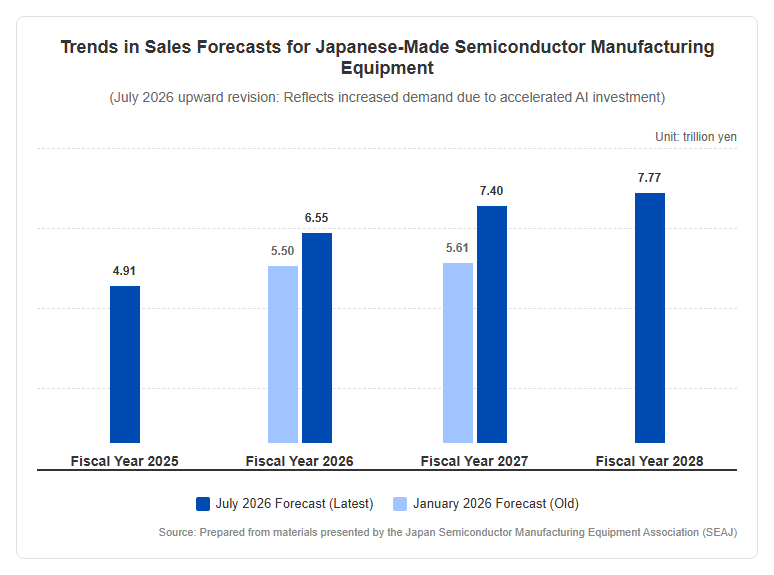
The Japan Semiconductor Equipment Association (SEAJ) released its latest semiconductor and FPD manufacturing equipment demand forecast on July 2, 2026. According to the report, sales of Japanese-made semiconductor manufacturing equipment in fiscal 2026 are expected to reach 6.5502 trillion yen, a 26% increase from the previous year. As of January 2026, the forecast for that fiscal year projected sales at 5.5004 trillion yen, but this announcement includes an increase of about 1.05 trillion yen. This upward revision reflects strong investments in advanced logic for AI servers, as well as a significant increase in DRAM investments, especially in high-bandwidth memory (HBM).
The growth of the manufacturing equipment market does not stop at a single year. SEAJ forecasts for fiscal year 2027 to 7.4017 trillion yen, a 13% increase from the previous year, citing continued demand for semiconductors for AI servers and increased equipment delivery due to the completion of new fabs (semiconductor factories). Furthermore, by fiscal year 2028, the market is projected to expand to 7.7718 trillion yen, making it highly likely that the Japanese semiconductor manufacturing equipment market will shift to a larger market size.
Please refer to the diagram below.
Reaching the ‘1 trillion dollar market’ ahead of schedule by four years
The global semiconductor market itself is expanding at an unprecedented speed. According to a forecast released by the World Semiconductor Market Statistics (WSTS) in June 2026, global semiconductor sales in 2026 are expected to reach $1.5112 trillion, an 89.9% increase year-on-year. Traditionally, it was predicted that the global semiconductor market would surpass $1 trillion around 2030, but not only will this milestone be moved up by four years, but the market size itself is also expected to expand further.
The memory sector is driving this growth, with an astonishing 249.5% year-on-year increase expected in 2026. Additionally, the logic field, which handles computation, is expected to grow at a high rate, increasing by 37.3% year-on-year. Semiconductors have now gone beyond mere industrial rice and have become strategic materials known as 21st-century oil and digital diamonds, and expectations and investments in equipment manufacturers supporting their production are expected to remain at high levels for the next several years.
[Engine of Growth] Explosive Expansion of AI Server and Memory Investments
Tight supply and demand for advanced logic and HBM (High Bandwidth Memory)
The main factor behind this upward revision is the exceptionally strong investment in advanced semiconductors for AI servers. In particular, demand for GPUs (image processing units), which are essential for learning and inference in generative AI, and the HBM that is paired with them, is exploding in demand. With the evolution of HBM generations, the number of DRAM die layers is increasing from 12 to 16 layers, and even 20 layers, and the increasing complexity of manufacturing processes is driving up equipment investment.
In the memory sector, demand for general-purpose DRAM for AI servers is increasing, and price increases continue due to supply constraints. Additionally, regarding NAND flash, demand for SSDs (solid-state drives) for AI servers has been rapidly increasing since early 2026, and the replacement of traditional hard disk devices (HDDs) is also progressing. Manufacturing these advanced devices requires advanced technologies such as Gate All Around (GAA) structures and Backside Power Supply (BSPDN), which strongly drive demand for Japanese-made equipment on both frontend and backend processes.
The Impact of Next-Generation AI: ‘Agentic AI’ and ‘Physical AI’
SEAJ is focusing on new AI advancements as factors that will generate additional demand in the future. In addition to the current mainstream training and inference of large language models (LLMs), there will be a growing need for agency AI that plans and acts on behalf of humans. This will increase the importance of CPUs that manage multiple processes, and the demand for DRAM and SSDs supporting them is expected to expand further.
Additionally, physical AI that acts in the real world, autonomous robots, and simulations using digital twins are expected to bring significant changes to manufacturing. These technological innovations demand even higher performance, lower power consumption, and larger capacity in semiconductors, further accelerating investments in miniaturization and advanced packaging such as hybrid bonding. AI demand is becoming established as a longer-term growth driver, distinct from the traditional smartphone- and PC-centered cycles.
[Market Transformation] Japan’s Market Surpasses 2 Trillion Yen and Strengthening the Supply System
Japan’s domestic market to exceed 2 trillion yen for the first time in fiscal 2028
Japan’s domestic semiconductor manufacturing equipment market is also reaching a historic turning point. SEAJ forecasts that sales in the Japanese market for fiscal year 2026 will increase by 10% year-on-year to 1.5835 trillion yen, and in fiscal 2028, it is expected to reach 2.2763 trillion yen, a 25% increase from the previous year. This is the first time in history that the Japanese market has exceeded 2 trillion yen, confirming the strong momentum of domestic investment.
This growth is driven by second-phase investments by major foundries, preparations for mass production of logic semiconductors using the 2nm process, and proactive investments in advanced DRAM and NAND. Compared to forecasts as of January 2026, the growth outlook for the Japanese domestic market has been significantly raised. Although investments in automotive and power semiconductors have shown some stagnation, preparations for mass production of advanced memory and logic have more than compensated for this growth.
Strengths of Japanese-made equipment and hybrid production models
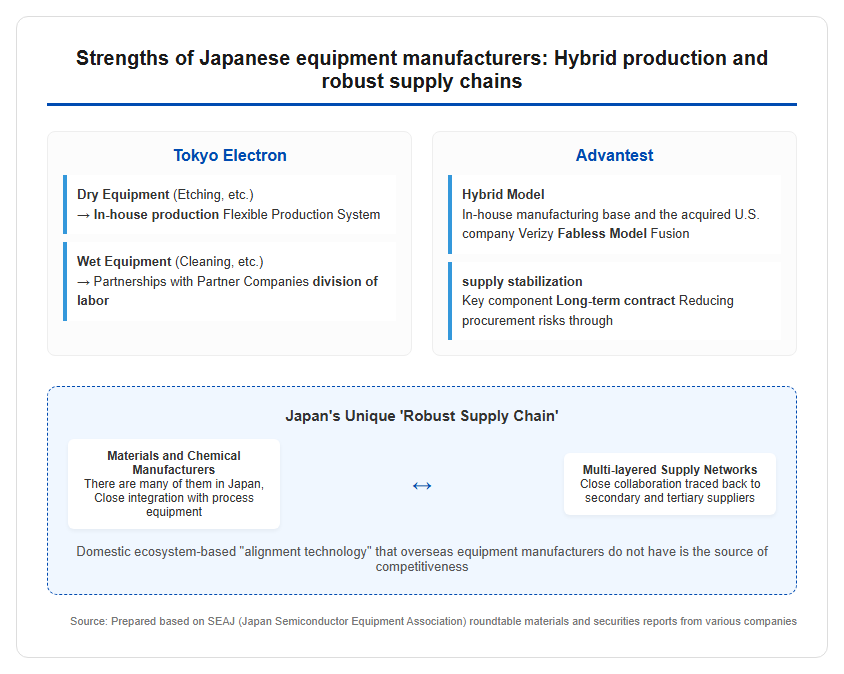
The reason Japanese companies maintain a high market share in the global semiconductor manufacturing equipment market is the presence of a strong supply chain centered on the domestic market. Although it varies depending on the type of equipment, especially in process equipment, close collaboration with the numerous domestic material and chemical manufacturers in Japan is a major advantage. Equipment manufacturers are establishing hybrid production models that combine in-house and outsourcing to respond to waves in demand.
For example, Tokyo Electron is promoting division of labor for wet equipment, while maintaining a flexible system focused on in-house production for dry equipment. Advantest has adopted the fabless model from Velizy, which was acquired by the U.S., to reduce fixed cost burdens while responding to rapid demand fluctuations. Regarding the supply network for components and parts, communication is being carried out retroactively to secondary and tertiary suppliers, and long-term contracts for key components are being promoted to enhance supply capacity.
Please refer to the diagram below.
[Geopolitical Risk] Uncertainty Brought by Trump Tariffs and Export Controls
The impact of the Trump administration’s tariff policies on business
While the market is booming, geopolitical risks remain the biggest concern. In particular, the tariff policies of the second Trump administration could have a serious impact on the semiconductor supply chain. According to a survey by PwC Japan, about 68% of Japanese companies are concerned about the impact of Trump’s tariffs, with specific effects cited as increased procurement costs at U.S. bases and reduced profits due to tariff burdens.
President Trump has hinted at imposing about 100% tariffs on semiconductor imports, which have not yet been implemented, but the uncertainty is making investment decisions difficult for companies. Although there has been an agreement between Japan and the U.S. to lower tariff rates, depending on the progress of investment in the U.S., there remains a risk that negotiations may return to square one. Semiconductor-related companies are being forced to consider measures based on multiple scenarios, such as double-tracking procurement networks, shifting production to the U.S., and even raising domestic sales prices.
The shock of the new bill on export controls to China, the ‘MATCH Act’
The new bill under consideration in the U.S. Congress for stricter export controls to China, the “MATCH Act,” also poses a significant threat to Japanese equipment manufacturers. This bill is a tough provision that if allies such as Japan and the Netherlands do not implement regulations at the same level as the United States, the U.S. will impose its own export bans. Specifically, it includes bans on selling equipment to major Chinese semiconductor companies such as Huawei (Chinese military), SMIC, and CXMT, as well as providing maintenance services for equipment that has already been sold.
Major Japanese companies such as Tokyo Electron have maintained a certain presence in the Chinese market and have provided maintenance services. However, if the MATCH Act is enacted, it will be forced to fundamentally review its business in China, and negative impacts on performance will be inevitable. As US-China tensions intensify and supply chain decoupling progresses, companies are being asked how they can quickly detect geopolitical changes and update their business strategies.
[Future Outlook] The battle for a resilient supply chain and securing talent
The Worsening Talent Wars
With the rapid expansion of the market, the semiconductor industry is facing an extremely serious shortage of talent. This is known as a talent war, and it extends not only to engineers but also to suppliers of components and parts, as well as logistics and human resources. To support the trillion-dollar market toward 2030, the current system is insufficient, and it is essential to cultivate talent and raise the overall level of the industry.
For example, Tokyo Electron has a large-scale hiring plan to increase its consolidated workforce from the current 18,000 to 25,000 by about 60% by the fiscal year ending March 2029. Additionally, the establishment of a talent supply system that transcends university and company barriers, such as the Semiconductor Reskilling Center established at Kumamoto University, has begun. Ensuring work-life balance and promoting manufacturing DX using robots and AI, as well as creating an environment where diverse talent can thrive, will be key to a company’s competitiveness.
Continuous R&D Investment Toward “Semiconductors = Future”
Even in uncertain environments, achieving sustainable growth requires massive R&D (research and development) investments in next-generation technologies. At a technological turning point, the importance of process integration—which highly combines lithography, etching, film formation, cleaning, and CMP—is increasing. Major Japanese equipment manufacturers maintain a high R&D ratio relative to sales and are simultaneously advancing four-generation technology development with a ten-year perspective ahead.
As SEAJ Chairman Kawai explains, semiconductors are the future itself and the foundational technology supporting a rich life for humanity. As the Japanese semiconductor manufacturing equipment market from 2026 onward is rising to a new stage of 6 trillion and 7 trillion yen, Japanese companies are required to skillfully manage their business to minimize geopolitical risks as threats while maximizing the enormous business opportunities brought by AI. By balancing contributions to technological innovation with supply chain resilience, Japan’s semiconductor industry is expected to once again play a leading role globally.
[#半導体製造装置 #SEAJ #生成AI #経済安全保障 #半導体市場 #日本経済 #テクノロジー動向]


コメント