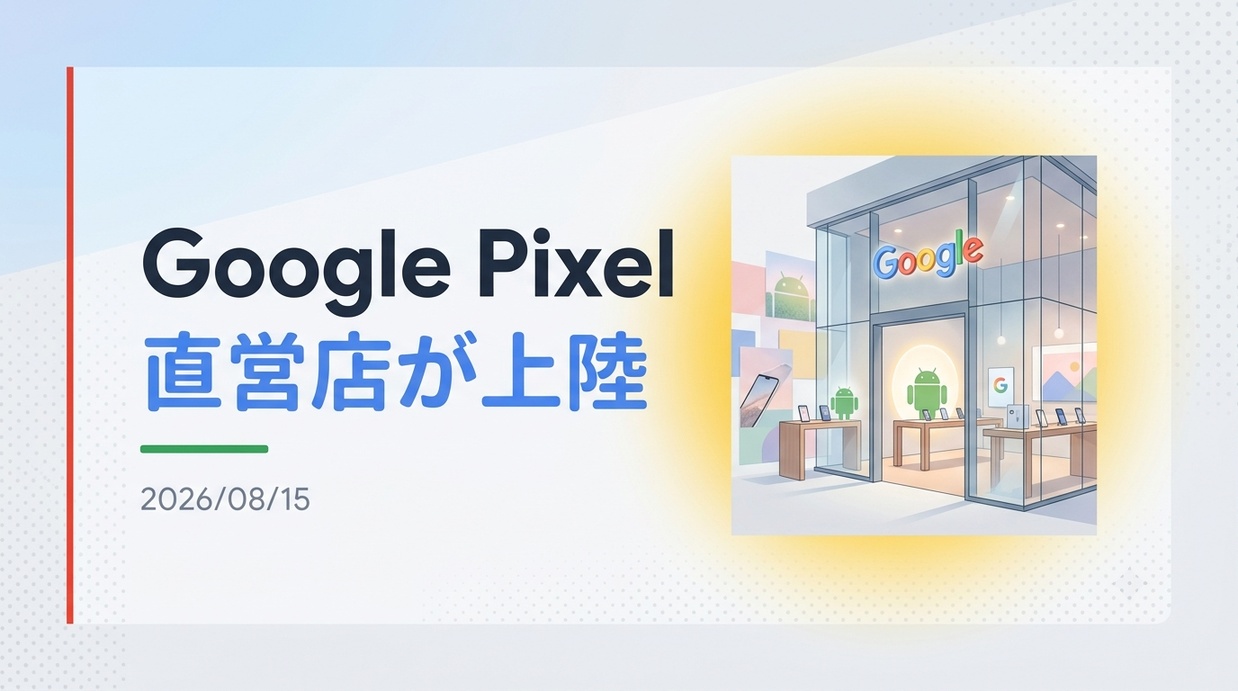
On August 13, 2026, Google opened “Google Store Omotesando” in Tokyo, its first direct retail location outside the United States and currently the largest Google flagship store in the world. This strategic expansion comes at a historic turning point in the Japanese smartphone market, where Apple’s iPhone share has fallen below 50% for the first time in years, allowing Google to surge into the number two market position in Japan.
- A Landmark Opening in Tokyo’s Omotesando District
- Integrating Experiences and Sustainability within the Japanese Retail Space
- A Design Philosophy Tailored to Japanese Sensibilities
- Shifting Market Dynamics: iPhone’s Share Drop and Google’s Climb
- Navigating Local Regulations: Pricing Strategies for the Japanese Market
- Experiencing the Next Frontier of AI at “Pixel Studio”
- Strengthening Community Engagement and Local Support Systems
A Landmark Opening in Tokyo’s Omotesando District
At 2:00 PM on August 13, 2026, Google Store Omotesando officially opened its doors in the heart of Tokyo’s trendsetting Omotesando-Harajuku area. Located within the “Omokado” (Tokyu Plaza Omotesando Harajuku) building, this site marks Google’s 11th direct retail store globally and its very first outside of the United States. The choice of Japan for this international debut is highly symbolic, as the country was the site of Google’s first overseas office in 2001.
-
Store Name: Google Store Omotesando
-
Location: Omokado, Jingumae Intersection area, Shibuya, Tokyo
-
Total Area: 1,158 square meters (making it the world’s largest Google Store)
-
Floor Configuration: Two floors above ground and one basement floor
For Google, this massive flagship store represents a significant shift in its retail strategy in Japan. Previously, the company relied primarily on “shop-in-shop” formats within major Japanese electronics retailers like Yodobashi Camera. By establishing a direct, large-scale physical presence in one of Tokyo’s primary cultural hubs, Google aims to move beyond mere sales and provide a dedicated space where Japanese consumers can engage with the brand’s identity and technological ecosystem.
Integrating Experiences and Sustainability within the Japanese Retail Space
Google Store Omotesando is designed as more than a sales floor; it is a “product” that integrates hardware, software, and AI into a single experience. The first floor serves as the main display area for the latest hardware, featuring the full lineup of Google Pixel smartphones, Pixel Watch, Nest smart home products, and Pixel Buds. A central attraction is the “California Dreaming—Landscape of Colors” art installation, which uses color palettes from the latest 2026 hardware models to evoke natural Californian landscapes like dunes and minerals, connecting Google’s design roots with its physical products.
Sustainability, a growing concern among Japanese consumers, is also a core theme of the store. The Omotesando location exclusively offers the “Recrafted by Google Pixel” accessory line, which consists of six unique items created by recycling fiber and fragments from Pixel Watch and Fitbit bands. These limited-edition products exemplify Google’s commitment to a circular economy while providing Japanese customers with locally unique merchandise. The following diagram illustrates the store’s layout and these initiatives.
A Design Philosophy Tailored to Japanese Sensibilities
The store’s design was managed by the same Hardware Design Studio responsible for Google’s physical products, ensuring a consistent aesthetic based on three core pillars: “Human,” “Optimistic,” and “Bold”. These concepts were carefully adapted to resonate with Japanese culture and local environmental conditions. For example, the exterior incorporates wood to blend with the Omotesando streetscape, but it features an intricate lighting system between the wooden slats that mimics the warm glow of traditional Japanese lattices (koshi) or paper lanterns (chochin) at night.
Recognizing that Japanese consumers highly value privacy and detailed technical guidance, the basement floor—named “Here to Help”—includes semi-private consultation booths. Here, staff provide one-on-one support for initial setup, data migration, and technical troubleshooting in a comfortable environment designed to reduce the anxiety of handling complex devices. This focus on a “Human” and personalized service model distinguishes the direct store from typical high-volume electronics retailers in Japan, fostering a sense of long-term reliability and brand loyalty among Japanese users.
Market Disruption and Google’s Strategic Growth in Japan
Shifting Market Dynamics: iPhone’s Share Drop and Google’s Climb
The Japanese smartphone market is currently undergoing a dramatic realignment. According to data from February 2026, Google officially surpassed Samsung to become the second-largest smartphone brand in Japan. This rise is particularly notable because it coincides with a decline in Apple’s dominance; for the first time in recent history, the iPhone’s market share in Japan has dipped below the 50% threshold.
-
iPhone: Market share in Japan dropped below 50%, a historic shift in a previously Apple-dominant market.
-
Google: Reached a 12.4% shipment share in Japan, ranking first among Android brands and second overall.
-
Key Driver: The massive success of the mid-range Pixel A-series (such as the Pixel 9a and 10a).
For Google, Japan has become a “vanguard” market where user growth is described as both rapid and enthusiastic. The sales ratio of the Pixel A-series in Japan is significantly higher than the global average, making the Japanese market a primary engine for the brand’s global hardware growth. The Omotesando store serves as a physical manifestation of this momentum, aimed at further eroding Apple’s “fortress” by offering a compelling alternative in a high-traffic urban center.
Navigating Local Regulations: Pricing Strategies for the Japanese Market
Google’s rapid ascent in Japan is partly due to its expert navigation of local telecommunications regulations and carrier sales practices. Under current Japanese guidelines, discounts on devices priced above 80,000 yen (tax excluded) are strictly capped, which affects how mobile carriers can market high-end phones. Google strategically priced its Pixel A-series around this 80,000-yen mark (for instance, the Pixel 10a was launched at 79,900 yen), allowing Japanese carriers like SoftBank and KDDI to maximize legal discounts.
Furthermore, Google has utilized aggressive promotional tactics tailored to the Japanese market, such as offering substantial “Store Credits” and high-value trade-in campaigns that often exceed the actual used-market value of older devices. These incentives, combined with Japanese carrier programs that allow users to return a device after two years to waive remaining payments, have enabled some consumers to obtain a new Pixel for an effective cost as low as 1 yen per month. This “best balance” of performance and cost-effectiveness has resonated deeply with cost-conscious Japanese consumers, particularly after recent legal changes made traditional high-end smartphone discounts more difficult to obtain in Japan.
AI Innovation and the Future of the Google Brand in Japan
Experiencing the Next Frontier of AI at “Pixel Studio”
The second floor of the store, branded as “Pixel Studio,” is a dedicated space for experiencing Google’s latest AI innovations. Rather than focusing on simple product specifications, this floor encourages visitors to play with AI as a form of entertainment. Several booths utilize Google’s “Gemini” AI models to demonstrate how technology can be integrated into daily life and creative expression.
One popular feature is the “Avatar Station,” where Gemini analyzes a visitor’s photo to generate a personalized 3D avatar, which can then be printed onto a physical card to take home. Other demonstrations include “Genie 3,” a world-building model that can generate and let users explore a virtual 3D world based on simple text prompts, and “Nano Banana,” an AI model for advanced image and video generation. By transforming complex technology into “moments of excitement,” Google aims to broaden its brand appeal to families and younger demographics in Japan who may not be traditional tech enthusiasts. The following diagram summarizes these experiences.
Strengthening Community Engagement and Local Support Systems
Looking forward, Google Store Omotesando is intended to function as more than a retail outlet; it aims to become a community hub for the Omotesando and Harajuku districts. Google plans to host various workshops and events, ranging from basic tutorials on using Pixel devices to collaborative projects with local creative communities. By evolving from a place of consumption to a place of community, Google hopes to deepen the emotional connection Japanese users have with the brand.
Simultaneously, the “Here to Help” support floor is crucial for long-term user retention in Japan. By performing repairs on-site, the store can offer same-day service for certain issues—a significant advantage over the multi-day turnaround often required when going through a mobile carrier. The store also offers free, face-to-face support for migrating data from an iPhone to a Pixel, directly addressing one of the biggest hurdles for Japanese users considering a switch. This combination of cutting-edge AI experiences and a high-reliability “trust hub” for hardware support is set to be the cornerstone of Google’s long-term strategy to expand its brand value across Japan.
Reference Pages
-
【Google Store Omotesando】https://store.google.com/jp/magazine/google_store_omotesando?hl=ja
-
【Google Japan Blog】https://blog.google/intl/ja-jp/products/devices-services/google-store-tokyo/
【#Google #Pixel #AI #Gemini #Omotesando #Smartphone #Technology #Japan】


コメント