US-based Anthropic has officially released the cloud execution feature (cloud sessions) for its AI coding assistance tool, “Claude Code,” and started distributing up to $250 in trial credits to existing paid users. The background behind this move is the aim to provide a device-independent, long-running autonomous development environment and accelerate the adoption of AI agents in the enterprise sector.
- Background on the End of the Research Preview and the Start of General Availability
- Conditions for obtaining up to 0 in credits and application procedure
- Detailed Mechanism of the Scope of Application and Pricing System
- Four Startup Methods and Parallel Processing via Independent Virtual Machines
- OS-level sandboxing and security controls
- Advancements in Autonomous AI Coding and Key Points to Watch
Background on the End of the Research Preview and the Start of General Availability
On September 23, 2026, US-based Anthropic announced the general availability of “Cloud Sessions,” a new feature that completes development work for its AI coding assistance tool, “Claude Code,” entirely in the cloud. Originally released as a research preview in October 2025 under the name “Claude Code on the web,” the feature has now graduated to a generally available (GA) version after approximately 11 months of testing.
While traditional Claude Code primarily relied on running commands and code via a terminal in the developer’s local PC environment, processing power, battery consumption, and local environment constraints presented ongoing challenges. With the introduction of Cloud Sessions, all heavy computational processing and code modification tasks are now executed on virtual machines managed by Anthropic.
As a result, even if developers close their laptops or turn off their power, AI agents can now autonomously continue coding and debugging tasks in the background. This is expected to significantly lower the barriers to entry for agentic workflows that require high computational resources—such as long-term build processes and refactoring spanning multiple files—and dramatically boost development productivity in the enterprise sector.
Conditions for obtaining up to 0 in credits and application procedure
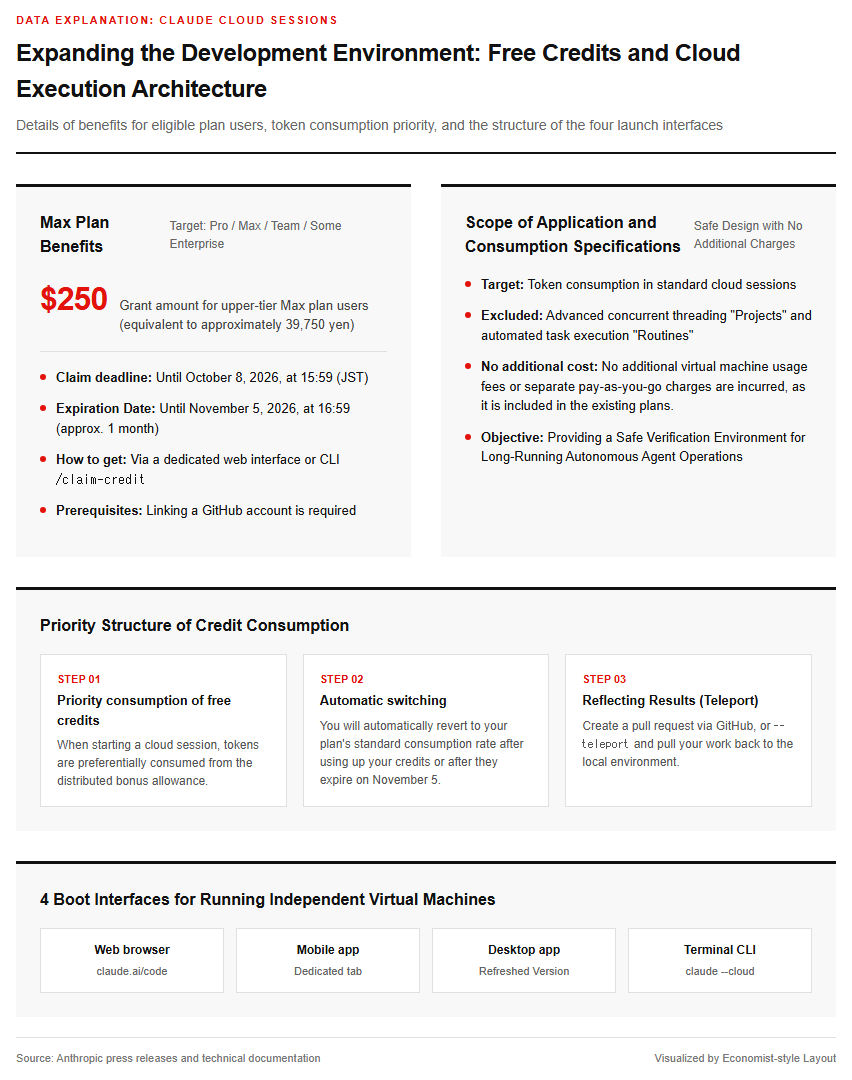
Along with this official release, Anthropic has launched a promotion distributing one-time free credits dedicated to cloud sessions for existing users subscribed to paid plans. The granted amounts are $100 (equivalent to approximately 15,900 Japanese yen) for Pro plan users, and $250 (equivalent to approximately 39,750 Japanese yen) for users of the top-tier Max plan. Eligible individuals are current users of the Pro, Max, and Team plans who already have paid subscriptions, as well as Enterprise users who meet specific conditions. The procedure to obtain the credits is extremely simple, and they can be claimed by applying through a dedicated web interface or by typing and executing /claim-credit in the Claude Code command-line interface (CLI). The deadline to claim the credits is set for October 7, 2026, Pacific Time (October 8 at 15:59 Japan Time), and users should note that the right will expire if this deadline is missed. In addition, the expiration date for the acquired credits is set for November 5, 2026 (November 5 at 16:59 Japan Time), designed to be used up for trying out cloud sessions within a period of about one month. Note that linking a GitHub account is required to start a session.
Detailed Mechanism of the Scope of Application and Pricing System
There are important specifications regarding the applicability and billing consumption structure of the distributed credits that users should be aware of before getting started. These free credits apply exclusively to token consumption in regular cloud sessions, and do not apply to “Projects,” which perform advanced parallel thread processing, or “Routines,” the automated task execution feature. The credits are managed as a bonus separate from the user’s regular subscribed plan usage quota (usage limit). When a cloud session is initiated, the distributed credits are consumed with priority, and once the credits are exhausted or after they expire on November 5, the system automatically reverts to consumption based on the original plan regulations. Anthropic has explained that this trial allocation does not incur any additional usage fees for the virtual machines themselves or separate pay-as-you-go charges. In other words, the costs required to run cloud sessions are included within the scope of existing Pro or Max plans, designed so that users can try them out without worrying about extra charges. Given that high consumption caused by the automatic looping of certain features became a subject of discussion in the past, the company has adopted an additive reserve quota format this time, creating an environment where users can securely verify long-running autonomous agent operations with peace of mind.
Technical Architecture and Its Impact on Future Development Environments
Four Startup Methods and Parallel Processing via Independent Virtual Machines
To support diverse development styles, Cloud Sessions provide four distinct startup interfaces: “claude.ai/code” operated via a browser, a dedicated tab within the Claude mobile app, the refreshed desktop app, and running the claude --cloud command in the terminal. Each session runs on an independent virtual machine in the cloud, allowing developers to execute multiple tasks spanning different repositories in parallel from a single management console. An important note regarding the execution procedure is that the virtual machine clones the current branch of the GitHub repository rather than local uncommitted work. Therefore, you must push your changes to the remote repository before submitting tasks to the cloud. Once work is complete, you can either create a pull request directly from the screen or use the claude --teleport command to pull your work back to your local terminal. Please refer to the figure below.
. Even if you close the PC screen, the AI proceeds with implementation, and since you can correct and track progress in real-time, it is a groundbreaking feature that significantly transforms the conventional approach to local development environments.
OS-level sandboxing and security controls
Even in terms of security, which is of the utmost importance for enterprise use, cloud sessions feature a robust multi-layered defense architecture. Each virtual machine serving as the execution environment operates inside a strictly isolated sandbox with separated network and file systems. The file writing area is restricted to beneath the target working directory, a design that prevents unnecessary external access and unauthorized command execution. Git operations are performed via a proxy service that keeps authentication credentials outside the sandbox, and communication with anything other than authorized repositories is blocked. In addition, for necessary external connections such as fetching npm packages or PyPI libraries, administrators can individually configure allowed communication domains. By applying Managed Settings, an enterprise-oriented configuration, it is possible to prohibit individual developers from bypassing permissions (bypassPermissions) and uniformly enforce security policies. Furthermore, by combining this with a Zero Data Retention (ZDR) agreement that does not retain transmitted data or use it for training, secure internal operations that mitigate information leakage and supply chain risks are achieved.
Advancements in Autonomous AI Coding and Key Points to Watch
The newly announced transition of cloud execution to general availability and the credit distribution symbolize AI’s evolution from a simple code completion tool into an “autonomous task-executing agent.” Entering 2026, alongside improving the performance of the models themselves, Anthropic has rapidly strengthened the securing of computational resources and self-running capabilities for long-duration tasks. By integrating cloud sessions with top-tier models like the existing Claude Fable 5.1 and Opus 5, hours-long analyses of entire codebases and large-scale test fixes are becoming executable in unmanned environments. Key points to watch moving forward include the balance between the usage costs of autonomous agents running in the cloud and actual token consumption efficiency, as well as the establishment of management guidelines within enterprises. In particular, guardrail designs such as the placement of human-in-the-loop checkpoints and daily API usage limits will be key factors that determine the success of AI adoption. While leveraging the free credits available until November 5, organizations are required to advance optimal operational design and governance structures tailored to their own development workflows.
Reference page
- [ClaudeDevs Official Announcement (X)] https://x.com/ClaudeDevs/status/2102871550974427462
- [Claude Code Official Documentation] https://code.claude.com/docs/en/changelog
【#ClaudeCode #Anthropic #AICoding #CloudSession #GenerativeAI #DevelopmentEfficiency】

コメント