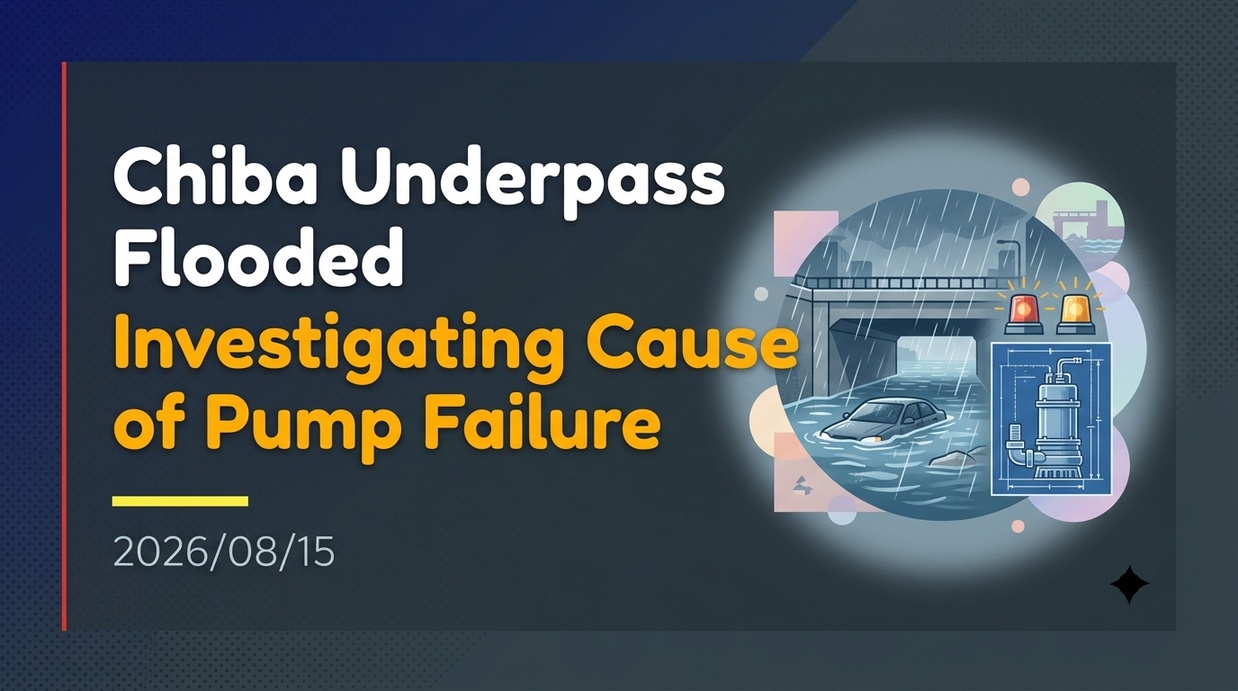
In August 2026, a fatal accident occurred in an underpass in Chiba City, Japan, when drainage pumps failed to operate during record-breaking rainfall. The incident was caused by a backup generator malfunction during a power outage, highlighting an urgent need for a nationwide review of Japanese infrastructure maintenance protocols.
- Fatal Underpass Flooding in Chiba: Record Rainfall and Equipment Failure
- Root Causes of the Failure: Power Outages and Backup Generator Malfunction
- Maintenance Gaps and Blind Spots in Japanese Infrastructure Management
- Legal Liability and Judicial Precedents under the State Redress Act
- Nationwide Emergency Measures by the Japanese Government
- Future Outlook: Transitioning to Smart Infrastructure Maintenance
Fatal Underpass Flooding in Chiba: Record Rainfall and Equipment Failure
Between August 13 and 14, 2026, a severe weather event officially named the “Reiwa 8 August Chiba Torrential Rain” struck Chiba Prefecture, Japan. Triggered by three successive occurrences of linear rainbands, the storm resulted in eight deaths across the prefecture. A particularly tragic incident occurred at the National Route 16 underpass in Murata-cho, Chuo-ku, Chiba City. A man in his 40s became trapped in his passenger car as the underpass flooded; he was later confirmed dead at a hospital. Although the facility was equipped with drainage pumps designed to activate automatically as water levels rose, they failed to function during the peak of the storm. An alarm indicating a pump abnormality sounded at approximately 8:30 PM on August 13, but by the time a contracted maintenance crew arrived, the pumps were already stationary and the underpass was heavily submerged. It was not until after midnight on August 14—nearly four hours later—that Chiba National Highway Office staff manually started the emergency generator to begin drainage. During this period, Chiba City recorded 367.0 mm of rain in 24 hours, the highest since records began and roughly three times the average total for the entire month of August in Japan. The following chart illustrates the scale of this rainfall.
Root Causes of the Failure: Power Outages and Backup Generator Malfunction
The direct cause of the drainage failure was a local power outage combined with the failure of the emergency generator, which was supposed to provide backup power automatically. Underpasses in Japan are typically constructed at depths significantly lower than the surrounding ground level—approximately 3 meters in the case of the Murata-cho site—making them highly susceptible to rapid flooding from rain and groundwater if mechanical pumps stop. In this accident, the power failure not only disabled the main pumps but also caused the electric warning signs, which should have displayed “Road Closed,” to remain dark, allowing vehicles to enter the danger zone unknowingly. Although the Japanese Ministry of Land, Infrastructure, Transport and Tourism (MLIT) reported that the generator had passed a regular inspection in June or July of 2026, it failed to trigger during the actual emergency. The Chiba National Highway Office is currently conducting a detailed investigation into the control panels and battery systems to determine why the automated backup system failed despite recent positive inspection results.
Maintenance Gaps and Blind Spots in Japanese Infrastructure Management
While Japanese drainage facilities undergo periodic inspections, this incident follows a pattern where equipment fails during a disaster despite having “no abnormalities” in previous checks. A recent survey of 27 underpasses in Aichi Prefecture, Japan, following a similar flooding event, revealed that four sites had significant malfunctions. Specifically, one site had a depleted battery that prevented the emergency generator from starting—a defect only discovered during an emergency inspection after a power outage incident. Most local governments in Japan conduct inspections before the “Tsuyu” (rainy season) and typhoon season, but the rigor and frequency of these checks often vary by the managing authority. Many of Japan’s river management and drainage facilities were constructed during the high-growth period of the 1960s and 70s and are now reaching the end of their design life. Chiba Prefecture has implemented a “Longevity Plan” to systematically replace aging parts and reduce failure risks through lifecycle cost management, but the rapid increase in “guerrilla rainstorms” (sudden localized heavy rain) is outpacing these traditional maintenance schedules.
Legal Liability and Judicial Precedents under the State Redress Act
When fatal underpass flooding occurs in Japan, the legal responsibility of road managers is often scrutinized under the State Redress Act (National Redress Law). Article 2, Paragraph 1 of this act holds the state or local public entity liable for damages if there is a “defect in the installation or management” of a public structure. A landmark ruling by the Wakayama District Court in July 2021 provides a relevant precedent. In that case, a vehicle was submerged after a drainage pump failed during a typhoon-induced power outage. The court found the road manager liable because they had ignored warnings from a maintenance contractor for three years regarding a faulty battery and charging circuit in the emergency generator. The court ruled that the road lacked the safety it “ordinarily should possess”. In the Wakayama case, the driver’s damages were reduced by 40% due to comparative negligence, as the court decided the driver should have recognized the danger of entering the flooded area. For the Chiba incident, the adequacy of inspections, the delay in manual intervention, and the failure of warning signs will be key factors in determining whether the Japanese government bears similar legal liability. Refer to the figure below for a summary of this legal framework.
Nationwide Emergency Measures by the Japanese Government
Following the Chiba accident, the Japanese Ministry of Land, Infrastructure, Transport and Tourism (MLIT) issued an urgent notice on August 14, 2026, to all regional development bureaus to conduct emergency inspections of underpass drainage and emergency power systems. The directive prioritizes verifying whether emergency generators activate automatically during power outages and mandates immediate repairs for any discovered defects. MLIT also requested that information be shared with prefectural and municipal governments across Japan to raise awareness for facilities not directly managed by the national government. Because water levels can rise faster than staff can arrive to physically close a road, Japanese authorities are increasingly exploring hard-stop solutions. These include the installation of physical gates or “balloon-type temporary blockade devices” that inflate automatically when triggered by water level sensors, providing a mechanical barrier even before human personnel reach the site.
Future Outlook: Transitioning to Smart Infrastructure Maintenance
A major shift toward “preventive maintenance” using IoT (Internet of Things) and AI (Artificial Intelligence) is now being promoted as a long-term solution in Japan. The National Institute for Land and Infrastructure Management (NILIM) recently established guidelines for smart maintenance technologies that use AI to detect abnormal operation patterns in pumps. By analyzing vibration and electricity usage data in real-time, these systems can predict potential failures before they occur during a storm. Additionally, many Japanese municipalities are implementing systems where water level sensors and camera feeds are managed via a cloud-based platform, allowing for immediate information sharing between police, fire departments, and road managers. Moving from traditional time-based inspections to 24-hour real-time health monitoring of infrastructure—a concept known as “Smart Infrastructure”—is seen as essential to mitigate the rising risks of extreme weather events in Japan. Ensuring the resilience of these hidden “underground guardians” is now a top priority for protecting lives in an era of climate change.
References
-
【Response Status for Torrential Rain on Aug 13, Reiwa 8 – MLIT Kanto Regional Development Bureau】https://www.ktr.mlit.go.jp/saigai/kyoku_dis00001046.html
-
【Results of Emergency Inspections for Underpass Management Systems – Aichi Prefecture】https://www.pref.aichi.jp/soshiki/douroiji/20161018under-tenken.html
-
【Longevity Plan for River Management Facilities – Chiba Prefecture】https://www.pref.chiba.lg.jp/kakan/choujumyouka.html
-
【Report on Accident Prevention Measures for Road Flooding – Ministry of Internal Affairs and Communications】https://www.soumu.go.jp/main_content/000548174.pdf
-
【Guidelines for Efficient Preventive Maintenance Using IoT and AI – NILIM】https://www.nilim.go.jp/lab/bcg/kisya/journal/kisya20250306.pdf
-
【Court Precedent on Damage Claims under State Redress Act (Wakayama District Court) – MLIT】https://www.mlit.go.jp/road/manage/suit/case_wakayama.pdf
【#ChibaTorrentialRain #UnderpassSafety #JapanInfrastructure #DisasterPrevention #DrainagePumps #StateRedressAct #EmergencyInspections #RoadSafety】

コメント