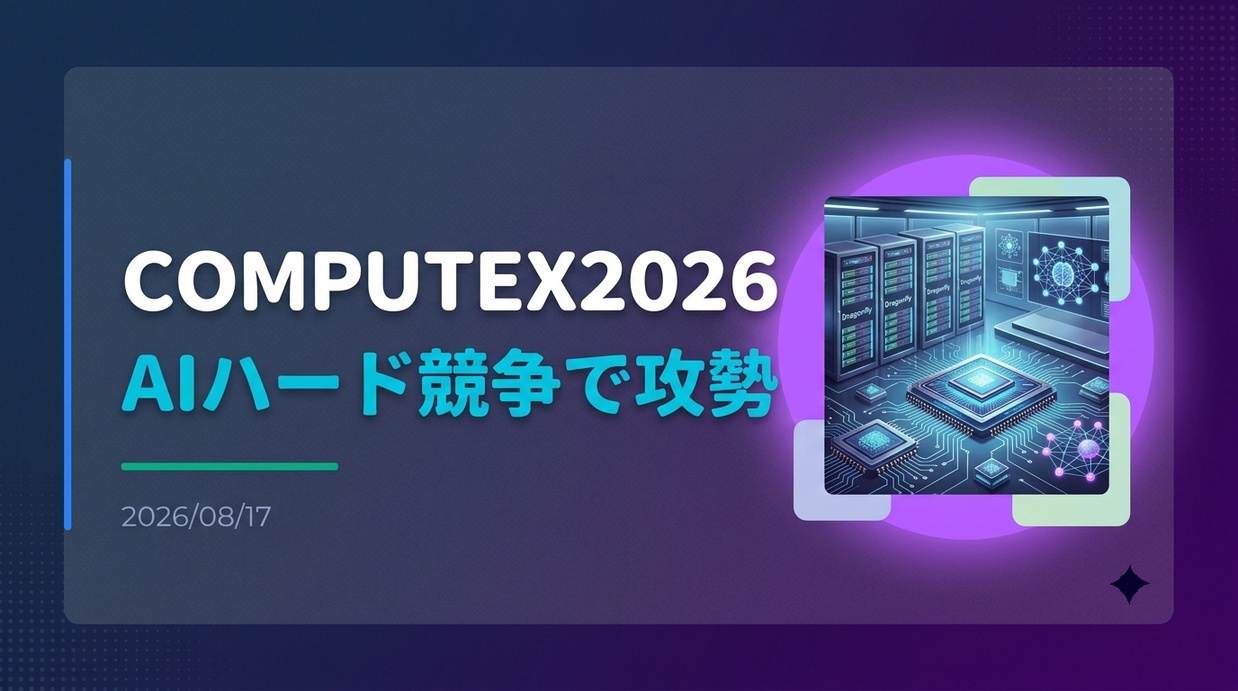
At the COMPUTEX 2026 trade show held in June 2026, Qualcomm unveiled a new hardware strategy centered on “Agentic AI”. As artificial intelligence evolves from simple tools into autonomous actors, a fundamental shift is occurring in both device design and data center infrastructure.
2026: The Year of the AI Agent
During the COMPUTEX 2026 event held in Taipei, Taiwan, from June 2 to 5, 2026, Qualcomm CEO Cristiano Amon declared that “2026 is the year of agents”. He explained that AI is moving beyond simply responding to human prompts to a phase called “Agentic AI,” where it understands user intent and executes tasks autonomously. This paradigm shift means the center of the digital experience will move away from the smartphone itself toward personal AI agents, while devices like phones and PCs will serve merely as “endpoints” to access these agents. At the exhibition, Qualcomm demonstrated how these agents could fundamentally transform human workflows, assisting with everything from office productivity to grocery shopping and exercise. Amon also expressed gratitude to the Taiwanese ecosystem, particularly the manufacturing giant TSMC, noting that such technological evolution depends on strong industry partnerships. The following diagram illustrates the transformation of workflows through Agentic AI.
Dragonfly: A New Brand for the Data Center
At the event, Qualcomm officially unveiled “Dragonfly,” a new product brand specifically designed for AI data centers. This move signals Qualcomm’s aggressive entry into the rapidly growing AI server market, leveraging its long-standing expertise in edge devices. Amon emphasized the importance of “Distributed AI,” where chips are placed both in edge terminals like smartphones and in the cloud to blur the boundaries caused by communication latency and optimize processing. The company has already begun collaborating with major cloud service providers, known as hyperscalers, and displayed Dragonfly-branded server racks at the venue. According to the company’s financial report for the third quarter of fiscal year 2026, Qualcomm recorded revenue of \$9.9 billion (approximately 1.6 trillion Japanese yen), with growth accelerating in its non-handset businesses. The company aims to increase total revenue from non-handset sectors to \$40 billion by fiscal year 2029, with the Dragonfly brand serving as a cornerstone of this strategy.
Technical Background and the Shift in Design Philosophy
Distributed Computing to Support Autonomous AI
As Agentic AI becomes widespread, computational demand is expected to reach unprecedented scales. CEO Cristiano Amon noted that autonomous Level 3 AI agents, which execute multi-step tasks, consume over 1 million tokens per task. By 2030, global token demand is projected to reach a staggering 4.01 quadrillion. To meet this demand, a “Distributed AI” approach that splits processing between the cloud and local devices is essential. For example, by distributing tasks for coding or website creation, token consumption can be reduced by approximately 30%, lowering costs to one-fourth of cloud-only alternatives. In the field of robotics, Amon explained the need for a “three-tier hierarchical computing system” to handle instantaneous execution, grounding (ensuring accurate outputs), and high-level reasoning. Qualcomm is supporting the development of humanoids and multi-legged robots by providing edge AI platforms capable of high-level sensor integration and centralized processing.
Pursuing Extreme Power Efficiency for Constant Operation
For AI agents to remain “always-on” and continuously perceive their surroundings, device architecture must be fundamentally reimagined. Amon challenged the industry by asking how a device can survive a full day if an agent is operating autonomously, given that even human-driven usage already drains batteries quickly. This requirement makes extreme power efficiency the most critical factor in hardware design. Achieving this requires the integration of powerful CPUs to automate tasks and high-density Neural Processing Units (NPUs) to execute AI models locally. Qualcomm’s latest “Snapdragon X2 Elite” and the “Snapdragon C” platform—the latter targeting entry-level laptops starting at \$300—are utilizing this efficiency as a competitive weapon. Furthermore, local AI inference is becoming a standard requirement due to privacy concerns, as users increasingly demand high-level processing without sending their data to cloud servers.
Competitive Environment and Future Outlook
The Intensifying Hardware Power Map
At COMPUTEX 2026, Qualcomm was not alone in its offensive; major semiconductor manufacturers like NVIDIA, Intel, and AMD also presented their roadmaps for the fall season. NVIDIA introduced its first “Superchip” for Windows PCs, the “RTX Spark,” positioning it as a direct competitor to Apple Silicon in the premium laptop segment. Intel targeted the handheld gaming market, which has been dominated by AMD since 2022, by launching the “Arc G3 Extreme,” a chip manufactured using Intel’s advanced “18A” process node. As AI performance becomes the primary differentiator for hardware, Qualcomm’s strategy involves the Snapdragon C platform to bring AI capabilities to a broader audience at a \$300 price point. Additionally, Qualcomm’s legal victory in its lawsuit against the British chip designer Arm has secured the company’s freedom to develop its own custom “Oryon” CPU cores, providing a significant tailwind for its future development.
6G Communication and the Semiconductor Supercycle
A key area of future focus is the fusion of AI with “6G,” the next-generation wireless standard. Amon defined 6G as “the first wireless generation designed for the AI era,” stating that its greatest impact will be “sensing” rather than just connectivity. Hundreds of millions of wireless connections will function like radar to perceive the physical world, creating massive, city-level “digital twins” that provide essential real-time context for Agentic AI. More broadly, the semiconductor industry is entering what experts call a “supercycle,” driven by persistent infrastructure demand for generative AI. The global semiconductor market is expected to reach approximately \$975 billion (roughly 146 trillion Japanese yen) in 2026 and could hit \$2 trillion annually by 2030. Amidst this explosion in demand, industry watchers are closely monitoring how Qualcomm’s strategy of integrating the edge and cloud will position the company in the new computing economy. Japanese companies are also benefiting from this boom; for instance, Advantest, a leading Japanese semiconductor testing equipment manufacturer, reported a 110.8% increase in quarterly operating profit due to high demand for AI chip testing.
Reference Page
- 【Networking-Aware Energy Efficiency in Agentic AI Inference: A Survey】https://arxiv.org/abs/2603.xxxxx (Publication date: March 2026)
【#Semiconductors #AIAgents #Qualcomm #COMPUTEX2026 #DigitalTwin #6G #Technology】

コメント