At the Apsara Conference 2026, Alibaba Group announced the start of pre-training for its next-generation frontier AI model, “Qwen4,” with undisclosed specifications. Behind this is a strategy to secure global AI supremacy amidst U.S. semiconductor export controls through the ultra-massive scaling of models and autonomous self-improvement technology.
- Key Event: Pre-training of Qwen4 initiated with undisclosed specifications
- Scaling Roadmap Targeting 5 to 10 Trillion Parameters
- Fully Automated Learning in 33 Cycles and Chip Design Automation Track Record
- Vertical integration through proprietary semiconductor “GenMu V900” and 20GW power infrastructure
- Cost Supremacy and Ecosystem Expansion Against the US Closed Camp
- Future Outlook and Key Focus: Multimodal Evolution and Practical Application in 2027
Key Event: Pre-training of Qwen4 initiated with undisclosed specifications
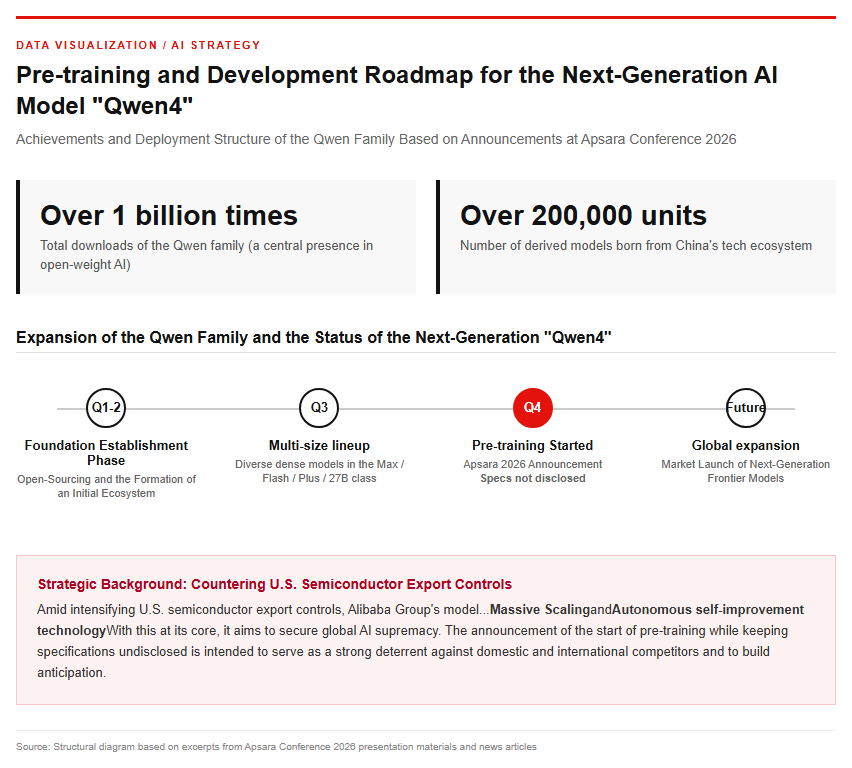
At the annual conference “Apsara Conference 2026” held on September 22, 2026, Alibaba Group officially announced that its next-generation foundational model, “Qwen4” (Tongyi Qianwen 4), is currently in the pre-training stage. In this announcement, no specific specifications such as the release date, detailed parameter count, or the application of an open-source license were disclosed at all, revealing that development is progressing while remaining unreleased.
Traditionally, the Qwen family has been deployed in a variety of dense model sizes, such as Max, Flash, Plus, and the 27B class. A similar family structure is expected to be carried over to the Qwen4 series. Within China’s technology ecosystem, the Qwen series has amassed over 1 billion cumulative downloads and spawned more than 200,000 derivative models, establishing itself as a central pillar of open-weight AI. The announcement of the commencement of pre-training without disclosing its specifications serves as a strong demonstration of technological leadership to competing US and Chinese AI firms, while simultaneously acting as a catalyst for globally heightening expectations for what the next-generation frontier model will achieve. The following diagram illustrates the evolutionary process of the Qwen family.
Scaling Roadmap Targeting 5 to 10 Trillion Parameters
Alibaba announced the start of training for Qwen 4, while simultaneously presenting a long-term technology roadmap for the subsequent next-generation models, “Qwen 4.5” and “Qwen 5.” This roadmap explicitly sets a goal of scaling future models to reach a size of 5 to 10 trillion parameters (5-10 Trillion Parameters).
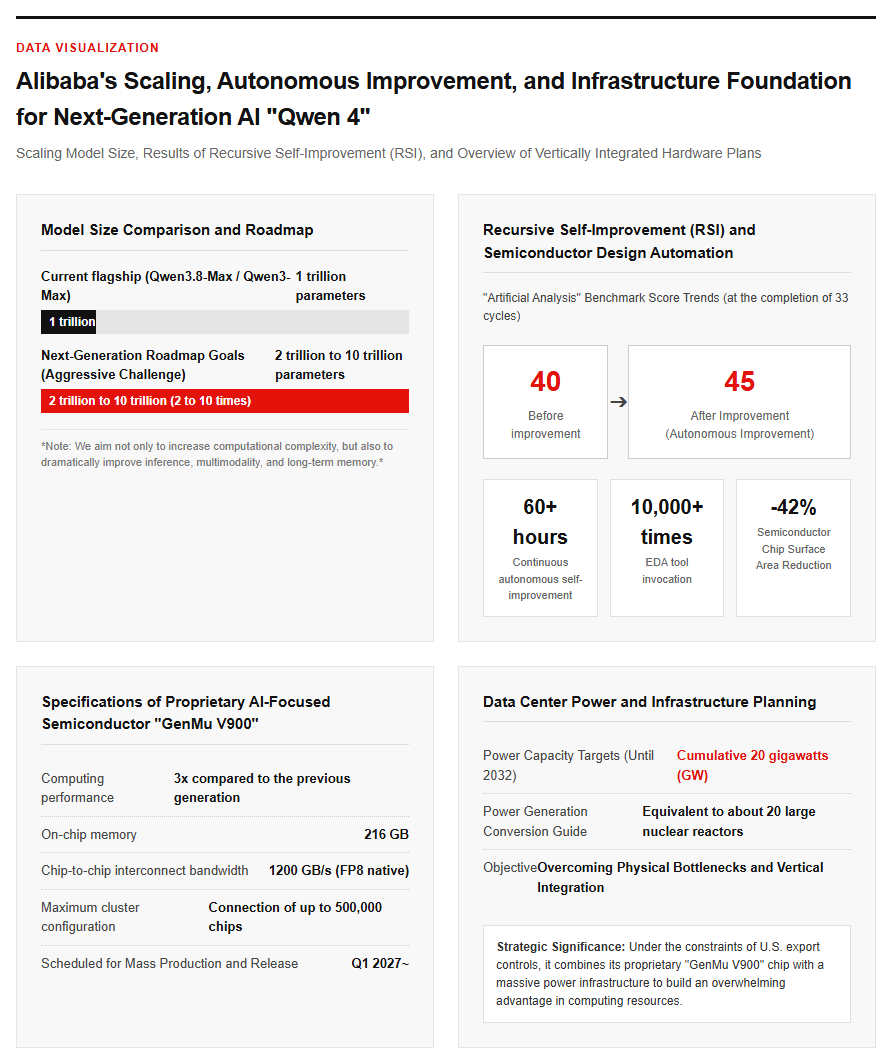
The scaling up of model size goes beyond merely increasing the amount of computation, bringing about dramatic improvements in complex reasoning capabilities, multimodal understanding, and long-term memory processing. Compared to the currently deployed flagship models “Qwen3.8-Max” and “Qwen3-Max,” which are in the 1-trillion-parameter class, the scale targeted by the next-generation roadmap is an extremely aggressive challenge equivalent to a 2x to 10x increase.
To support this scaling strategy, the company continues to invest in large-scale pre-training computational resources while striving to improve the efficiency of its model architecture. Amid growing concerns over the quantitative limits of pre-training data (the “data wall”), the company is establishing a system to efficiently complete the training of ultra-large-scale models by leveraging recursive self-improvement techniques and synthetic data generation, as described below.
Technological Breakthroughs Brought by Recursive Self-Improvement and Autonomous AI
Fully Automated Learning in 33 Cycles and Chip Design Automation Track Record
As technical evidence supporting the development of Qwen4, Alibaba has disclosed the results of Recursive Self-Improvement (RSI) achieved with its current flagship model, “Qwen3.8-Max”. Qwen3.8-Max executed 33 iterative cycles over the course of more than a month in a completely autonomous environment covering the entire process, from pipeline design and data verification to experiment execution and error diagnosis. Through this automated learning loop, it successfully and autonomously raised its score on the third-party evaluation benchmark “Artificial Analysis” from 40 to 45.
Furthermore, in a semiconductor design experiment conducted as a verification of advanced autonomous engineering, the following extremely symbolic results have been reported.
- Execution of continuous autonomous self-improvement for over 60 hours
- Completion of Over 10,000 Autonomous Tool Calls to EDA (Electronic Design Automation) Tools
- Succeeded in reducing the surface area of a semiconductor chip by 42% without sacrificing any performance
This achievement, in which AI optimizes its own code and hardware configuration without human intervention, confirms that AI development itself has entered a new phase of autonomy and acceleration.
Vertical integration through proprietary semiconductor “GenMu V900” and 20GW power infrastructure
To support the continuous training and inference operations of ultra-large-scale AI models, Alibaba is strongly driving vertical integration at the hardware and infrastructure layers. Amid restrictions on acquiring cutting-edge NVIDIA chips due to US semiconductor export controls against China, the company has announced its proprietary AI-dedicated semiconductor, the “GenMu V900.”
The main specifications and computing infrastructure plans for the GenMu V900 chip are as follows.
- Equipped with 3x the computational performance of the previous generation and 216GB of on-chip memory
- 1200GB/s of high-speed inter-chip interconnect bandwidth and native support for the FP8 data format
- Enables the construction of ultra-large-scale computing clusters linking up to 500,000 chips
- Scheduled to begin mass production and deploy to its own data centers starting in the first quarter of 2027
- An expansion target to secure a cumulative 20 gigawatts (GW) of data center power capacity by 2032
A power capacity of 20 GW is equivalent to the power output of about 20 large-scale nuclear reactors, and through securing power—widely considered a physical bottleneck—and consolidating proprietary chips, they aim to solidify their superiority in computational resources. An overview of the infrastructure and semiconductor configuration is shown in the figure below.
The Horizon of the Open-Weight Strategy in the US-China AI Hegemony Struggle
Cost Supremacy and Ecosystem Expansion Against the US Closed Camp
Currently, global AI development is solidifying into a two-tiered structure: the U.S.’s “closed, highest-performance, vertically integrated” approach and China’s “open-weight, cost-efficient, sovereignty-focused” approach. While OpenAI, Anthropic, and Google seek to monopolize the market in the high-price range centered around closed APIs, Alibaba is deploying an ecosystem strategy to become the “Android of the AI world” by widely releasing open-weight models.
Alibaba’s open strategy is gaining support from companies in the Global South and Europe, leveraging overwhelming cost performance capable of reducing inference costs by 60% to 90% compared to U.S. commercial models. Even for a 1-trillion-parameter-class model like Qwen3.8-Max, the adoption of a Mixture-of-Experts (MoE) architecture keeps the activated parameters per request to approximately 95 billion, thereby achieving both a drastic reduction in operational costs and high-speed inference.
The growing demand for “sovereign AI”—the desire to operate AI within a nation’s own data and legal jurisdiction—is also acting as a powerful tailwind for the open-weight camp. By releasing model weights and enabling customization, they are rapidly capturing market share overseas.
Future Outlook and Key Focus: Multimodal Evolution and Practical Application in 2027
The pre-training of “Qwen4,” which launched with undisclosed specifications, and its roadmap will serve as a crucial leading indicator for the future trajectory of the US-China AI competition. In the short term, the rollout of the image generation model “Qwen-Image 3.1” and next-generation video generation models is scheduled within 2026, accelerating its evolution as a multimodal foundation that goes beyond text.
The key focus points and schedule going forward are as follows.
- Late 2026: Sequential release of the multimodal model “Qwen-Image 3.1” and video generation models
- Q1 2027: Mass production of proprietary AI chip “GenMu V900” and full-scale adoption in the Qwen4 training cluster
- Mid-2027: Commercial release of Qwen 4 and full-scale development of Qwen 4.5/5 boasting 5 to 10 trillion parameters
- Long-term Outlook: METR task time horizons reach the scale of several days to a month, and long-term autonomous agents permeate practical business operations.
Not only the evolution of algorithms, but also the successful mass production of proprietary chips and securing physical power infrastructure will be the key to determining winners and losers from 2027 onward. The path of autonomous improvement and massive scaling demonstrated by Qwen4 will bring about an irreversible transformation in the global industrial structure.
Reference Page
- 【Alibaba Puts Qwen4 Family Into Training; Roadmap Points to 5–10T Qwen4.5 and Qwen5】https://pandaily.com/category/ai
【#Qwen4 #Alibaba #ArtificialIntelligence #GenerativeAI #UltraLargeLanguageModel #AIBreakthrough #Semiconductors】

コメント