Meta announced “Brain2Qwerty v2” on June 29, 2026, is a groundbreaking AI technology that reconstructs text with high precision from brain activity without any surgical procedures. This technology aims to break through the limits of accuracy and practicality in non-invasive interfaces, redefining the future of communication.
- Key Points of the Announcement and the Shift to Non-Invasive Methods
- Incredible accuracy: What an average of 61% means
- Adoption of MEG (Magnetoencephalography) to Capture Magnetic Fields
- The evolution of decoding through LLMs and asynchronous processing
- Physical Limits and the Issue of ‘Brain Privacy’
- Future possibilities indicated by scaling laws
Key Points of the Announcement and the Shift to Non-Invasive Methods
On June 29, 2026, FAIR Lab, Meta’s (formerly Facebook) AI research division, announced “Brain2Qwerty v2,” the latest breakthrough in non-invasive brain-computer interface (BCI) research that does not require electrodes implanted in the brain. Traditionally, most BCIs boasting high accuracy have been “invasive” methods, such as those led by Elon Musk’s Neuralink, which involve opening the skull and placing electrodes directly into the brain. However, Meta chose to adopt an externally worn magnetoencephalography (MEG) scanner that does not involve surgical risks, converting brain activity directly into text.
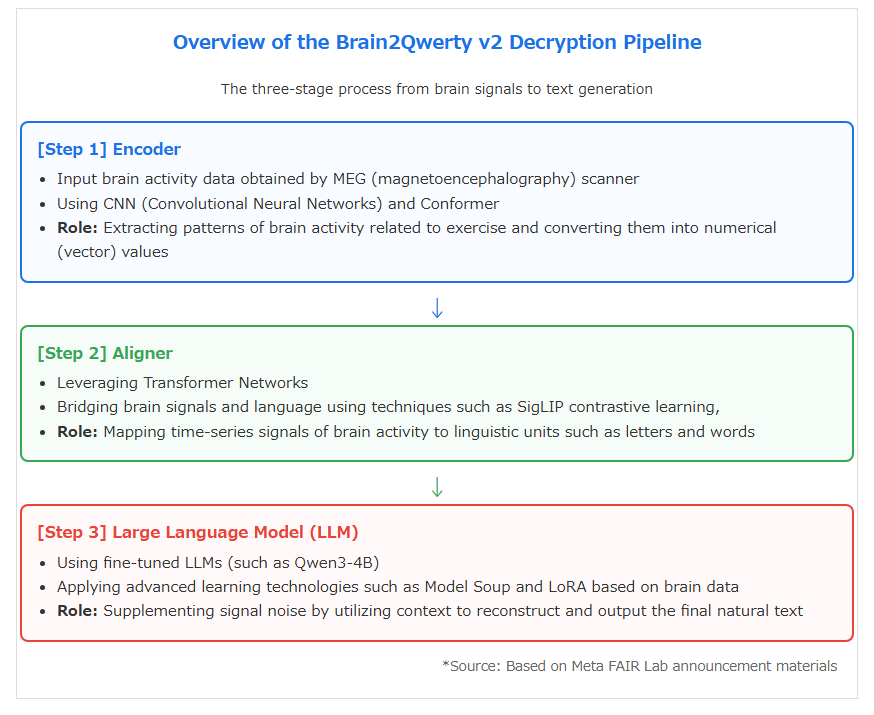
The ultimate goal of this study is to support communication among people who have lost the ability to speak or move due to brain injury or amyotrophic lateral sclerosis (ALS). The feature of not requiring surgery holds the potential to make BCI technology, which was previously difficult to accept unless medically critical, accessible to a wider range of people. With this announcement, Meta has released its training code and datasets as open source to promote the reproduction and advancement of research, hinting at its intention to gain long-term leadership in this field. The diagram below provides an overview of how Brain2Qwerty v2 processes brain activity and converts it into text.
Incredible accuracy: What an average of 61% means
The biggest reason Brain2Qwerty v2 shocked the world was that, despite being non-invasive, it achieved an extremely high average word accuracy rate of 61%. The highest-performing participant achieved a correct answer rate of 78%, successfully decoding more than half of all sentences with an extremely high accuracy—with a single word error or less. This is an extraordinary leap compared to the fact that previous non-invasive methods have only achieved about 8% correct vocabulary accuracy.
Of course, there is still a gap in the overwhelming accuracy of over 99% achieved by invasive BCI, but there are few other cases where such practical values are achieved for a non-surgical method. According to Meta’s report, this performance improvement is not just an algorithmic improvement, but is supported by the “quantity and diversity” of training data described later. Although it is still in the research stage at this point, the average figure of 61% fundamentally overturns the conventional wisdom of experts that “non-invasive types are too inaccurate to be useful.”
How the latest AI technology turns thoughts into text
Adoption of MEG (Magnetoencephalography) to Capture Magnetic Fields
To achieve highly accurate decoding, Meta chose not the conventional EEG, but magnetoencephalography (MEG). EEG measures electric potentials on the scalp, but electrical signals are attenuated as they pass through the skull and scalp, making the area heavily affected by the volumetric conductor effect. On the other hand, magnetic fields have the physical property of almost no distortion even when passing through biological tissues, so MEGs can capture what is happening inside the brain with extremely high spatial and temporal resolution.
According to Meta’s comparative experiments, the error rate for EEG was 65%, while MEG reduced it to 29%, showing a clear difference in accuracy. In the experiment, nine volunteers typed for 10 hours while wearing MEG devices, and about 22,000 sentences of data collected were used for AI training. Because MEG picks up extremely weak magnetic fields that are only a fraction of the Earth’s magnetic field—just a few hundred million times the Earth’s magnetic field—a massive shielded room is required for measurement, and this high-resolution data forms the foundation supporting ‘restoring thought.’
The evolution of decoding through LLMs and asynchronous processing
Inside the Brain2Qwerty v2 system, it consists of a three-stage advanced AI pipeline: a CNN encoder, a Transformer aligner, and a large language model (LLM). First, the encoder extracts motion-related brain patterns from MEG data measured in 500 milliseconds, and the aligner maps them to linguistic units. Ultimately, fine-tuned LLMs (such as Qwen3-4B) rely on context to fill in the “holes” in noisy brain signals, completing the sentences as natural and meaningful.
Notably, it achieves “asynchronous decoding,” which does not require any timing information such as the “moment of key input,” which was essential in its predecessor model (v1) announced in 2025. Since v2 can generate text directly from streams of continuous brain activity, it theoretically opened the way for decoding with just “typing recall” without moving fingers. Furthermore, by automatically optimizing the model’s hyperparameters using the AI agent Claude Opus, Meta achieves higher learning efficiency than human adjustments—a characteristic AI-first approach.
Challenges and Future Developments for Practical Application
Physical Limits and the Issue of ‘Brain Privacy’
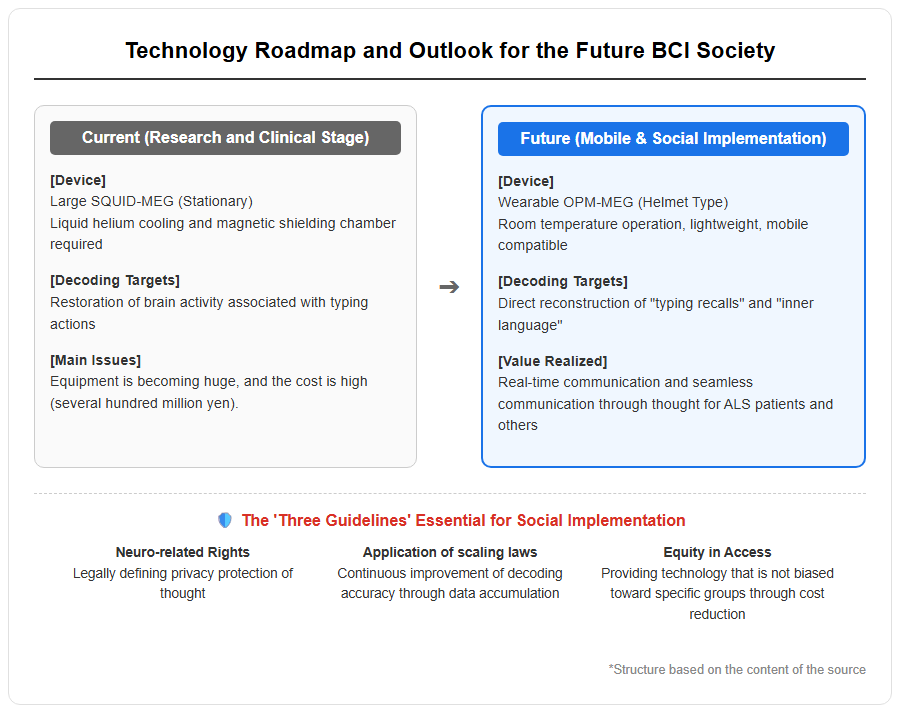
Alongside this technological breakthrough, there are still significant barriers to popularizing Brain2Qwerty v2 in the general public. The biggest challenge is the sheer size of the device. The MEG equipment currently in use is expensive at about $2 million and requires cryogenic cooling with liquid helium, making it impossible to exit the magnetic shield room. In other words, at present, it only works when “sitting quietly under the device,” and it does not support mobile applications such as walking in daily life.
Furthermore, as technology advances to the point where people can read thoughts without surgery, privacy and ethical issues will become even more serious. In the EU, projects such as SATORI and SIENNA are progressing in establishing guidelines for respect for autonomy and privacy protection in neuroscience research, and there is a growing demand for recognition of ‘neuro-related rights (neurorights)’ that clarify the legal status of brain activity data. Given concerns about giant IT companies like Meta accessing people’s thought data, ensuring transparency and establishing strict regulations has become an urgent priority.
Future possibilities indicated by scaling laws
The most important discovery Meta cites in this research is the establishment of the ‘scaling law’ in brain signal decoding. Just as the performance of AI models continues to improve with the amount of data used, the accuracy of brain activity decoding tends to improve as training data increases. Surprisingly, even with 90 hours of data, there are no signs of saturation in accuracy, and Meta believes that “if we continue to stack data, we could completely close the performance gap with invasive BCI.”
The most anticipated future prospect is the miniaturization of hardware. Currently, research is rapidly progressing on the “OPM-MEG (Optical Pumping Magnetometer)” that operates at room temperature and can be worn like a helmet. When this pairs with the advanced decoder of the Brain2Qwerty model, true mobile BCI will be born. The dawn of an era where surgery is not needed and everyone can communicate instantly just by “thinking” is no longer just a story of science fiction; it is beginning to become reality through solid calculations and accumulated data. The diagram below envisions a society where wearable BCI devices will become widespread in the future.
[#Meta #Brain2Qwerty #BCI #人工知能 #脳科学 #テクノロジー #生成AI #ニューロテクノロジー]


コメント