
The Thai government has launched the “TH-AI Passport” program, which provides 5 million citizens with free access to advanced AI tools such as ChatGPT and Gemini for one year. This initiative aims to boost the country’s stagnant AI adoption rate and bridge the digital divide.
- Key Event: Free access to premium AI tools for 5 million users
- Conditional Continued Usage: “Learn to Earn” and the Point Evaluation System
- Background to Adoption: Stagnant AI Adoption Rates and Urgency for Economic Growth
- Concerns over lack of transparency and doubts about the procurement process
- Ensuring data sovereignty and changing the contract to “Pay Per Active User”
- Future Outlook and Key Focus Areas in Thailand’s AI Strategy
Key Event: Free access to premium AI tools for 5 million users
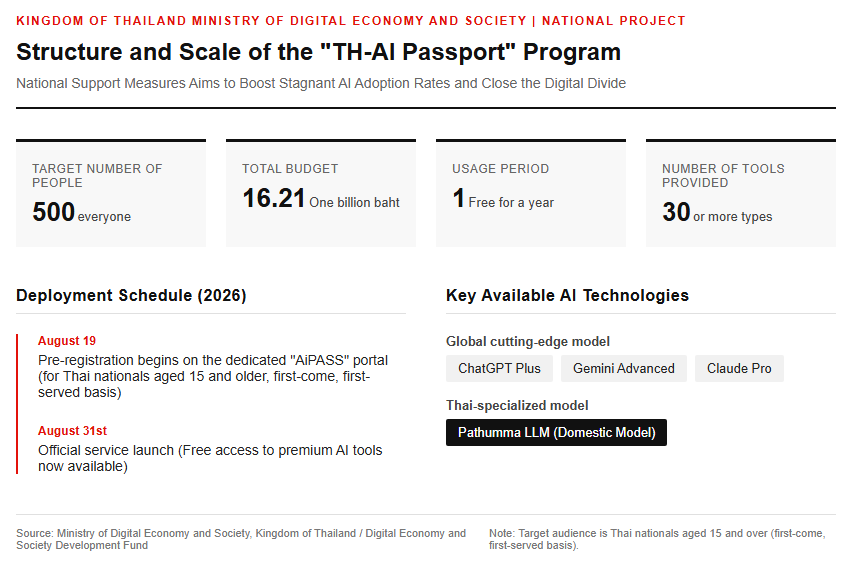
Thailand’s Ministry of Digital Economy and Society opened pre-registration for the “TH-AI Passport” program on August 19, 2026. This national digital talent development project offers free one-year access to professional-grade AI tools to up to 5 million Thai citizens aged 15 and older on a first-come, first-served basis, with official services launching on August 31, 2026. The budget amounts to 1.621 billion baht, allocated from the Digital Economy and Society Development Fund. Through the domestic-only portal “AiPASS,” participants will be able to use more than 30 types of advanced generative AI technologies, including world-class tools such as ChatGPT Plus, Gemini Advanced, and Claude Pro, as well as the Thai-specific homegrown model “Pathumma LLM.” Through this digital initiative, the Thai government aims to raise the level of IT literacy nationwide and support improvements in citizens’ daily productivity.
Please refer to the figure below.
Conditional Continued Usage: “Learn to Earn” and the Point Evaluation System
The defining feature of this project lies in its usage restrictions linked to learning, designed to ensure it doesn’t just end up as a mere distribution of tools. For the first three months following registration, all users are granted “Innovator” status, allowing them to freely try out the professional AI for 30 days. However, to maintain access rights beyond that period, completing an online educational program based on the “Learn to Earn” concept is mandatory. Specifically, the system is structured so that access rights for the following month will not be renewed unless users complete more than 96 provided AI-related courses and score 100 points or higher on the tests. Furthermore, the project employs a “replacement” system in which participants with extremely low usage frequency are forcibly stripped of their access rights, which are then transferred to new applicants. By doing so, it aims to intensively allocate resources to highly motivated citizens and maximize both educational impact and practical utility within a limited budget.
Chapter 2: The Digital Divide Facing Thailand and Project Challenges
Background to Adoption: Stagnant AI Adoption Rates and Urgency for Economic Growth
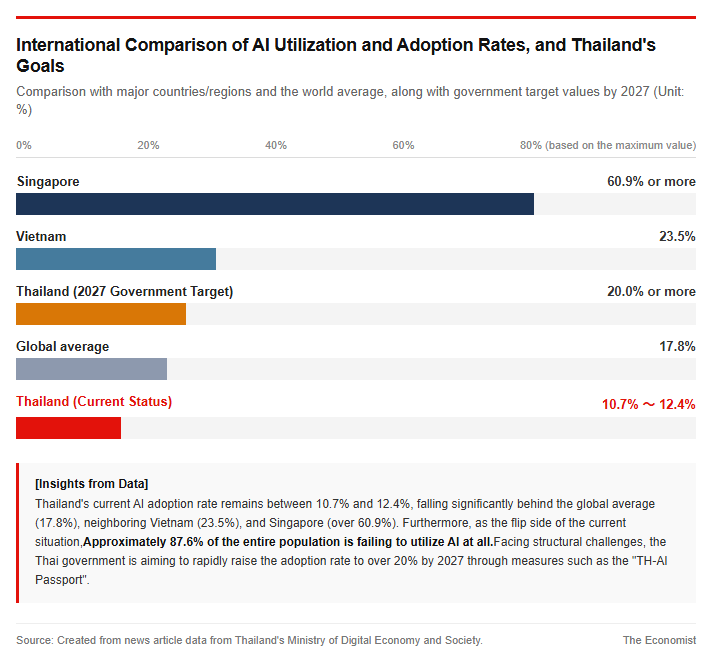
Behind Thailand’s promotion of such rapid AI adoption initiatives lie a sense of urgency regarding neighboring countries and the goal of escaping the economic middle-income trap. Currently, the utilization and adoption rate of AI in Thailand is estimated to be around 10.7% to 12.4%, which falls below the global average of 17.8%. In particular, the country is clearly lagging behind regional competitors such as Singapore, where adoption exceeds 60.9%, and Vietnam at 23.5%. Although the adoption speed of generative AI in Thai workplaces has recorded the second-highest growth rate in the world, this is merely being driven by a fraction of knowledge workers and corporate leaders, and approximately 87.6% of the general population—including those in the manufacturing, agriculture, education, and healthcare sectors—still does not utilize AI at all. The Thai government aims to augment its workforce, which is struggling with rapid aging and stagnant productivity, by leveraging AI, and has set a target to raise the overall AI adoption rate to 20% or higher by 2027.
Please refer to the figure below.
Concerns over lack of transparency and doubts about the procurement process
This project, backed by a massive injection of public funds, is stirring up considerable controversy within the country. In particular, the opposition People’s Party and certain lawmakers are severely questioning the lack of transparency in the procurement process. Concerns have been raised over the exceptionally rapid pace of the process—spanning a mere 34 days from the announcement of the tender to the deadline, which included the New Year holidays—as well as the fact that the “TH Consortium,” which was involved in formulating the specifications, ended up winning the bid with a meager discount rate of just 1.5%. Furthermore, suspicions have emerged that requirements in the specifications to use digital screen advertising at specific convenience store locations may constitute preferential treatment or profit-steering for a politically favored company. In response to these concerns, it has been decided to temporarily freeze the planned second phase of the project, valued at 900 million baht, shifting toward a cautious stance of carefully assessing the effectiveness of the first phase before moving forward.
Chapter 3: Data Security and Future Outlook
Ensuring data sovereignty and changing the contract to “Pay Per Active User”
In response to safety concerns surrounding the project, the Ministry of Digital Economy and Society has implemented security measures. All personal information and usage data are stored within cloud infrastructure inside Thailand and are not directly transferred to servers in other countries. Furthermore, the ministry strictly prohibits development companies contractually from using Thai users’ input data for training their own models or for secondary use, asserting that the tool is safer than typical free tools. The accumulated anonymous data is planned to be contributed to the development of the domestic AI “ThaiLLM” in the future. Additionally, to prevent the waste of budget, the contract terms were changed from an initial fixed-budget payment to a “Pay Per Active User” model, where payment is based on the number of active users who actually meet the conditions and use the service. This keeps the actual burden per user down to approximately 24.70 baht per month, enhancing the transparency of budget management.
Future Outlook and Key Focus Areas in Thailand’s AI Strategy
Thailand’s “TH-AI Passport” is an ambitious state-led initiative to guarantee citizens access to technology. However, many experts point out that simply renting overseas tools for a year will not foster a true domestic AI ecosystem or an independent technological foundation. Compared to approaches such as Vietnam’s, which prioritizes establishing legal frameworks and channeling funds to domestic developers, or India’s model of investing in foundational infrastructure, Thailand’s method has a structural weakness in that it tends to rely on user consumption. Whether this program can leave behind genuinely valuable results depends not on a mountain of expired accounts after the one-year usage period ends, but on how effectively it has cultivated skilled talent capable of independently generating value. Future evaluation will closely watch whether this initiative, as a step toward bridging inequality, serves as a catalyst to propel Thailand’s economy to the next stage.
Reference Page
- [TH-AI Passport Official Registration Site] https://de.aipass.net/
【#Thailand #AIPassport #ScienceAndTechnology #DigitalDivide #HumanResourceDevelopment #AIGovernance #DataSovereignty】


コメント