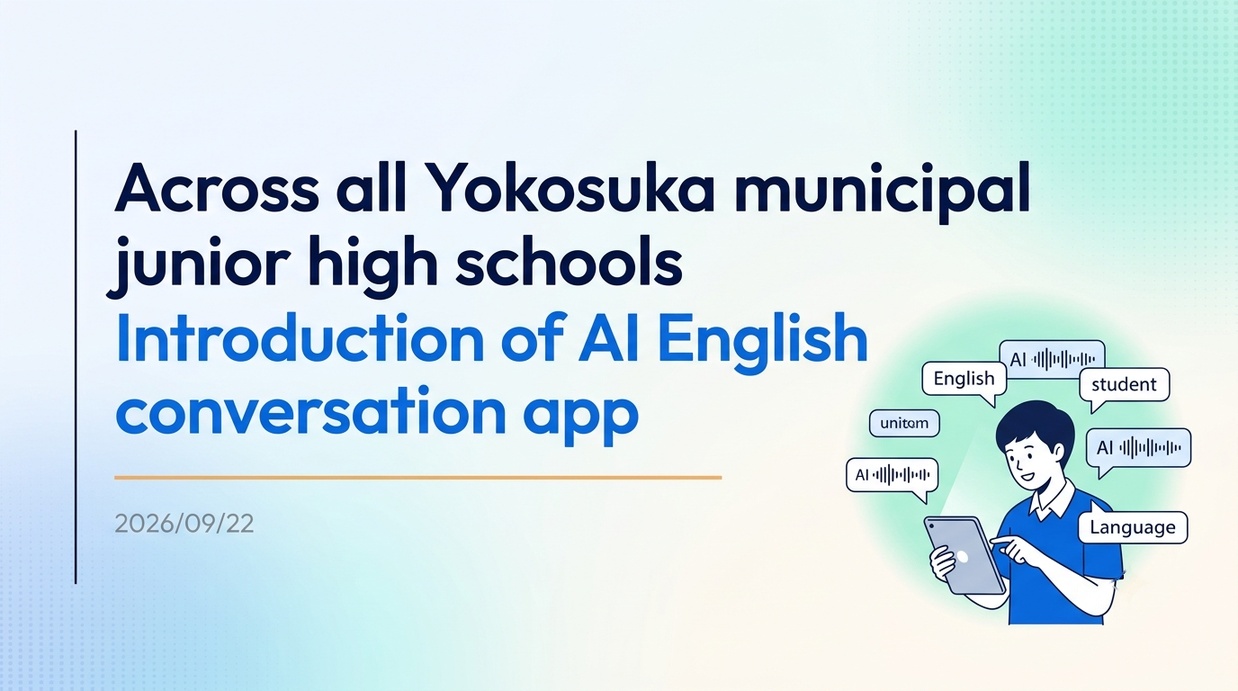
Yokosuka City in Kanagawa Prefecture has announced the rollout of the AI-powered English learning application “WorldClassroom” across all 23 of its municipal junior high schools. Driven by educational Digital Transformation (DX), the initiative aims to deliver personalized learning tailored to each student while alleviating the administrative workload on teachers.
- Prefectural First: Citywide Implementation and Advanced Features
- Supporting Personalized Learning and Independent Study
- Reform of Teachers’ Work Styles and Streamlined Evaluations
- The Context Behind Educational DX in Yokosuka City and MEXT Guidelines
- Operational Challenges and Ensuring an Equitable Learning Environment
- Expansion of the Municipally Led Model and the Future of Language Education
Prefectural First: Citywide Implementation and Advanced Features
To digitalize its educational environment and enhance students’ practical language skills, Yokosuka City, Kanagawa Prefecture, has decided to implement the AI-driven English learning application “WorldClassroom” across all 23 of its municipal junior high schools. This marks the first initiative of its kind by a municipality in Kanagawa Prefecture, with a phased rollout scheduled to begin on September 1, 2026. The budget allocated for this project is 84,969,000 yen.
A standout feature of the application is its complete alignment with official school textbooks. Because students can learn in direct synchronization with their daily classroom lessons, the app functions as far more than a supplementary study tool, enabling highly effective learning. In terms of functionality, it features real-time speaking practice with interactive AI avatars. When students speak or read aloud, the AI instantly evaluates their pronunciation and accent precision, providing an immediate numerical score and feedback. Additionally, the app offers model audio with adjustable playback speeds, automated grammar and composition feedback for writing tasks, and built-in tools for recording and managing student presentation videos. As a municipally led initiative deploying a textbook-aligned AI learning platform across an entire junior high school network, this program is drawing significant attention nationwide.
Supporting Personalized Learning and Independent Study
Implementing this app is expected to establish an environment for personalized learning tailored to each student’s proficiency level and learning pace. Traditional classroom settings face physical constraints in providing every student with sufficient speaking opportunities and individualized feedback on writing. However, leveraging the AI app enables students to practice speaking, listening, and writing repeatedly at their own pace without fear of peer judgment.
The learning process is illustrated below.
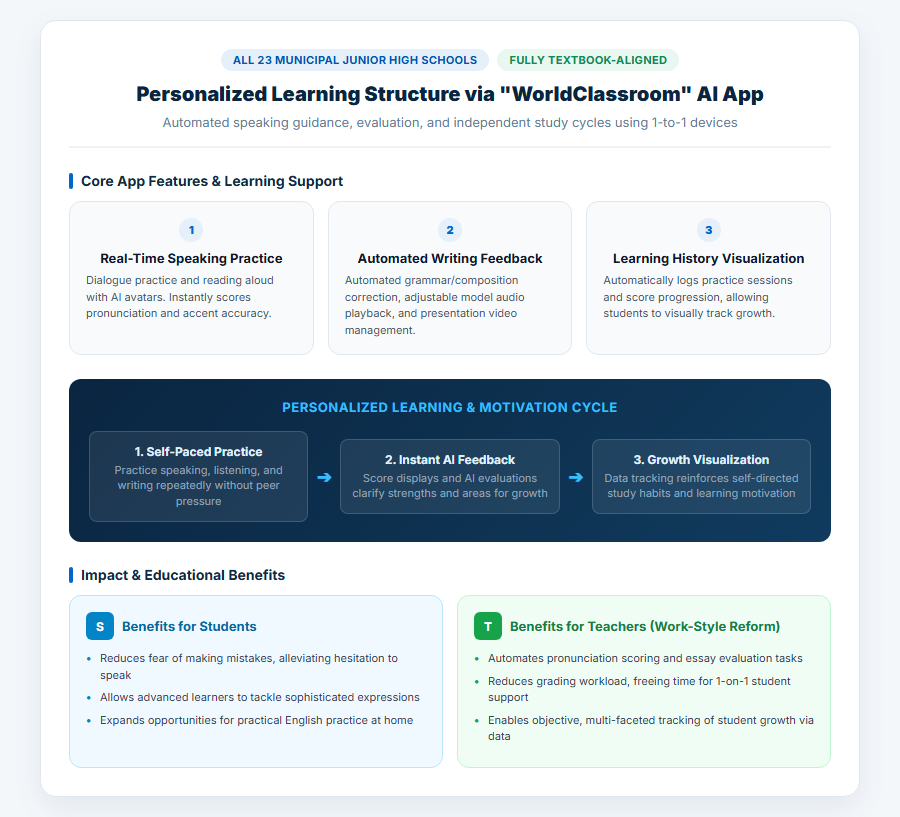
Each student’s practice history and score progression are automatically recorded and visualized in charts within the system. This allows students to objectively track their own growth, boosting motivation and helping establish independent study habits. Furthermore, as long as students have a device and internet connectivity, they can engage with authentic English outside class hours or at home, enhancing the quality of study beyond the classroom. For students who struggle with English, the platform reduces anxiety about making mistakes, while more advanced students can tackle sophisticated expressions, establishing a versatile foundation to support diverse educational needs.
Challenges in Education and the Social Value of AI Integration
Reform of Teachers’ Work Styles and Streamlined Evaluations
The introduction of the AI English learning app not only deepens student learning but also holds major significance for work-style reform and operational efficiency among educators. In Japanese schools, teachers spend vast amounts of time grading essays, scoring speaking assignments, and manually tracking daily learning data, contributing significantly to teacher burnout.
By leveraging this app, pronunciation scoring, essay correction, and learning record data tracking are fully automated, substantially lightening teachers’ administrative loads. The time freed up through this efficiency can be redirected toward human-centric educational activities, such as individual student guidance, counseling, and high-quality lesson preparation. Moreover, the objective learning data compiled by the AI goes beyond assessing basic knowledge and skills; it serves as a valuable support tool for evaluating holistic student growth, including the active learning attitudes emphasized in the national curriculum. Enabling teachers to offer targeted guidance based on objective data ultimately elevates the overall quality of instruction across the school system.
The Context Behind Educational DX in Yokosuka City and MEXT Guidelines
Yokosuka City was able to make a swift decision on this cutting-edge initiative due to its established organizational culture of turning change into opportunity and actively adopting digital technologies. In April 2023, Yokosuka City launched full municipal testing of ChatGPT-4 just one month after its release—an unprecedented speed for local government—achieving remarkable results, including an estimated annual reduction of 22,700 administrative work hours. A strategic culture has taken root across the city government: accepting that AI may be “80% perfect” while relying on human oversight to fulfill the remaining 20%.
The diagram below illustrates the concept of Educational DX.
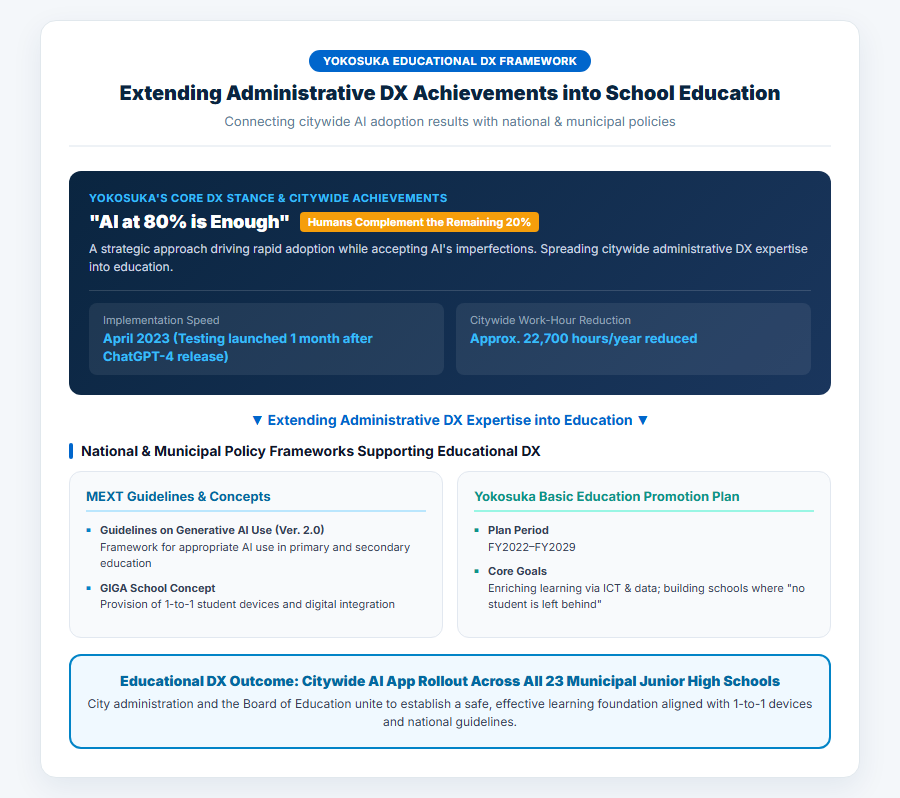
The integration of AI into school education aligns directly with this broader municipal DX momentum. Furthermore, it accords with Version 2.0 of the Guidelines on the Use of Generative AI in Primary and Secondary Education published by the Ministry of Education, Culture, Sports, Science and Technology (MEXT), as well as the GIGA School Concept’s provision of one device per student. Yokosuka City’s Basic Education Promotion Plan (FY2022–2029) explicitly prioritizes enriching learning through ICT and data while building an inclusive school environment where no student is left behind. Administrative leaders and the board of education are moving forward together to establish a modern learning foundation adapted to an evolving society.
Implementation Concerns and Future Outlook
Operational Challenges and Ensuring an Equitable Learning Environment
To maximize benefits from the citywide AI rollout, several operational challenges and considerations must be addressed. A key concern is the potential disparity in learning opportunities caused by differences in home internet access or student digital literacy. Delivering the benefits of digital tools equitably to all students will require robust support structures and thoughtful coordination between schools and families.
Additionally, as highlighted in MEXT guidelines, generative AI and automated evaluation systems carry risks such as incorrect outputs (hallucinations) and algorithmic bias. Rather than blindly trusting AI responses, it is vital to pair technology deployment with information literacy instruction and fact-checking guidance, reinforcing that humans bear final responsibility for verification. Stringent data privacy and copyright controls are also essential, requiring strict operational rules to prevent students from inputting personal information. Ensuring AI is not treated merely as a time-saving shortcut, but rather as a catalyst for critical thinking and inquiry, will determine the ultimate success of the program.
Expansion of the Municipally Led Model and the Future of Language Education
Ahead of its September 2026 launch, Yokosuka City’s initiative is attracting keen interest from local governments and educators across Japan. In addressing longstanding challenges in Japanese English education—namely, insufficient speaking practice and low student engagement—this municipally led model of deploying textbook-aligned AI across all junior high schools serves as a key benchmark for regional educational reform.
Under MEXT initiatives to strengthen English education through AI, adoption of AI learning platforms is gaining traction across multiple municipalities, accelerating innovation in language learning. The practical data and operational insights gathered in Yokosuka will offer invaluable reference points for educators nationwide. As students overcome their anxiety about English through interactive dialogues with AI characters, they are expected to build practical communication skills vital for a globalized society. A new vision of education—where humans and AI leverage their respective strengths to unlock potential—is spreading from Yokosuka to the rest of the nation.
Reference Pages
- 【Yokosuka City Press Conference Materials】https://www.city.yokosuka.kanagawa.jp/8310/nagekomi/20260902_kisyakaiken.html
- 【MEXT AI-Powered English Education Portal】https://ai-eigo.mext.go.jp/
【#YokosukaCity #GenerativeAI #EnglishEducation #EducationalDX #WorldClassroom】

コメント