Regarding the accident on August 20, 2026, on the Tobu Nikko Line in Kanuma City, Tochigi Prefecture, which resulted in the deaths of four workers, the Tochigi Prefectural Police conducted a search of the primary contractor, “Tobu Kensetsu,” on suspicion of professional negligence resulting in death. This has brought to light deficiencies in safety management relying on visual checks and the background of how communication broke down within the multi-tiered subcontracting structure.
- The Limited Express “Spacia X” Collision Accident at Shin-Kanuma Station
- Raid on Tobu Construction and Establishment of a Special Investigation Team
- The Breakdown of Human-Dependent Safety Checks and Information Transmission
- Limitations of Visual Inspection and Technology Adoption for Safety Measures
- The Prime Contractor’s Management and Supervisory Responsibilities and Tobu Construction’s Disciplinary Record
- Pursuing Criminal Liability and Prospects for Systematic Recurrence Prevention
The Limited Express “Spacia X” Collision Accident at Shin-Kanuma Station
Around 10:45 AM on August 20, 2026, an accident occurred at the premises of Shin-Kanuma Station on the Tobu Nikko Line in Kanuma City, Tochigi Prefecture, where four workers who were spraying herbicide on the tracks were struck by the “Spacia X No. 2” limited express train bound for Asakusa from Tobu-Nikko, resulting in their deaths. About 50 passengers and crew members were on board the train, but none of the passengers were injured. The accident site was on the tracks adjacent to a disused old platform, and no evacuation space was provided under the platform for workers to take refuge in an emergency. The workers consisted of a total of four people: three workers from a partner company who were spraying herbicide on the inbound track side at the time, and one supervisor from Tobu Construction who had come to check on the work. Upon entering Shin-Kanuma Station, the limited express train sounded its horn after confirming a signal given by a lookout. However, the workers had actually not evacuated, and although the driver noticed the abnormality and applied the emergency brakes, it was impossible to avoid a collision. As a result of this accident, the Tobu Nikko Line suspended operations for about four and a half hours between Shin-Tochigi and Shimo-Imaichi, developing into a serious situation with a total of 33 trains suspended.
Raid on Tobu Construction and Establishment of a Special Investigation Team
Following the accident, the Tochigi Prefectural Police took the situation seriously and established a 45-member special investigation team at the Kanuma Police Station the following day, August 21. Then, at around 9:00 a.m. on August 23—just three days after the accident—investigators executed a search and seizure on suspicion of professional negligence resulting in death at the offices of Tobu Construction, the primary contractor that was directly commissioned by Tobu Railway to perform weed-clearing work (located in a building housing the General Affairs Department in Imaichi, Nikko City, Tochigi Prefecture). Additionally, similar compulsory investigations were conducted on several other affiliated companies of Tobu Railway. About 10 investigators were seen entering the building carrying cardboard boxes, and based on the seized materials, authorities plan to determine whether there were any deficiencies in the on-site safety management system or the instructions given to subcontractors. The unusually swift raid highlights the immense social impact of the accident and suggests that police suspect potential gross negligence within the safety management structure. Moving forward, the special investigation team is expected to question surviving on-site workers, lookouts, and the train driver to clarify where the responsibility lies among all parties involved.
Structural Flaws of the “Train Lookout” System and Past Accident Examples
The Breakdown of Human-Dependent Safety Checks and Information Transmission
The biggest question in this accident is why the “evacuation completed” signal, which allows a train to enter, was sent while workers were still left on the tracks. For the work at the site, a system of about 10 people in total, including workers and lookouts, was in place. As for the safety management procedures, two “relay lookouts” were to be stationed at positions approximately 315 meters ahead and behind the work site, and one “train lookout” was to be placed about 80 meters from the site to relay information on approaching trains visually. However, according to Tobu Railway’s explanation, it has become clear that proper communication was not established between the relay lookouts and the train lookout. Some reports have also pointed out the possibility that the relay lookouts were not stationed at their designated positions where they should have been. As a result, without proper confirmation of whether all workers had evacuated, a yellow flag indicating safety was waved by the on-site train lookout, highlighting a fatal breakdown in the information transmission system where only the information of “safety” was conveyed to the driver of the limited express train while a hazardous situation remained.
Limitations of Visual Inspection and Technology Adoption for Safety Measures
The recent accident at Shin-Kanuma Station has once again laid bare the limitations of safety management that relies solely on human duty of care and visual signals. Even in a document compiled in February 2020 by a Ministry of Land, Infrastructure, Transport and Tourism study group on the use of satellite positioning in railways, it was officially pointed out that checking for approaching trains visually by watchmen carries the risk of “variations in visual estimation” and “human errors, such as failing to notice approaching trains.” To prevent such accidents, JR East has, since fiscal 2016, introduced a system that links workers’ devices with the GPS location data of trains to automatically issue proximity warnings, operating it across approximately 1,500 kilometers of railway lines. Similarly, JR West has operated a comparable train approach warning system across about 2,800 kilometers since 2008, though it remains unconfirmed whether such mechanical safety redundancy measures were in place at the site of this recent accident. To ensure even more reliable safety, “track closures”—which completely block trains from entering the section—should be applied; however, the reality is that “interval work” (performing work between trains without stopping them) continues to be chosen due to concerns over schedule disruptions and costs.
The following figure is an analysis example published by the Japan Transport Safety Board, showing the roles and progression in past accidents involving intrusion onto adjacent tracks.
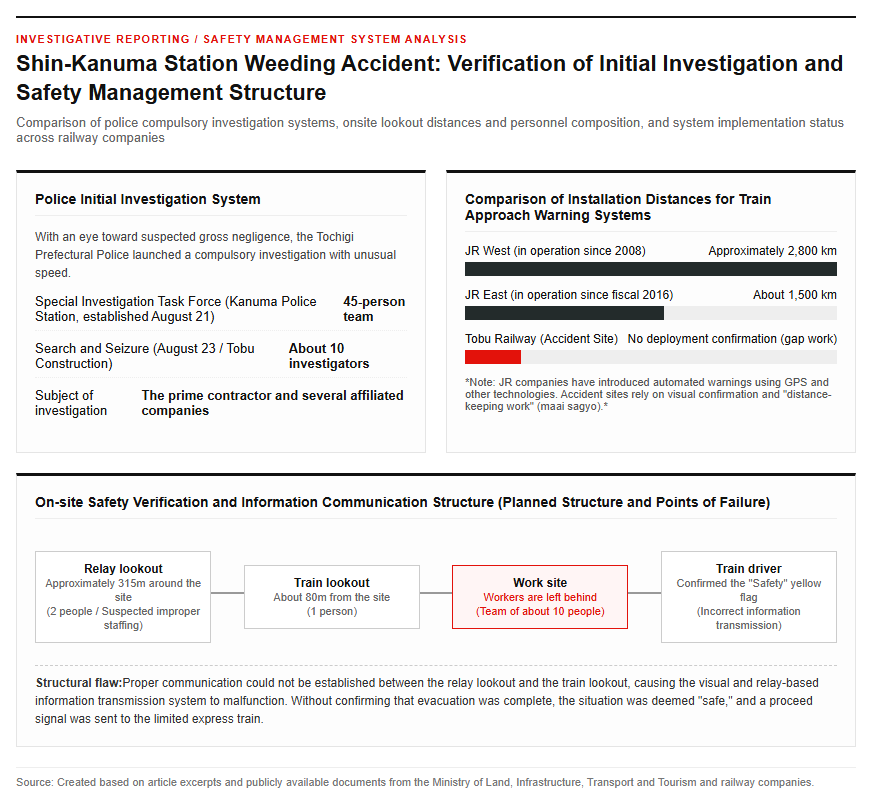
Thus, when communication environments and procedures for each role become ambiguous, a single person’s assumptions or communication errors can lead directly to life-threatening accidents.
Future Issues Regarding Multi-Layered Subcontracting and Safety Management Systems
The Prime Contractor’s Management and Supervisory Responsibilities and Tobu Construction’s Disciplinary Record
At the time of the accident, out of the 10 people working at the site, a total of 2 belonged to the primary contractor, Tobu Construction—specifically, 1 work supervisor and the 1 supervisor who died—while the remaining workers and lookouts consisted of employees from multiple subcontractors and partner companies. Although Tobu Construction was in the position of a primary contractor directly commissioned by Tobu Railway to perform weeding work, it was also a party involved in managing and supervising the work by assigning its own employees as on-site supervisors. In railway maintenance sites, a multi-tiered subcontracting structure driven by cost reduction and labor shortages has become chronic, and the issue has been pointed out that safety education and management tend to be inadequate at the end-tier subcontracting companies that actually perform dangerous work. Furthermore, issues surrounding safety management have been confirmed for Tobu Construction in the past as well. According to debarment information published by the Ministry of the Environment (Tohoku Regional Environment Office), the company has a history of being subjected to a debarment disposition from February 15 to February 28, 2017, due to a construction-related accident caused by inadequate safety management measures. In this accident as well, a major focus is whether management responsibility as the primary contractor was appropriately fulfilled.
Pursuing Criminal Liability and Prospects for Systematic Recurrence Prevention
Although a compulsory investigation via house search has begun, identifying criminal responsibility in an organizational accident is no easy task. In a past similar case—the fatal accident involving a track maintenance worker at Toyama Chihou Railway (which occurred in April 2023)—it took approximately two years and one month for the police to send the papers to prosecutors. Ultimately, the only party to receive a guilty verdict was the individual site supervisor at the time (one year and six months of imprisonment, suspended for three years), while Toyama Chihou Railway as a corporate entity and the technical general manager at the time were not indicted. Furthermore, in the JR West Fukuchiyama Line derailment accident of April 2005 that claimed 107 lives, the Supreme Court finalized the acquittals of all three successive former presidents who had been forcibly indicted for professional negligence resulting in death and injury, demonstrating the limits of pursuing individual criminal responsibility. In the latest accident as well, it is necessary to delve not only into the negligence of the individual train lookout, but also into systemic issues within Tobu Railway and Tobu Construction, such as safety management system design, staffing, and cost burdens for equipment. A key point to watch moving forward will be whether a fail-safe mechanism can be established that automatically stops trains even if a human makes a mistake.
Reference page
- 【Train Collides with Worker Who Entered Adjacent Up Line During Track Closure Work on Down Line (Investigation Report) | Japan Transport Safety Board】http://jtsb.mlit.go.jp/jtsb/railway/report/RA10-3-1.pdf
- [Regarding the Suspension from Bidding for Tobu Construction Co., Ltd. | Ministry of the Environment] https://www.env.go.jp/kanbo/chotatsu/post_26.html
[#TobuNikkoLine #ExpressTrainCollision #SpaciaX #SafetyManagement #HouseSearch #MultiTieredSubcontracting #OccupationalSafety]

コメント