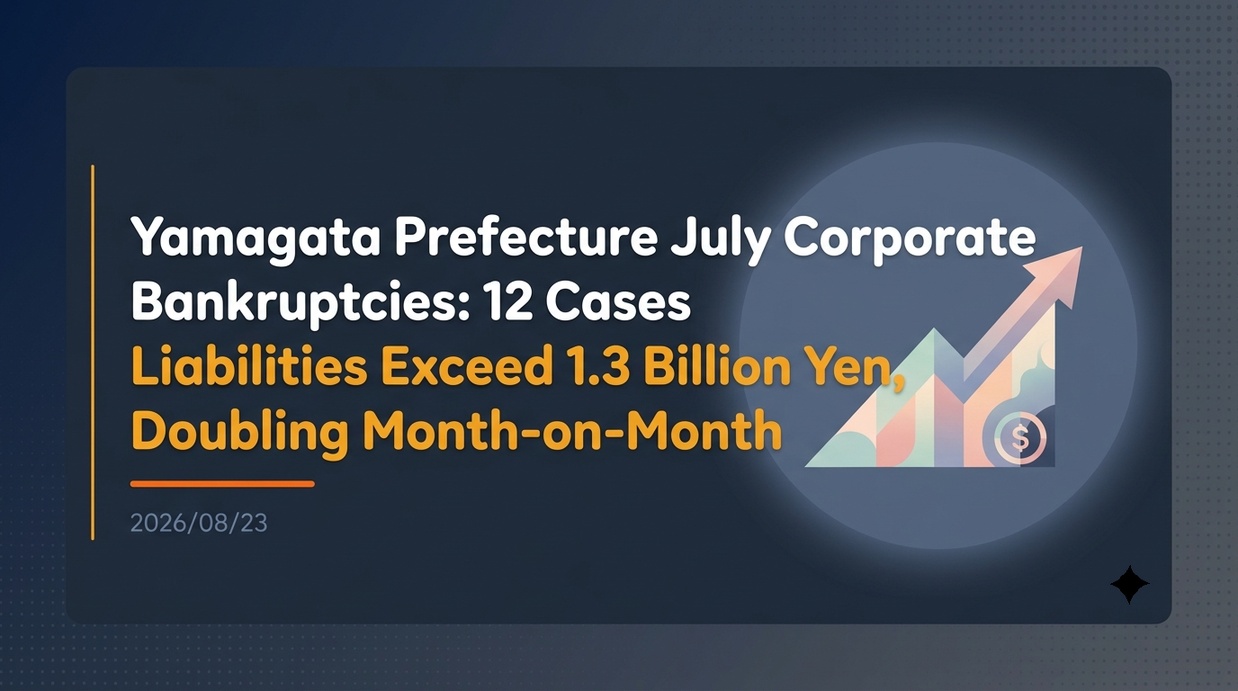
Corporate bankruptcies in Yamagata Prefecture in July 2026 reached 12, surging more than twofold from the previous month’s 5. In the background lies a severe business environment surrounding small businesses, such as prolonged high raw material prices, soaring labor costs, and the repayment burden of zero-zero loans.
- The overall picture and trends of bankruptcies that doubled to 12 cases in a single month
- Breakdown by industry and factor, led by the retail sector
- The triple hardship of sluggish sales, endless inflation, and soaring prices
- The Full-Scale Repayment of Zero-Zero Loans and Growing Anxiety Over Repayment
- High Bankruptcy Risk Concentrated in Small Businesses with Fewer Than 10 Employees
- Economic Outlook and Future Developments for 2026 Amid Continuing Plateau Phase
The overall picture and trends of bankruptcies that doubled to 12 cases in a single month
According to a survey released by Teikoku Databank’s Yamagata branch, the number of corporate bankruptcies in Yamagata Prefecture in July 2026 reached 12, more than doubling from the 5 cases recorded in the previous month of June 2026. This is the first time in 14 months—since May 2025—that the number of monthly bankruptcies in Yamagata Prefecture has exceeded 10. In addition, total liabilities associated with these bankruptcies amounted to a combined 1.353 billion yen, also seeing a sharp increase. This marks the first time in 10 months since September 2025 that monthly liabilities have surpassed 1 billion yen. As such, in terms of both bankruptcy cases and total liabilities, July 2026 was a month when the financial distress of companies in Yamagata Prefecture rapidly became apparent. Please refer to the following graph for a visual overview of bankruptcy trends among companies in the prefecture.
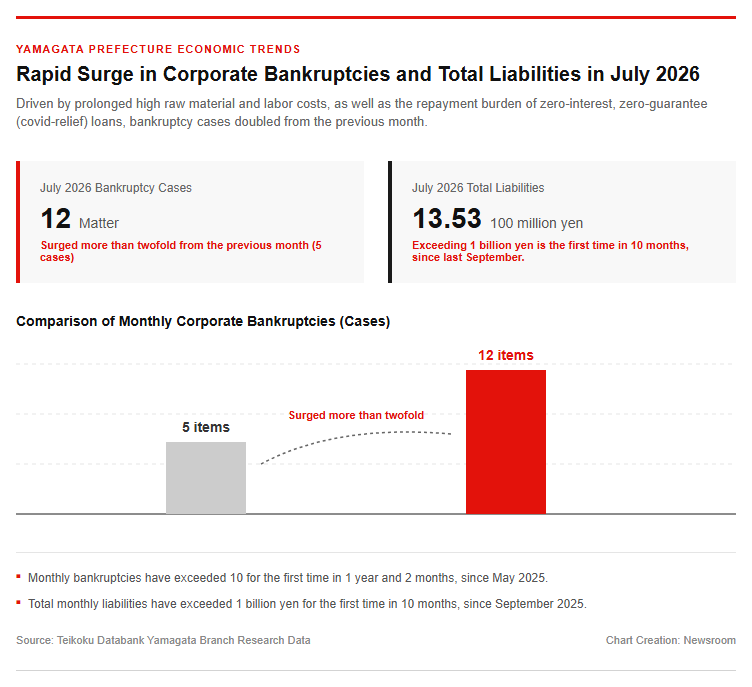
The doubling in the number of bankruptcies is not a temporary phenomenon, but rather suggests that the cash flow limits faced by small and micro enterprises in the prefecture have reached a breaking point.
Breakdown by industry and factor, led by the retail sector
Looking at bankruptcies in July 2026 by industry, the retail sector recorded the highest number with 5 cases, followed by the wholesale sector with 3 cases. In the retail sector, which is close to everyday consumers, sluggish sales and rising costs are directly leading to business failures. An analysis of the causes of bankruptcy shows that 10 out of the total 12 cases were due to sluggish sales, with shrinking demand driven by economic stagnation being the primary factor. Aside from these, there was 1 case of mismanagement caused by lax business planning and inappropriate use of funds, and 1 case resulting from a chain bankruptcy triggered by a business partner. As such, direct sales declines due to poor performance are triggering numerous bankruptcies, casting a serious shadow particularly on the retail and wholesale industries, where the declining purchasing power of local residents is a growing concern. These small and medium-sized enterprises, which rely on local market structures, are forced into fierce competition amid limited demand, facing structural challenges that cannot be solved through self-help efforts alone.
Background of Cost-Push Pressure and Deteriorating Cash Flows
The triple hardship of sluggish sales, endless inflation, and soaring prices
What is troubling companies in Yamagata Prefecture is not simply a slump in sales. According to a survey on the 2026 economic outlook conducted by Teikoku Databank’s Yamagata Branch, the top economic concern cited by local companies is inflation, with 49.3% of respondents expressing caution. Furthermore, as policies necessary for economic recovery, many companies are calling for price-relief measures and expanded support for small and medium-sized enterprises (SMEs). Price increases for various goods and soaring labor costs driven by minimum wage hikes are steadily eroding the financial resilience of SMEs. In particular, rising geopolitical risks due to the tense situation in the Middle East and relentless increases in raw material costs are problems that are extremely difficult to resolve in the short term. Amid conditions where growing sales is difficult, cost-push inflation is underway—with procurement and labor costs unilaterally surging—cornering regional SMEs that are unable to sufficiently pass on these costs to prices.
The Full-Scale Repayment of Zero-Zero Loans and Growing Anxiety Over Repayment
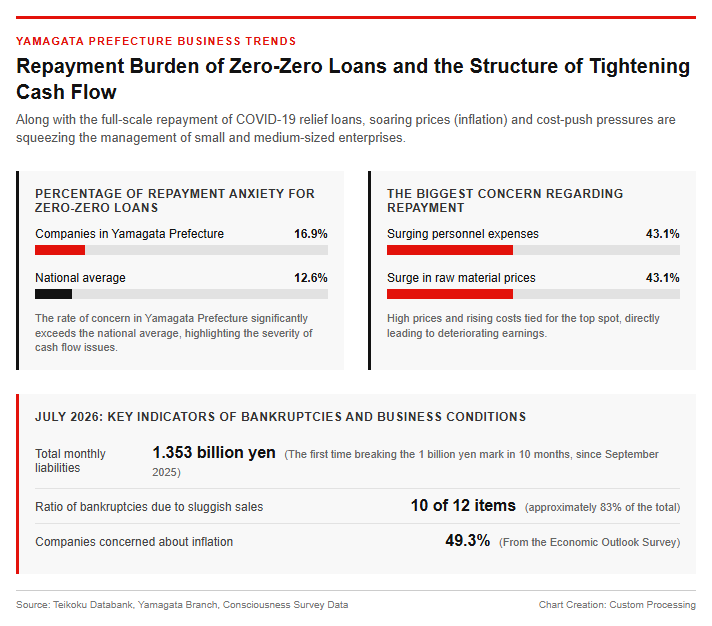
The repayment burden of COVID-19-related loans featuring practically zero interest and no collateral—so-called “zero-zero loans”—introduced during the spread of the novel coronavirus is also proving to be a major drag. In an opinion survey conducted in August 2024 targeting companies in Yamagata Prefecture, 16.9% of local businesses that utilized the loans responded that they have concerns about future repayments. This percentage significantly exceeds the national average of 12.6%, vividly illustrating the tighter cash flow situation faced by companies in Yamagata Prefecture compared to the national average. As for the primary concerns regarding repayment, soaring labor costs and soaring raw material prices tied for first place at 43.1% each, demonstrating once again that high prices are directly dealing a blow to cash flow. The reality is that as the temporary life-extending measure of capital injection through loans comes to an end and full-scale principal repayments begin, companies that have been unable to regain their earning power are reaching their limits one by one. Regarding the broader impact of bankruptcies after zero-zero loans, the following conceptual diagram serves as a useful reference.
Management Crises in Small Businesses and Future Outlook
High Bankruptcy Risk Concentrated in Small Businesses with Fewer Than 10 Employees
According to a bankruptcy risk analysis survey targeting companies in Yamagata Prefecture, published by Teikoku Databank’s Yamagata branch, high-risk companies (grades 8 to 10) considered to have a high probability of going bankrupt within the next year totaled 1,555. This represents an increase of 139 companies compared to the 2024 survey, indicating an ongoing rise in baseline bankruptcy risks within the prefecture.
Of particular concern is the breakdown of these high-risk companies. Among the 1,555 high-risk firms, businesses with annual sales of less than 100 million yen account for approximately 70% of the total, while small-scale enterprises with fewer than 10 employees make up about 80%. By industry, manufacturing companies were the most numerous at 487, representing a 19.7% increase from 2024. This data indicates that bankruptcy risks are extremely high among small-scale enterprises lacking management resources—particularly subcontracting manufacturers and businesses close to sole proprietorships—which are the first to bear the brunt of soaring prices and rising labor costs.
Economic Outlook and Future Developments for 2026 Amid Continuing Plateau Phase
In a corporate sentiment survey regarding the economy in Yamagata Prefecture for 2026, the largest share of companies—36.8%—viewed the economic outlook as being in a plateau phase. Companies seeing the economy in a recovery phase stood at a mere 7.4%, while those viewing it as worsening reached 23.5%. Thus, many businesses feel that the current economy is stagnating and the future remains uncertain. Moving forward, the business environment is set to become increasingly harsh due to factors such as ongoing price hikes for various products, further minimum wage increases, and geopolitical risks stemming from volatile international affairs. Teikoku Databank’s Yamagata branch analyzes that it is impossible to dismiss concerns that the number of companies in Yamagata Prefecture facing difficulties in continuing their operations will continue to grow. There is a strong demand for local governments and financial institutions to strengthen essential, hands-on support aimed at business revitalization and management improvement, going beyond mere cash flow assistance.
Reference Page
- 【Bankruptcy Statistics: July 2026 Report – Teikoku Databank】https://www.tdb.co.jp/report/bankruptcy/aggregation/20260810-bankruptcy202607/
- [Yamagata Prefecture: Corporate Sentiment Survey on the 2026 Economic Outlook – Teikoku Databank] https://www.tdb.co.jp/report/economic/20260130-2026econ-outlook-yamagata/
- [Yamagata Prefecture: “Bankruptcy Risk” Analysis Survey (2025) – Teikoku Databank] https://www.tdb.co.jp/report/economic/20260402-highrisk-yamagata/
- [Survey on COVID-19-Related Loans Among Companies in Yamagata Prefecture (August 2024) – Teikoku Databank] https://www.tdb.co.jp/report/economic/20241121-covid19loans-yamagata/
【#YamagataPrefecture #CorporateBankruptcies #InflationDrivenBankruptcies #ZeroZeroLoans #SMESupport #RegionalEconomy #InflationImpact】

コメント