
The Japanese government has significantly expanded the R&D tax system, establishing new tax reduction measures for strategic technology fields such as artificial intelligence and quantum technology. This move is driven by the need to strongly stimulate domestic private-sector R&D investment amid intensifying international innovation competition.
- Creation of a New Tax Framework Targeting National Strategic Sectors Like AI and Quantum Technology
- The Record-High Tax Credit Rate of 40% for In-House Research and 50% for Joint Research, and Its Impact
- The practical start date of application and the mandatory process for plan certification by the Ministry of Economy, Trade and Industry (METI)
- Changes Brought About by the Global Advanced Technology Investment Competition and the Closer Integration of Science and Business
- The Divergence Between Domestic Public-Private Investment and Research & Development Support as a Foundation for a Strong Economy
- Phased review of the existing general tax system and strengthening of restrictions on overseas outsourcing expenses
Creation of a New Tax Framework Targeting National Strategic Sectors Like AI and Quantum Technology
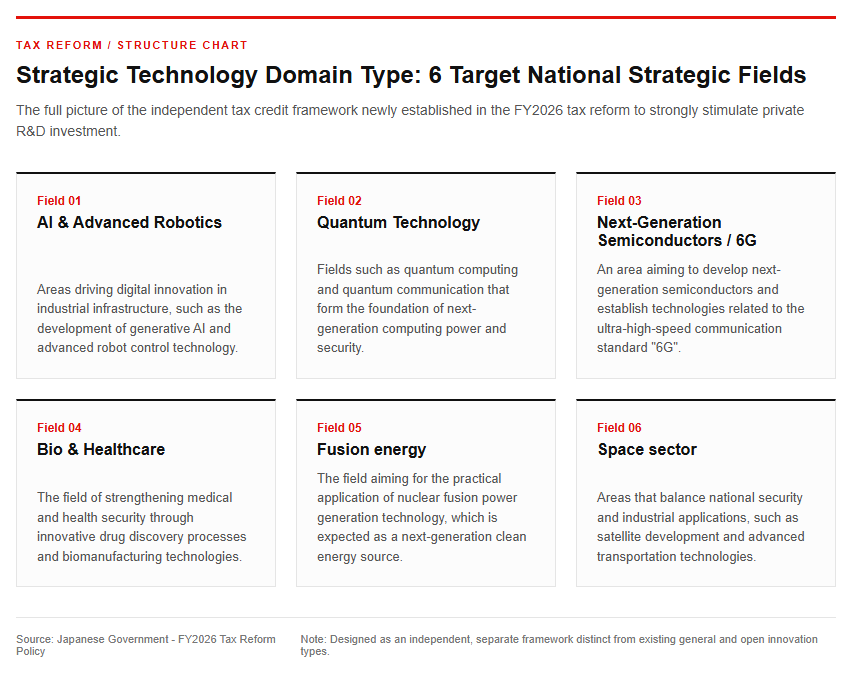
The Japanese government has decided to establish a “Strategic Technology Field” category within the R&D tax credit system as a new tax incentive to support innovative technological development in the FY2026 tax system reform. This new category is designed as a completely independent, separate framework from the existing general and open innovation types. The targets are six national strategic fields designated as priority industrial technologies crucial to the foundation of Japan’s industrial base and security. Specifically, these cover AI and advanced robotics including generative AI and robot control; quantum technology referring to quantum computers and quantum communications; next-generation semiconductors and 6G technology, which is the next-generation high-speed communication standard; bio-healthcare involving drug discovery and biomanufacturing; fusion energy, which is nuclear fusion power generation technology; and the space sector related to satellites and transportation technology. In these areas, the government aims to strongly support technological developments that can be expected to achieve early social implementation and commercialization, thereby establishing domestic technological independence and international superiority. Please refer to the figure below.
The Record-High Tax Credit Rate of 40% for In-House Research and 50% for Joint Research, and Its Impact
The greatest impact that the newly established Strategic Technology Fields category will have on the market lies in its unprecedented tax credit rates of 40% for in-house research and 50% for joint and commissioned research. Compared to the current general category, where the tax credit rate caps out at a maximum of 14% depending on the increase or decrease in R&D expenses, this figure stands out as an exceptionally bold investment incentive. In particular, when private companies conduct joint or commissioned research with cutting-edge R&D centers certified by the Minister of Economy, Trade and Industry, the University Base Strengthening Category becomes available, applying a record-high deduction rate of 50%. The upper limit for the tax credit amount is set at 10% of corporate tax liability, which can be used in combination with other frameworks such as the general category and deducted under separate management. Furthermore, a system will be established allowing a 3-year carryforward of tax credits for any deduction limits that could not be fully utilized in the current period. This will provide companies with a solid management foundation to stably pursue long-term investments in foundational advanced technology development, which requires massive amounts of capital yet takes time to monetize.
The practical start date of application and the mandatory process for plan certification by the Ministry of Economy, Trade and Industry (METI)
Although this groundbreaking strategic technology domain category is positioned as part of the FY2026 tax reform, companies are scheduled to actually be able to utilize the tax reduction system starting in FY2027. The reason for the one-year lag before the actual application begins is that, as a prerequisite for applying for the tax cuts, strict preliminary reviews and plan certification procedures by the Ministry of Economy, Trade and Industry (METI) based on amendments to the Act on Strengthening Industrial Competitiveness will be required. Businesses considering utilizing the system must obtain prior certification for a priority R&D plan stipulated under the Act. In addition, research institutions conducting joint research—such as universities and national research and development agencies—must also have their national certification publicly announced as facilities adequately equipped with the necessary personnel and equipment. This special measure will apply for up to five years from the certification date for plans certified by the end of FY2028. Unlike conventional procedures where companies receive tax reductions automatically simply by applying, businesses must begin building a practical operational framework right away, including the compartmentalized management of research details and the preparation of supporting documentation.
Current Domestic and International Situation Surrounding R&D Tax Incentives and the Background of Institutional Design
Changes Brought About by the Global Advanced Technology Investment Competition and the Closer Integration of Science and Business
The Japanese government’s move to drastically strengthen the R&D tax system stems from the arrival of an era of proximity between science and business, where advanced scientific breakthroughs are instantly commercialized and directly linked to massive new businesses. In major countries such as the US and China, an intense public-private investment competition on the scale of trillions of yen is already underway for sensitive technologies that dictate national futures, such as artificial intelligence, semiconductors, and space exploration. For instance, the United States reinforced its support in 2024 by positioning AI and semiconductors as priority technologies, while Germany laid out a priority investment policy in 2025 focusing on quantum and AI as core technologies. In South Korea as well, a 40% tax credit for semiconductor investment has been introduced, bringing the competition to secure status as a global development hub to its absolute limit. There was a profound sense of crisis that if Japan fails to keep pace internationally and secure an equal-footing investment environment, brilliant minds and cutting-edge research hubs would drain overseas. This tax system is also a defensive measure for the state to step forward and strongly entice private enterprises to make high-risk, colossal investments in technological development.
The Divergence Between Domestic Public-Private Investment and Research & Development Support as a Foundation for a Strong Economy
Research and development (R&D) serves as the source of Japan’s growth potential, and in fact, private companies account for about 80% of total domestic research investment, amounting to 18.0 trillion yen (as of fiscal 2023). However, against the government’s ambitious goal in the Science and Technology Basic Plan to reach a total of approximately 120 trillion yen in combined public and private R&D investment over the five-year period from fiscal 2021 to fiscal 2025, the cumulative investment for the three-year period from fiscal 2021 to fiscal 2023 stood at only about 62.5 trillion yen. To bridge this gap with the target and to continue maintaining and expanding the target of approximately 120 trillion yen over five years in the new basic plan for fiscal 2026 and beyond, even stronger government backing than ever before was essential. By nature, while R&D activities generate positive external economic effects that benefit society as a whole, they tend to result in underinvestment by companies since they do not yield short-term profits. The government positions superior technological development as the very foundation for realizing the strong economy advocated by the Takaichi Cabinet, and has clearly outlined a policy to maximize private-sector dynamism through neutral and fair tax measures in addition to budgetary allocations.
Phased review of the existing general tax system and strengthening of restrictions on overseas outsourcing expenses
Simultaneously with the establishment of a new strategic technology domain category, structural reforms of the existing R&D tax credit system will be implemented in phases. First, regarding the general-type tax scheme applicable to total expenditures, the calculation formulas for the deduction rate (0% to 14%) and the deduction cap (20% to 30%) will be revised sequentially from fiscal 2026 to fiscal 2028. Meanwhile, for the R&D tax system targeted at small and medium-sized enterprises (SMEs), a framework has been added to support the growth of cash-strapped startups, such as newly permitting a three-year tax credit carryforward. Additionally, as a notable reform, the treatment of commissioned research expenses overseas will be tightened. This is a measure taken from the perspective of maintaining employment for advanced domestic research talent and preventing the weakening of domestic research bases. With the exception of overseas clinical trials for new drug development and the like, the applicable tax credit ratio for R&D expenses outsourced overseas will be lowered to 70% in fiscal 2026, 60% in fiscal 2027, and reduced to 50% from fiscal 2028 onward. The government is not merely casting a wider net for tax cuts, but has embedded a strong resolve into the institutional design to encourage the relocation of development hubs back to Japan and promote the utilization of domestic innovation talent.
Reference page
- [Ministry of Economy, Trade and Industry: Regarding the FY2026 Tax Reform for R&D Taxation] https://www.meti.go.jp/main/yosan/yosan_fy2026/pdf/03.pdf
- [National Tax Agency: No.5441 Overview of the R&D Taxation System] https://www.nta.go.jp/taxes/shiraberu/taxanswer/hojin/5441.htm
[#RDtaxSystem #StrategicTechnologyField #ArtificialIntelligence #QuantumTechnology #Semiconductors #TaxReform #NewTechnologyNation #StrongEconomy]

コメント